


Deduction of Ex-Gratia Benefits from Motor Accident Compensation Cannot Negate Dependent Mother's Rights: SC
 Copy Link
 Share
 Save
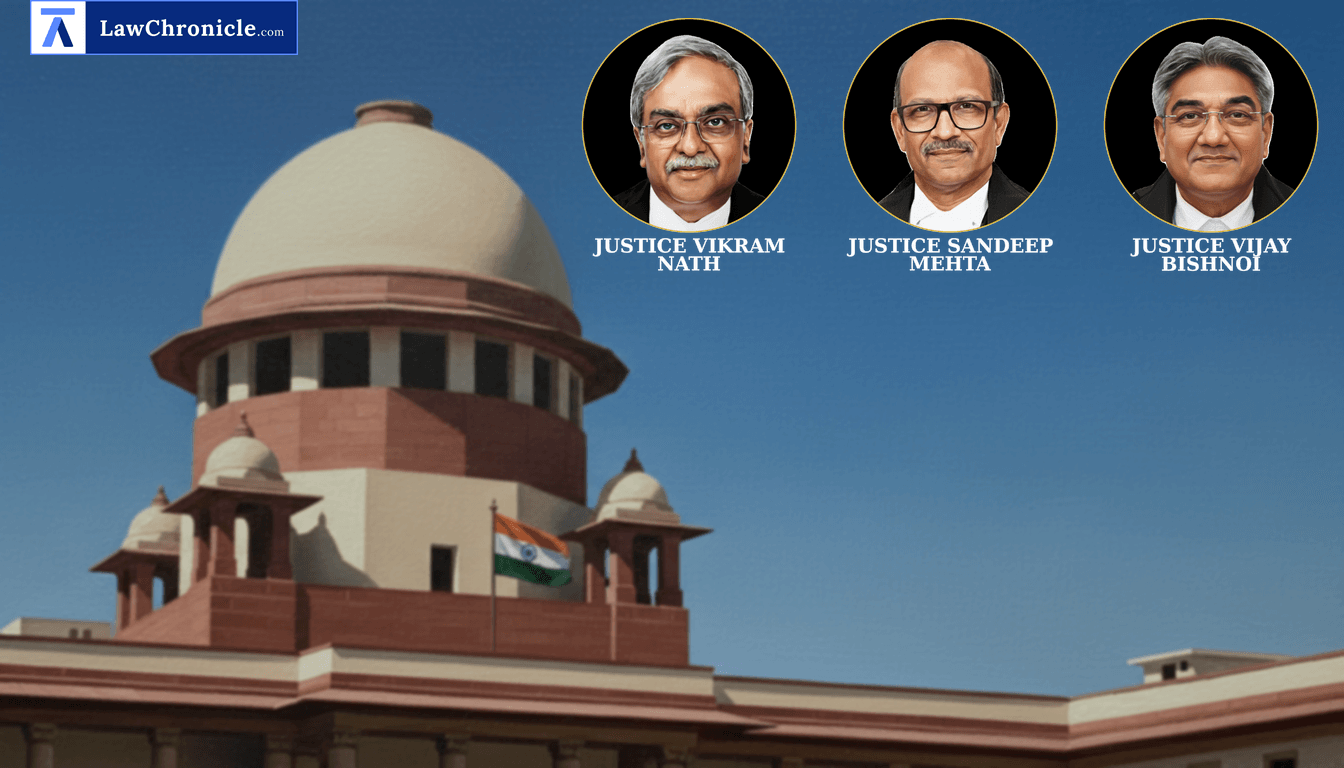
The Supreme Court has clarified that while ex gratia financial assistance provided by the State to the family of a deceased government employee may be deducted from motor accident compensation to prevent double recovery, such deductions must not deprive dependents who are ineligible for the State benefits.
A three-judge bench comprising Justice Vikram Nath, Justice Sandeep Mehta, and Justice Vijay Bishnoi heard an appeal regarding the calculation of 'just compensation' under the Motor Vehicles Act, 1988. The Court examined whether financial assistance received under the Haryana Compassionate Assistance to the Dependents of Deceased Government Employees Rules, 2006 should be set off against the total compensation awarded by a Motor Accident Claims Tribunal.
Harmonizing Dual Benefits and the Prevention of Windfall
The Court observed that the principle of deducting state-provided financial assistance from insurance claims is intended to ensure that compensation does not become a financial windfall. Relying on the precedent set in Reliance General Insurance Company Ltd. vs. Shashi Sharma and Others ( "(2016) 9 SCC 627": 2016 CaseBase(SC) 867), the Court affirmed that pay-related emoluments received by dependents under the 2006 Rules are liable to be excluded while computing loss of dependency. This ensures that the compensation granted does not exceed the actual pecuniary loss suffered.
The Court, in its reasoning, observed: "The harmonious approach for determining a just compensation payable under the 1988 Act, therefore, is to exclude the amount received or receivable by the dependants of the deceased government employee under the 2006 Rules towards the head financial assistance equivalent to 'pay and other allowances' that was last drawn by the deceased government employee in the normal course."
Protection of the Dependent Mother’s Independent Legal Right
A critical issue arose regarding the deceased's mother. While the widow and daughter were eligible for assistance under the Haryana Compassionate Assistance to the Dependents of Deceased Government Employees Rules, 2006 (governed by the Family Pension Scheme, 1964), the mother was not. The High Court had deducted the entire assistance amount from the total compensation, effectively leaving the mother with no share of the 'loss of dependency' award. The Supreme Court noted that this resulted in the illegal enrichment of the insurance company at the expense of a dependent parent.
The Court, in its reasoning, observed: "Negating the mother’s claim, who is entitled to a 1/3rd share of the total compensation awarded, would amount to an illegal enrichment of the Respondent No.1/Insurance Company at the cost of a dependent parent... we cannot lose sight of the fact that under social welfare legislations, the paramount consideration is awarding just and adequate compensation for all dependents of the deceased."
Background:
The case originated from a fatal motor accident on July 23, 2012, involving a constable in the Haryana Police. The Motor Accident Claims Tribunal, Rohtak, initially awarded ₹ 37,30,680/-. On appeal, the High Court of Punjab and Haryana reduced this to ₹ 7,70,400/- after deducting ₹ 29,21,400/- which was the financial assistance payable under the Haryana Compassionate Assistance to the Dependents of Deceased Government Employees Rules, 2006.
The Appellants argued that the 2006 Rules were welfare legislation and should not benefit the insurer. The Supreme Court partially agreed with the High Court on the deduction principle citing Reliance General Insurance Company Ltd. vs. Shashi Sharma and Others ( "(2016) 9 SCC 627": 2016 CaseBase(SC) 867) and National Insurance Company Ltd. vs. Birender and Others, but found that the High Court failed to protect the share of the mother, who was a dependent under the Motor Vehicles Act, 1988 but not a 'family member' under the pension rules. Consequently, the Supreme Court restored the mother's 1/3rd share of the dependency loss, increasing the final compensation to ₹ 19,01,000/-.
Case Details:
Case No.: Civil Appeal No. 2026 (Arising out of SLP (Civil) No. 13979 of 2018)
NeutralCitation: 2026 INSC 575
Case Title: Sarla Devi & Ors. v. Reliance General Insurance Company Limited & Ors.
Appearances:
For the Petitioner(s): Mr. Rameshwar Singh Malik, Senior Counsel
For the Respondent(s): Mr. Joy Basu, Senior Counsel
Source: 2026 CaseBase(SC) 487
Similar Articles
 Breaking News


