


Supreme Court Restores High Court Award Subject To Deduction Of Government Compassionate Aid Under 2006 Rules
 Copy Link
 Share
 Save
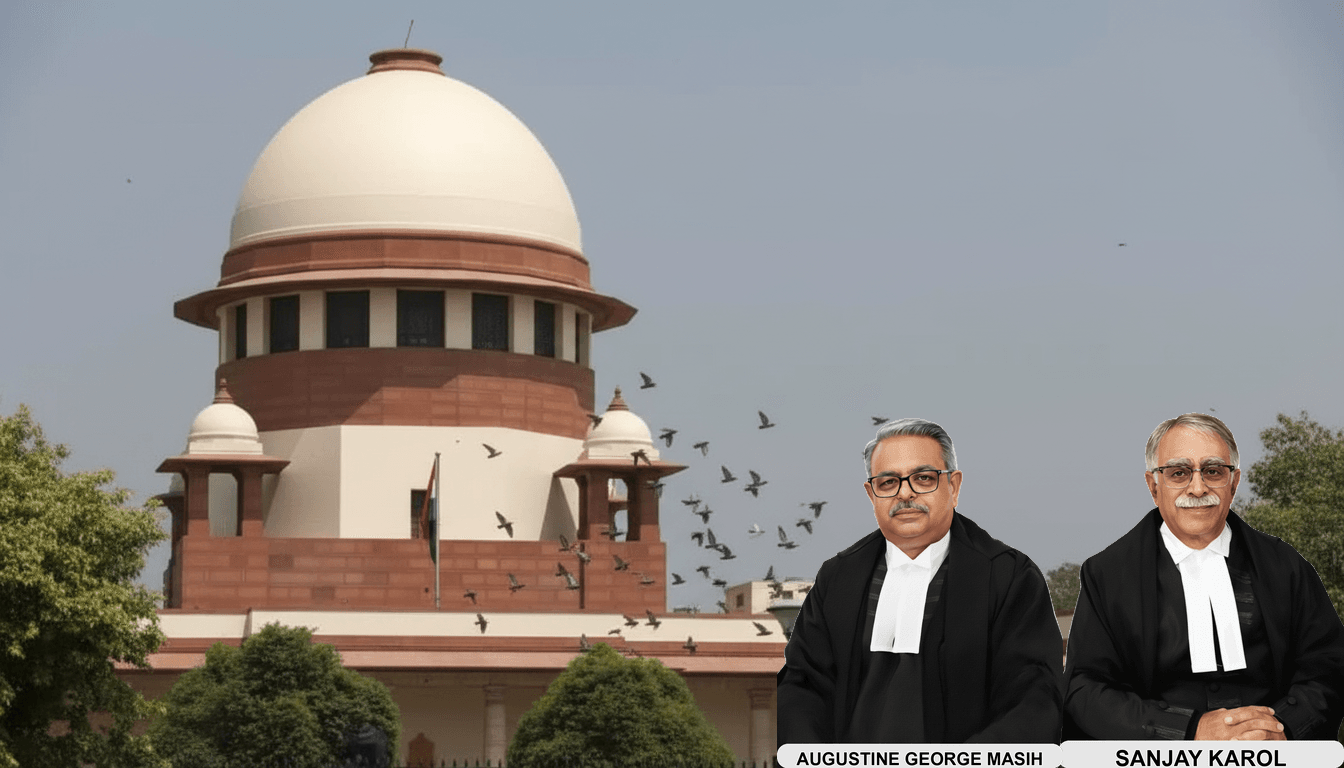
A bench of Justices Sanjay Karol and Augustine George Masih heard appeals by Reliance General Insurance Company Limited challenging orders of the High Court of Punjab and Haryana at Chandigarh that arose from a motor accident compensation dispute and a subsequent review/clarification application. The primary question was whether amounts payable under the Haryana Compassionate Assistance to Dependents of Deceased Government Employees Rules, 2006 (the 2006 Rules) must be deducted from compensation awarded under the Motor Vehicles Act.
The Court allowed the appeals, set aside the Review Order and restored the Main Order of the High Court, holding that amounts received under the 2006 Rules which overlapped with heads of compensation awarded under the Motor Vehicles Act must be deducted to avoid double recovery, but procedural safeguards applied before making deductions. The Court concluded that the High Court had relied on the three‑judge decision in Reliance General Insurance v. Shashi Sharma and followed the clarification in National Insurance Co. Ltd. v. Birender as to timing and proof. The Court, in its reasoning, observed: “26. Indeed, similar statutory exclusion of claim receivable under the 2006 Rules is absent. That, however, does not mean that the Claims Tribunal should remain oblivious to the fact that the claim towards loss of pay and wages of the deceased has already been or will be compensated by the employer in the form of ex gratia financial assistance on compassionate grounds under Rule 5(1). The Claims Tribunal has to adjudicate the claim and determine the amount of compensation which appears to it to be just. The amount receivable by the dependants/claimants towards the head of ‘pay and allowances’ in the form of ex gratia financial assistance, therefore, cannot be paid for the second time to the claimants. ... The harmonious approach for determining a just compensation payable under the 1988 Act, therefore, is to exclude the amount received or receivable by the dependants of the deceased government employee under the 2006 Rules towards the head financial assistance equivalent to ‘pay and other allowances’ that was last drawn by the deceased government employee in the normal course. This is not to say that the amount or payment receivable by the dependants of the deceased government employee under Rule 5(1) of the Rules, is the total entitlement under the head of ‘loss of income’. So far as the claim towards loss of future escalation of income and other benefits is concerned, if the deceased government employee had survived the accident can still be pursued by them in their claim under the 1988 Act. For, it is not covered by the 2006 Rules. Similarly, other benefits extended to the dependants ... including family pension, life insurance, provident fund, etc., that must remain unaffected and cannot be allowed to be deducted...” The Court also observed that “an application styled as one for clarification must be located within the limited corrective powers recognised by the Code of Civil Procedure, 1908” and that a clarification could not be used to “alter findings on negligence, modify the quantum of compensation, redistribute liability, or otherwise affect substantive rights under the guise of clarification.”
Background
The dispute arose from a collision on 2 November 2009 when a motorcycle carrying three persons struck a jeep; Smt. Hom Devi, a MPHW employed at PHC Chhara, died and others were injured. The Motor Accidents Claims Tribunal, Rohtak awarded Rs. 8,80,000 with interest. The claimants sought enhancement before the High Court, which in its Main Order (18 September 2019) enhanced compensation to Rs. 29,09,240 but directed that amounts received under the 2006 Rules be deducted. The claimants then sought clarification; by the Clarification Order (17 January 2023) the High Court modified its position to hold that “the entire amount of compensation as received from the Government under the Scheme of 2006 , will not be deductible” and fixed a figure of Rs. 25,83,949. The insurer filed review, leading to the 15 October 2024 order which was impugned before the Supreme Court.
The Supreme Court examined the interplay between the three‑judge decision in Reliance General Insurance v. Shashi Sharma — which held that only those components of 2006 Rules that overlapped with loss of pay and allowances should be deducted — and the later decision in Birender which required proof of eligibility or receipt before making deductions. The Court held the two decisions were consistent: Shashi Sharma defined what was deductible; Birender prescribed the procedural safeguards and timing for deduction. The Court further held that a High Court entertaining a clarification could act only within the corrective confines of Sections 151 and 152 CPC and could not effect substantive change under the guise of clarification.
As a result, the Supreme Court allowed the appeals, set aside the Review Order and restored the Main Order with the direction that the amount received under the 2006 Rules would be deducted from the award as modified by the Main Order. The rate of interest awarded by the Tribunal remained unchanged. The claimants were directed to file an affidavit before the Tribunal indicating sums received, if any, to enable adjustment; if no amount was received or receivable under the 2006 Rules, the claimants would be entitled to the full amount as per the Main Order. The Court directed supply of bank details and fixed appearance before the Tribunal on 27 February 2026; Registry was asked to send a copy of the judgment to the Punjab and Haryana High Court. There was no order as to costs.
Case Details:
Case No.: Civil Appeal Nos. 2506-2507 of 2026 (2026 INSC 188)
Case Title: Reliance General Insurance Company Limited v. Kanika & Ors.
Appearances:
For the Petitioner(s): [Names not indicated in the reported judgment]
For the Respondent(s): [Names not indicated in the reported judgment]
Source: 2026 CaseBase(SC) 149
Similar Articles
 Breaking News


