


Delhi HC: NDMC Licence Termination with Bharat Hotel Valid; ₹1,063 Cr Claim Back
 Copy Link
 Share
 Save
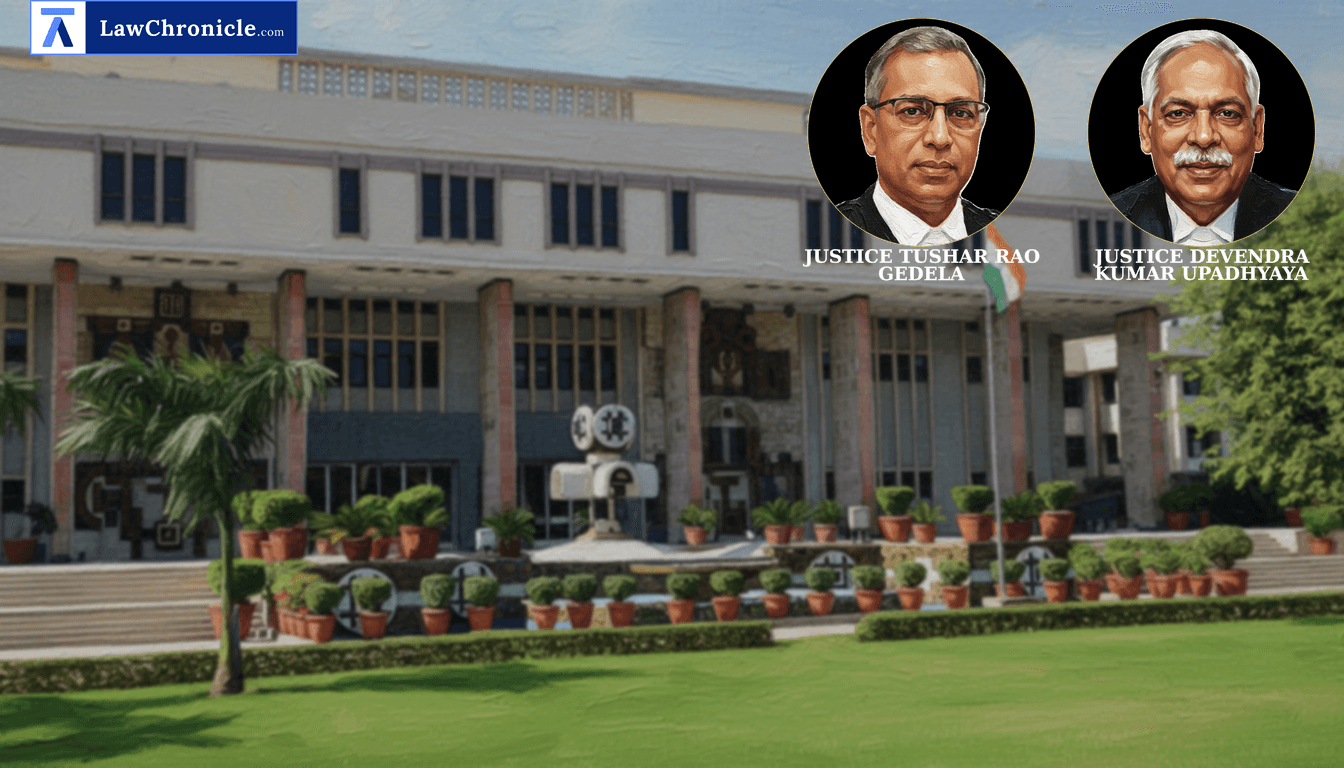
The Delhi High Court has affirmed the New Delhi Municipal Council's (NDMC) decision to cancel its licence agreement with Bharat Hotels, simultaneously directing the hotel group to clear outstanding licence fee dues amounting to Rs. 1,063 crore. The Court held that land in New Delhi is one of the scarcest natural resources, entrusted by the L&DO to the NDMC for management. The Court expressed any arrangement causing substantial financial loss to the NDMC unfairly burdens New Delhi's taxpayers and cannot be sanctioned, as it would violate Article 14 of the Constitution of India.
A bench of the Chief Justice Devendra Kumar Upadhyaya and Justice Tushar Rao Gedela heard intra‑court appeals by the New Delhi Municipal Council challenging an order of a learned Single Judge which had quashed a demand notice dated 13.02.2020 and a contemporaneous communication terminating a licence deed dated 22.04.1982, and the court considered whether the capped enhancement clause survived the enactment of the New Delhi Municipal Council Act, 1994.
The court set out that the licence deed of 22.04.1982 conferred permission to construct and commission a five‑star hotel but did not transfer ownership, and that prior permissions were saved by the repeal‑and‑savings provision only to the extent they remained consistent with the New Delhi Municipal Council Act, 1994.
The Court, in its reasoning, observed: "For the aforesaid reasons, we are of the considered and clear opinion that Clause 48 of the Licence Deed dated 22.04.1982, to the extent it puts a cap of 100% increase in licence fee at the time of its enhancement after completion of 33 years, is inconsistent with sub-Section 2 of Section 141 of the NDMC Act and hence, the same cannot be saved under Section 416 of the NDMC Act."
The court also quoted contractual provisions, noting that "The licencees shall run the Five Star Hotel themselves" and that the licensee remained responsible for the conduct of sub‑licensees. It relied on the principle that disposal of public natural resources for commercial purposes must be guided by public interest and revenue‑maximising considerations, and held that the capped enhancement would produce an anomalous outcome in which the public body would bear a large loss when the landowner’s revised ground rent was substantially higher. The court therefore allowed the appeals, set aside the Single Judge’s order and restored the demand and termination communication, while recording that public interest and equitable considerations weighed in favour of the NDMC’s stance.
Background
The appeals arose from two writ petitions originally filed by respondent no.1 challenging a notice of demand dated 13.02.2020 which quantified arrears and an enhanced licence fee and a contemporaneous communication terminating the Licence Deed dated 22.04.1982. The Licence Deed had been executed in 1982 by the New Delhi Municipal Committee (predecessor of NDMC) granting permission to construct and operate a five‑star hotel on municipal land on an annual licence fee of Rs.1.45 crore and containing Clause 48 providing for enhancement every 33 years capped at 100%.
The NDMC contended that after establishment of the Council, Section 416 of the New Delhi Municipal Council Act, 1994 preserved prior licences and permissions only to the extent they were consistent with the Act and that Section 141(2) of the New Delhi Municipal Council Act, 1994 required that consideration for disposal of immovable property not be less than market value. The NDMC relied on valuation work undertaken by SBICAPS (with inputs from CBRE and Knight Frank) to justify the enhanced demand and invoked the public‑interest principle that State instrumentalities must maximise revenue when alienating scarce natural resources as reflected in Natural Resources Allocation, IN RE, Special Reference no. 01 of 2012.
The licensee argued that the 1982 instrument was a contract saved by Section 416(2)(b) and that Clause 48 limited enhancement to 100% and therefore the demand was impermissible. The licensee further submitted that the sale agreements executed by sub‑licensees in 2016 were not within its knowledge and did not constitute a fundamental breach warranting termination. The Single Judge had earlier quashed the demand and the termination communication, but on appeal the High Court analysed the distinction between licences/permissions saved under Section 416(2)(a) and contracts saved under Section 416(2)(b), rejected a restrictive noscitur a sociis reading of the savings clause, and held Clause 48 inconsistent with Section 141(2) of the New Delhi Municipal Council Act, 1994 as interpreted by precedents such as Aggarwal & Modi Enterprises (P) Ltd. v. New Delhi Municipal Council and The Indian Hotels Company Limited v. New Delhi Municipal Council which were deployed to show that licences must secure market‑value consideration in a fair competition. The court also engaged the constitutional standard, observing that adoption of non‑competitive methods that do not maximise revenue when public natural resources are alienated could be arbitrary under Article 14 of the Constitution of India, 1950, a point canvassed through discussion of Natural Resources Allocation, IN RE, Special Reference no. 01 of 2012.
On the termination issue the court found the execution of four documents of 01.05.2016 by nominees of a sub‑licensee to be a fundamental breach of Clauses 11, 29 and 30 given the licensee’s continued responsibility for sub‑licensees, and recorded that withdrawal applications subsequently filed did not demonstrate restoration of status quo (no refund of consideration or re‑vested possession was shown). The court further considered remedial equity and public interest while exercising extraordinary writ jurisdiction and relied on principles recognised in Shiv Shankar Dal Mills v. State of Haryana and on the approach to tempering legal formulations with equity in M.S. Sanjay v. Indian Bank to conclude that setting aside the NDMC action would produce an unjust burden on taxpayers.
The court therefore concluded that Clause 48’s 100% cap was inconsistent with Section 141(2) of the New Delhi Municipal Council Act, 1994, that termination of the licence for fundamental breach was justified on the established facts, allowed the appeals and set aside the Single Judge’s order. No costs were awarded.
Case Details:
Case No.: LPA 364/2024 & LPA 387/2024
Case Title: NEW DELHI MUNICIPAL COUNCIL v. BHARAT HOTELS LTD & ANR.
Appearances:
For the Petitioner(s): Ms. Malvika Trivedi, Sr. Adv. with Mr. Sriharsha Peechara, Standing Counsel and Mr. Ashish Tiwari, ASC, Ms. Bani Dixit, Mr. Soumit Ganguli, Mr. Shailendra Slaria, Ms. Sujal Gupta, Ms. Ravicha Sharma, Ms. Shruti Agarwal, Mr. Sahib Patel, Mr. Akash Sharma and Mr. Anurag Tiwari, Advs.
For the Respondent(s): Mr. Sandeep Sethi, Sr. Adv., Mr. Darpan Wadhwa, Sr. Adv. & Mr. Shyel Trehan, Sr. Adv. with Mr. Amer Vaid, Mr. Manmilan Sidhu, Mr. Ankit Tyagi, Mr. Gyanendra Singh, Mr. Anubhav Yadav, Ms. Bhumika Bhatnagar, Mr. Sonali Jaitley Bakhshi, Mr. Jaiyesh Bakhshi, Mr. Ravi Tyagi, Mr. Mayank Mishra, Mr. Rohan Poddar, Ms. Riya Kumar, Ms. Shreya Sethi, Ms. Vidhi Jain and Mr. Krishna Gambhir, Advs.
Source: 2026 CaseBase(DEL) 250
Similar Articles
 Breaking News


