


Silence In Lease Deed Does Not Bar State's Power To Revise Royalty Rates: SC
 Copy Link
 Share
 Save
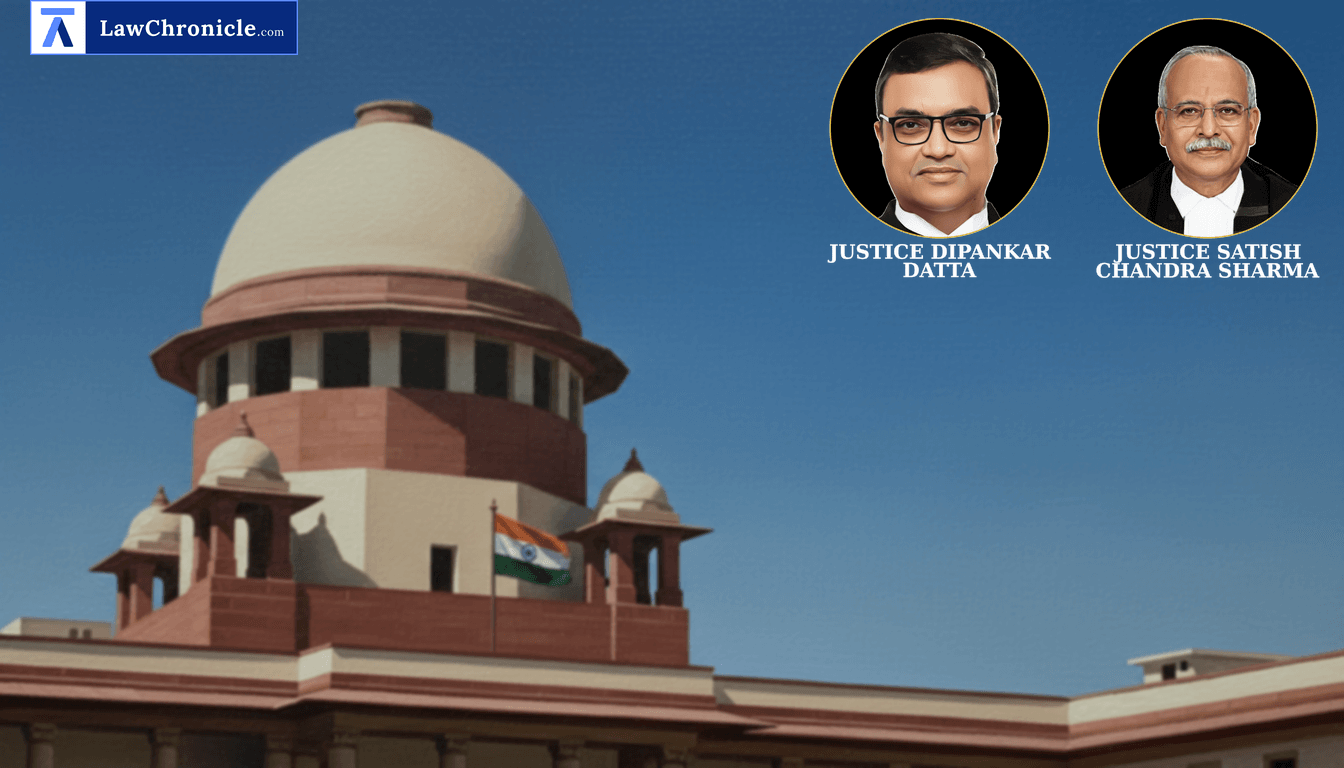
The Supreme Court has delivered a watershed ruling on sovereign regulatory powers, holding that the State's authority to revise royalty and dead rent for minor minerals remains intact even if a mining lease deed is silent on such future enhancements. Overturning a High Court decision, the apex court clarified that statutory grants are inherently governed by the prevailing legal regime, effectively preventing lessees from claiming a vested right to static financial terms during the subsistence of their contracts.
A bench comprising Justice Dipankar Datta and Justice Satish Chandra Sharma heard the appeals filed by the State of Haryana against a common judgment of the High Court of Punjab and Haryana. The central controversy involved whether the State could enhance the rate of royalty and dead rent by 50% during the subsistence of leases that lacked express clauses permitting such increases.
The Implied Character of Statutory Rules
The Court emphasized that a mining lease is a statutory grant and not a purely private contract. Consequently, the incidents of the lease must be read subject to the Mines and Minerals (Development and Regulation) Act, 1957 and the Punjab Minor Mineral Concession Rules, 1964. The bench observed that the power to revise royalty flows from Section 15 of the Mines and Minerals (Development and Regulation) Act, 1957 and is reinforced by the proviso to Rule 21(1)(i)(a) of the Punjab Minor Mineral Concession Rules, 1964.
The Court, in its reasoning, observed: "A mining lease granted under the 1964 Rules does not stand in isolation as a purely private contract between the State and the lessee; it is a statutory grant, necessarily governed by the MMDR Act and the Rules under which it is executed. Once the lease can be traced to the MMDR Act and the 1964 Rules, the incidents of the lease must be read subject to the statutory regime then in force... Their application, therefore, is not a subsequent imposition upon the lease, but an implied condition inherent in the lease deed itself."
The Court further relied on State of Rajasthan Vs. J. K. Synthetics to highlight that terms in a mining lease must yield to the statutory rules governing the lease, particularly when amendments increase financial liabilities like interest or royalty rates.
Validity of the 2005 Notification
Addressing the challenge to the notification dated 3rd June, 2005, the Court rejected arguments that the 50% hike was arbitrary. It noted that the State had considered comparative rates from neighbouring states and that the revision occurred after a five-year hiatus. The bench maintained that judicial review does not extend to the 'wisdom' of the rate but only to its legality and reasonableness.
Regarding the alleged violation of the Rules of Business of the Government of Haryana, 1977 framed under Constitution of India, the Court noted that the decision was approved by the Chief Minister, who was also the Minister-in-charge of Mining. The Court distinguished the present facts from MRF Limited vs. Manohar Parrikar, noting that since the Chief Minister was at the helm, the collective responsibility of the Council of Ministers was substantially satisfied.
Directions Issued to Statutory Authorities
While allowing the State to realize arrears, the Court provided limited relief regarding interest due to the long pendency of litigation. The Court has the following directions:
"Unpaid dead rent or royalty, if any, may be realised by the State from the respondents, according to law. However, considering the submissions made by the respondents aforenoted, namely, that the notification dated 3rd June, 2005 remained stayed for a substantial period, that the mining lease itself expired on 5th February, 2009, and that the State’s subsequent statutory regime provides for a lower rate of interest on delayed royalty, we are of the opinion that ends of justice would be met if, instead of directing waiver of interest as claimed, rate of interest on arrears of dead rent or royalty, if imposed, be limited to 12% per annum. Ordered accordingly."
Key Takeaways:
Statutory Primacy Over Contract
Silence in a government contract regarding a statutory power does not amount to a waiver of that power unless the statute explicitly allows contracting out.
Implied Conditions in Mining Leases
Rules governing royalty revisions are implied conditions of every mining lease, meaning lessees must anticipate periodic financial adjustments.
Executive Approval Standards
In matters of state finance, the imprimatur of the Chief Minister is a constitutional necessity, and his approval can validate decisions even if specific departmental consultations are missing.
Judicial Restraint in Fiscal Policy
Courts will not sit in appeal over the specific quantum of royalty hikes unless the decision is shockingly unreasonable or lacks any comparative material.
Ratio Decidendi:
A mining lease is a statutory grant and its incidents are governed by the Mines and Minerals (Development and Regulation) Act, 1957 and the rules framed thereunder. The liability of a lessee to pay royalty and dead rent is dynamic and remains subject to revision at the rate prescribed 'for the time being' by the State Government, even in the absence of an express enabling clause within the specific lease deed.
Background:
The dispute originated from an auction in 2001 where respondents were granted mining leases for masonry stone. In 2005, the State of Haryana amended the Punjab Minor Mineral Concession Rules, 1964 to increase royalty and dead rent by 50%. The lessees challenged this before the High Court, arguing the increase violated their lease terms and the Rules of Business of the Government of Haryana, 1977. The High Court had initially quashed the enhancement, holding it arbitrary and in violation of procedural rules. The Supreme Court set aside this finding, emphasizing the public trust doctrine and the State's duty to secure fair revenue from mineral exploitation. The appeals were allowed, upholding the 2005 notification while capping the interest on arrears at 12%.
Case Details:
Case No.: Civil Appeal No. of 2026 [Arising out of SLP (Civil) Diary No. 15252 of 2017]
NeutralCitation: 2026 INSC 690
Case Title: The State of Haryana & Ors. Versus M/S Faridabad Gurgaon Minerals & Anr.
Appearances:
For the Petitioner(s): Mr. Balbir Singh, Senior Advocate.
For the Respondent(s): Mr. Dhruv Mehta, Senior Advocate; Mr. Yashraj Singh Deora, Senior Advocate.
Source: 2026 CaseBase(SC) 643
Similar Articles


 Breaking News


