


Delhi HC Refuses to Bypass CAT for PwD Employee's Service Claims
 Copy Link
 Share
 Save
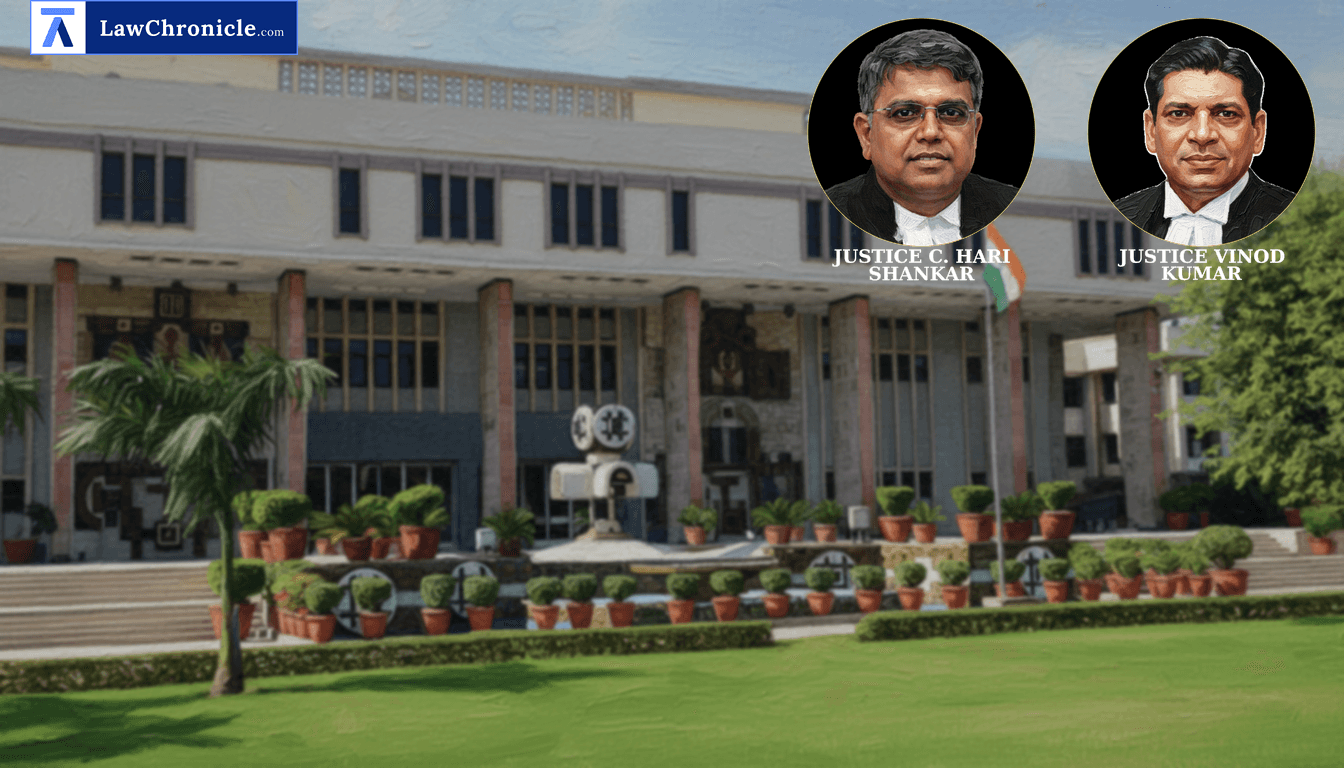
The Delhi High Court has reasserted the binding constitutional mandate that Administrative Tribunals serve as the exclusive courts of first instance for service matters, even in cases involving high-support-need persons with disabilities. Upholding the principles of L. Chandra Kumar v. UOI, the Court ruled it cannot act as a forum of first instance for employment-related grievances, regardless of the petitioner's urgent humanitarian claims.
Separating the petitioner's sprawling prayers into service claims, contempt allegations, and challenges to previous orders, a Bench of Justice C. Hari Shankar and Justice Vinod Kumar emphasized that judicial discipline prevents the High Court from overstepping the jurisdictional boundaries set by the Administrative Tribunals Act, 1985. The Court clarified that while constitutional remedies under Constitution of India, 1950 are part of the basic structure, they cannot be used to bypass the specialized adjudicatory framework designed for public servants.
Tribunal’s Discretion to Revisit Emoluments Upheld
The Court first examined the challenge to a specific direction from the Central Administrative Tribunal (CAT), which allowed the government to revisit the grant of increments and allowances after providing notice to the petitioner. Finding no legal infirmity in this procedural safeguard, the Bench rejected the prayer for quashing the Tribunal's observation. The Court noted that the initial stoppage of benefits was set aside by the Tribunal due to natural justice violations, and reserving liberty for the State to take a fresh decision following due process was a valid exercise of judicial authority.
The Mandate of L. Chandra Kumar as an Absolute Bar
Addressing the remaining service-related reliefs, including promotional benefits, restoration of withheld arrears, and damages for misfeasance the Court declared itself coram non judice. Citing the Seven-Judge Bench verdict in L. Chandra Kumar v. UOI, the Bench held that the High Court cannot entertain service matters directly under Section 14(1) of the Administrative Tribunals Act, 1985.
The Court, in its reasoning, observed: "L. Chandra Kumar v. UOI acts as an absolute bar to High Courts acting as courts of first instance in any matter which is amenable to adjudication by the Central Administrative Tribunal under Section 14(1) of the Administrative Tribunals Act, 1985. ... It is illegal and improper for a Court which is conscious that it has no jurisdiction to proceed with the matter, to do so."
Rejection of "Institutional Fraud" Arguments
The petitioner had argued that "administrative fraud" and the rule of exception in Whirlpool Corporation v. Registrar of Trade Marks justified a direct writ petition. However, the Court dismissed this, clarifying that the question of "alternate remedy" only arises when multiple forums possess jurisdiction; here, the CAT holds exclusive jurisdiction of first instance for service matters under Section 3(q) of the Administrative Tribunals Act, 1985.
Court Directions
Despite the jurisdictional bar, the Court acknowledged the petitioner's 81% disability and issued specific directions to ensure a speedy resolution. The Court has the following directions:
"(i) The prayer to set aside para 17 (vi) of the judgment dated 11 November 2025 of the Tribunal in OA 2183/2024 is rejected.
(ii) Liberty is reserved with the petitioner to agitate prayers (H) and (I) in this writ petition by way of a separate contempt petition/contempt application, if so advised.
(iii) In so far as the remaining prayers in this writ petition are concerned, liberty is reserved with the petitioner to move the Tribunal in substantive proceedings for the grant thereof. In case the petitioner so desires, he is at liberty to approach the Registry of this Court to transmit the record of this writ petition to the Tribunal, in order to avoid the exercise of refiling the papers in the Tribunal. In that event, the Tribunal would register the present writ petition as a substantive OA/TA and proceed to deal with the matter in accordance with law.
(iv) We also request the Tribunal to take this matter as expeditiously as possible, particularly keeping in mind the physical incapacity from which the petitioner suffers. For this reason, the parties would appear before the Tribunal on 20 July 2026. We request the Tribunal to thereafter to proceed with the matter with all due expedition and attempt to render a final judgment thereon as expeditiously as possible, preferably within a period of four months from the first date of hearing fixed by us hereinabove.
(v) Neither side would be entitled to take any adjournment on the date when this matter is listed before the Tribunal or on any subsequent date thereafter, save for rare and exceptional reasons."
Background:
The dispute arose from a series of grievances by Shri Suresh Kumar Rajput, an individual with 'High Support Needs' as defined under the Rights of Persons with Disabilities Act, 2016. The petitioner sought retrospective recognition of his disability status, promotional benefits to the post of Section Officer, and recovery of withheld arrears including Transport Allowance at double rates. A previous CAT order had partially ruled in his favor but allowed the government to revisit certain payments, a clause the petitioner challenged alongside new allegations of malicious misfeasance and contempt. The High Court ultimately found that since the crux of the dispute related to conditions of service, the statutory pathway through the Administrative Tribunal must be followed before any High Court scrutiny.
Key Takeaways:
Jurisdictional Exclusivity of Tribunals
Litigants cannot bypass the Administrative Tribunal for service matters by citing fundamental rights violations or humanitarian grounds; the Tribunal remains the mandatory court of first instance.
Misinterpretation of 'Alternate Remedy'
High Courts will not entertain service writs by applying discretionary 'alternate remedy' rules (like Whirlpool Corp) because the Tribunal’s jurisdiction is a statutory mandate, not just a matter of judicial discretion.
Procedural Flexibility for PwD Litigants
While maintaining strict jurisdictional boundaries, Courts may permit the transfer of records from the High Court to the Tribunal to prevent administrative burdens on disabled litigants.
Ratio Decidendi:
In view of the Seven-Judge Bench decision in L. Chandra Kumar v. UOI, High Courts are coram non judice regarding service matters amenable to the Central Administrative Tribunal under the Administrative Tribunals Act, 1985. The Tribunal must act as the court of first instance for all matters falling under Section 14(1), and the High Court’s jurisdiction under Article 226/227 is limited to the scrutiny of the Tribunal's final decisions.
Case Details:
Case No.: W.P.(C) 8366/2026, CM APPL. 39995/2026
Case Title: SHRI SURESH KUMAR RAJPUT v. GNCT OF DELHI & ORS.
Appearances:
For the Petitioner(s): Mr. Harish Kumar Karwal, Adv.
Source: 2026 CaseBase(DEL) 477
Similar Articles
 Breaking News


