


Detaining Authority Must Independently Consider Representations: Manipur High Court
 Copy Link
 Share
 Save
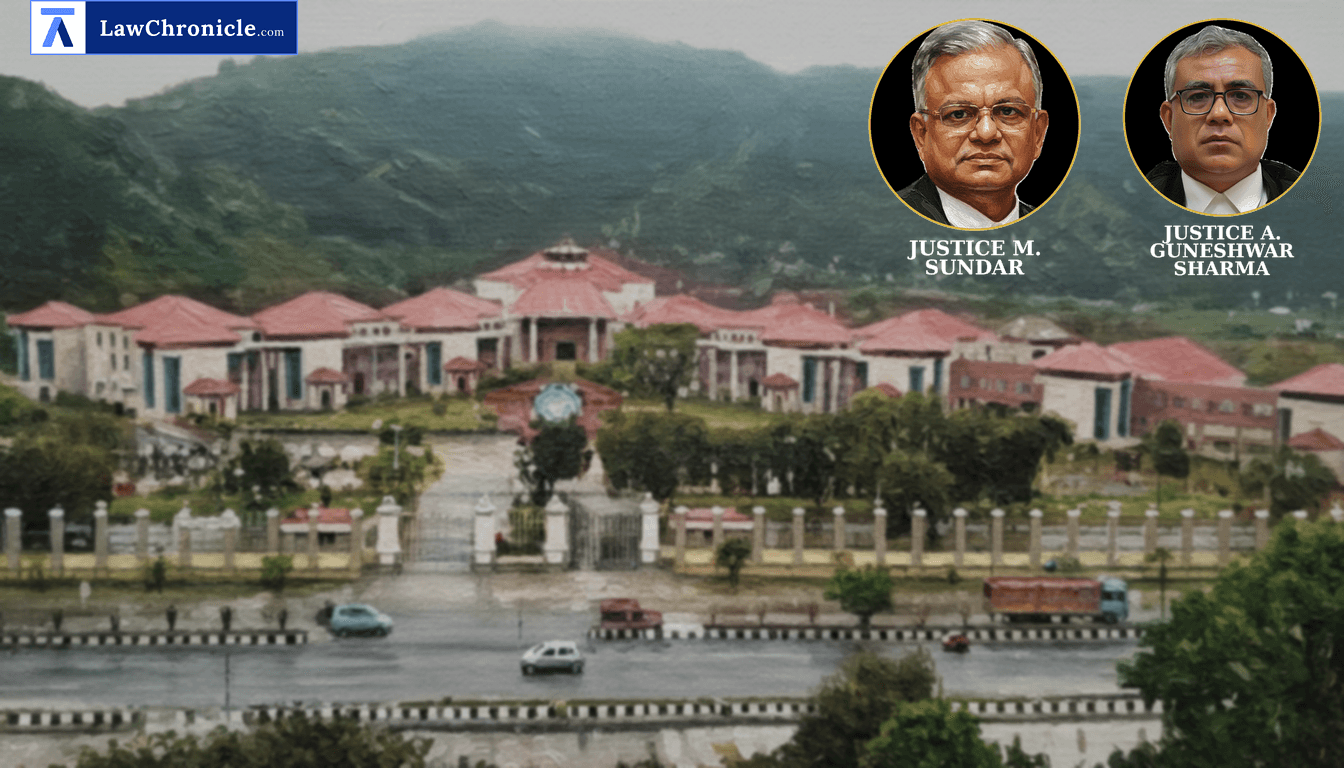
Executive overreach in preventive detention matters faced a stern judicial rebuke as the Manipur High Court ruled that a detaining authority's failure to independently consider a detenu's representation constitutes a fatal violation of constitutional safeguards. The Court underscored that merely forwarding such representations to higher officials without independent application of mind vitiates the entire detention process under the National Security Act, 1980.
In a significant judgment, a Division Bench comprising Chief Justice M. Sundar and Justice A. Guneshwar Sharma quashed a preventive detention order, emphasizing that the right to representation is not a mere formality but a sanctus duty that must be strictly observed by the specific authority to whom it is addressed.
Key Takeaways
Mandatory Independent Consideration
The detaining authority is constitutionally obligated to independently dispose of representations rather than merely acting as a post office for higher government levels.
Subjective Satisfaction Scrutiny
Subjective satisfaction for detention is justiciable if based on a misconception of statutes or reliance on expired or unverified notifications.
Tribunal Confirmation Requirement
When the executive relies on a notification declaring an organization 'unlawful' under Unlawful Activities (Prevention) Act, 1967, it must verify if such notification has been confirmed by the statutory Tribunal within the prescribed timelines.
Constitutional Safeguard Primacy
Any infraction of Article 22(5) of the Constitution of India, 1950, such as procedural delays or improper handling of representations, renders the continued detention illegal regardless of the underlying criminal allegations.
Judicial Rebukes on Procedural Lapses
The Court observed that the detaining authority (District Magistrate) failed to apply her mind to the representation sent by the detenu on 29.04.2026. Instead of deciding the matter, the authority merely forwarded it to the Commissioner (Home), which the Court found to be an impermissible shift of statutory duty. Citing Smt. Santosh Anand -Vs.- Union of India and others and Union of India and another -Vs.- Sneha Khemka and another, the Bench noted that the constitutional right to make a representation includes the right to obtain proper consideration by the specific authority addressed.
Furthermore, the Court found a second flaw regarding a Notification issued by the MHA declaring the PLA as an 'unlawful association'. The detaining authority failed to verify if this notification, issued nearly two years prior, had been confirmed by a Tribunal as required under Section 4 of the Unlawful Activities (Prevention) Act, 1967. This lack of verification indicated a "misconception of the legal architecture" and a failure to rely on materials of "rationally probative value."
The Court, in its reasoning, observed: "The detaining authority has neither examined the details as to whether the matter has been referred to a Tribunal and whether the Tribunal has either confirmed or cancelled the Notification nor has any order of the Tribunal been placed before the detaining authority. Therefore, the subjective satisfaction arrived at by the detaining authority is clearly flawed."
The Court has following directions:
"Ergo, the sequitur is, captioned writ petition is allowed. The impugned preventive detention order dated 21.04.2026... impugned approval order dated 01.05.2026... and impugned confirmation order dated 27.05.2026... are all set aside and Md. Abdul Hakim @ Inaocha... now lodged in Manipur Central Jail, Sajiwa, Imphal East is directed to be set at liberty forthwith if not required in connection with any other case/s."
Ratio
A detaining authority exercising power under Section 3(2) of the National Security Act, 1980 is under a constitutional obligation under Article 22(5) of the Constitution of India, 1950 to independently consider and dispose of a detenu's representation addressed to it. Failure to do so, by merely forwarding the representation to the State Government, constitutes a procedural infraction that vitiates the detention. Additionally, subjective satisfaction must be grounded in currently valid legal materials, including the verification of Tribunal confirmation for 'unlawful association' declarations under the Unlawful Activities (Prevention) Act, 1967.
Background
The case arose from the detention of Md. Abdul Hakim, who was arrested in March 2026 in connection with an FIR involving alleged offences under the Unlawful Activities (Prevention) Act, 1967, the Explosive Substances Act, 1908, and the Bharatiya Nyaya Sanhita, 2023. While in custody, a preventive detention order under the National Security Act, 1980 was clamped on him by the District Magistrate, Imphal East. The petitioner challenged the detention, arguing that his representation to the District Magistrate was never considered by her and was instead disposed of by the State Government. He further contended that the notification labeling his alleged group as unlawful had not been verified for Tribunal confirmation.
The Court referred to the principle in Ameena Begum -Vs.- State of Telangana and others regarding the limited but definite scope of judicial review over 'subjective satisfaction', noting it can be challenged if the authority acts under the dictation of another or misconstrues a statute. The Bench also noted that while the detenu had secured default bail in the substantive criminal case, he remained incarcerated solely due to the preventive order. The Court ultimately allowed the petition, setting aside the detention, approval, and confirmation orders.
Case Details:
Case No.: WP(Crl.) No. 17 of 2026
Neutral Citation: 2026:MNHC:210-DB
Case Title: Md. Abdul Hakim -Versus- District Magistrate, Imphal East and Others
Appearances:
For the Petitioner(s): Mr. Ch. Ngongo, senior advocate; Ms. S. Gangarani, counsel on record
For the Respondent(s): Mr. Phungyo Zingkhai, State Counsel; Mr. W. Darakeshwar, Sr. PCCG
Source: 2026 CaseBase(MAN) 90
Similar Articles
 Breaking News


