


Enclosed Rooms Not Within 'Public View' Under SC/ST Act: SC
 Copy Link
 Share
 Save
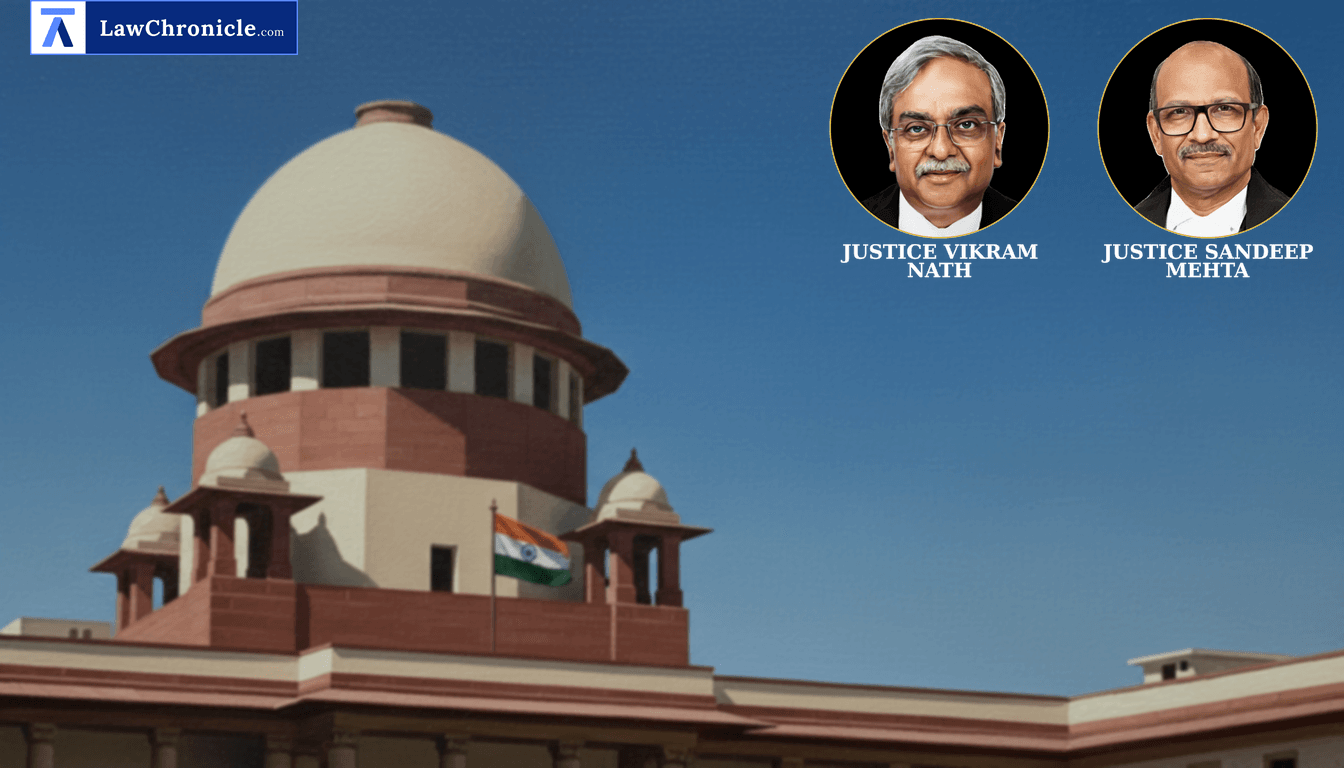
An alleged caste-based abuse uttered within the four walls of an enclosed office room with no public access fails to satisfy the mandatory statutory requirement of occurring in 'public view'. Reaffirming that mere presence within a school building does not automatically equate to a public spectacle, the Apex Court quashed SC/ST Act charges against a school manager where witnesses outside failed to hear or see the alleged slurs.
A bench comprising Justice Vikram Nath and Justice Sandeep Mehta quashed the summoning order and chargesheet under the Scheduled Castes and the Scheduled Tribes (Prevention of Atrocities) Act, 1989 against the manager of a public school, while allowing the prosecution to proceed strictly under the provisions of the Indian Penal Code, 1860.
Key Takeaways
Enclosed Spaces Excluded: Alleged caste-based slurs uttered inside a closed room without public access or visibility do not meet the legal threshold of 'public view'.
School Premises Distinction: The mere occurrence of an incident on school grounds does not inherently make it accessible or visible to the general public.
Specific Allegations Mandatory: Vague and general accusations of caste-based abuse without attributing specific words or slurs to the accused cannot sustain prosecution under the Scheduled Castes and the Scheduled Tribes (Prevention of Atrocities) Act, 1989.
Continuation of IPC Offence: Setting aside special penal charges under the Scheduled Castes and the Scheduled Tribes (Prevention of Atrocities) Act, 1989 does not bar criminal proceedings for general penal offenses like scuffle or assault under the Indian Penal Code, 1860.
Court Observations and Directions
The Supreme Court observed that even at the stage of taking cognizance, the foundational elements of an offense must clearly emerge from the record. Evaluating the site plan and witness statements recorded under Section 161 of the Code of Criminal Procedure, the Court noted that all key witnesses were teachers who merely attested to a scuffle in the school office without claiming to have entered the enclosed room or heard specific caste-based insults.
The Court, in its reasoning, observed: "17. The finding of the High Court that the incident occurred within public view cannot be sustained on the material placed on record. The requirement of 'public view' depends upon whether the alleged utterance was made in circumstances in which members of the public could witness or hear it. The mere fact that the occurrence took place within the premises of a school does not, by itself, satisfy this requirement. In the present case, the FIR and the site plan place the occurrence inside an enclosed room, while the statements of the witnesses do not establish that they were present inside the room or that they heard the alleged caste-based utterances. The material on record, therefore, does not establish that the alleged utterances were made in the presence or hearing of members of the public. The essential requirement of 'public view' is consequently not satisfied."
The Court issued the following directions:
"19. Accordingly, the appeal is allowed. The judgment and order dated 10th April, 2023 passed by the High Court of Judicature at Allahabad in Criminal Appeal No. 930 of 2023 is set aside. The proceedings arising out of FIR No. 37 of 2020, insofar as they relate to the offences under Sections 3(1)(r) and 3(1)(s) of the SC/ST Act against the appellant, stand quashed. The proceedings shall, however, continue insofar as they relate to the remaining offences under IPC."
Ratio
To constitute an offence under Section 3(1)(r) or Section 3(1)(s) of the Scheduled Castes and the Scheduled Tribes (Prevention of Atrocities) Act, 1989, the alleged insult, intimidation, or caste-based abuse must occur at a place 'within public view', meaning a place open to members of the public who can actually witness or hear the utterance. An incident occurring within the four corners of an enclosed room without public presence, access, or visibility fails to satisfy this statutory ingredient, regardless of whether the room is located inside a larger public or institutional building.
Background
The dispute originated from an incident on January 24, 2020, when the son of Respondent No. 2 sustained injuries during a school quarrel. Respondent No. 2 subsequently approached the appellant, the school manager. An altercation ensued inside the school office, resulting in cross-FIRs. Respondent No. 2 lodged an FIR alleging that the appellant, along with staff members, assaulted him and used caste-based slurs under Sections 147, 323, 342, and 504 of the Indian Penal Code, 1860 alongside Sections 3(1)(r) and 3(1)(s) of the Scheduled Castes and the Scheduled Tribes (Prevention of Atrocities) Act, 1989. Concurrently, the appellant's wife registered a separate FIR against Respondent No. 2 for assault and verbal abuse.
Following investigation, a chargesheet was submitted and the Special Judge took cognizance, summoning the appellant. The Allahabad High Court subsequently dismissed the appellant's appeal under Section 14A(1) of the Scheduled Castes and the Scheduled Tribes (Prevention of Atrocities) Act, 1989, holding that a prima facie case was established and that the counterblast nature of the case was not a ground for quashing.
Reversing the High Court's order, the Supreme Court relied on Karuppudayar v. State represented by the Deputy Superintendent of Police, Lalgudi, Trichy & Others ( "2025 INSC 132": 2025 CaseBase(SC) 344) and Hitesh Verma v. State of Uttarakhand ( "(2020) 10 SCC 710": 2020 CaseBase(SC) 649) to hold that offences under the Scheduled Castes and the Scheduled Tribes (Prevention of Atrocities) Act, 1989 were not prima facie established, as the site plan explicitly placed the encounter inside an enclosed room without public visibility or hearing.
Case Details:
Case No.: Criminal Appeal No. of 2026 (Arising out of SLP (Criminal) No. 5113 of 2023)
Neutral Citation: 2026 INSC 895
Case Title: Ramkrishna Chauhan v. State of U.P. & Anr.
Appearances:
For the Petitioner(s): Mr. Siddharth Aggarwal, Senior Advocate
For the Respondent(s): Counsel for Respondent-State
Source: 2026 CaseBase(SC) 809
Similar Articles
 Breaking News


