


Supreme Court Quashes SC/ST Act Count Where Abuses Occurred Inside Complainant’s House, Allows IPC Charges to Proceed
 Copy Link
 Share
 Save
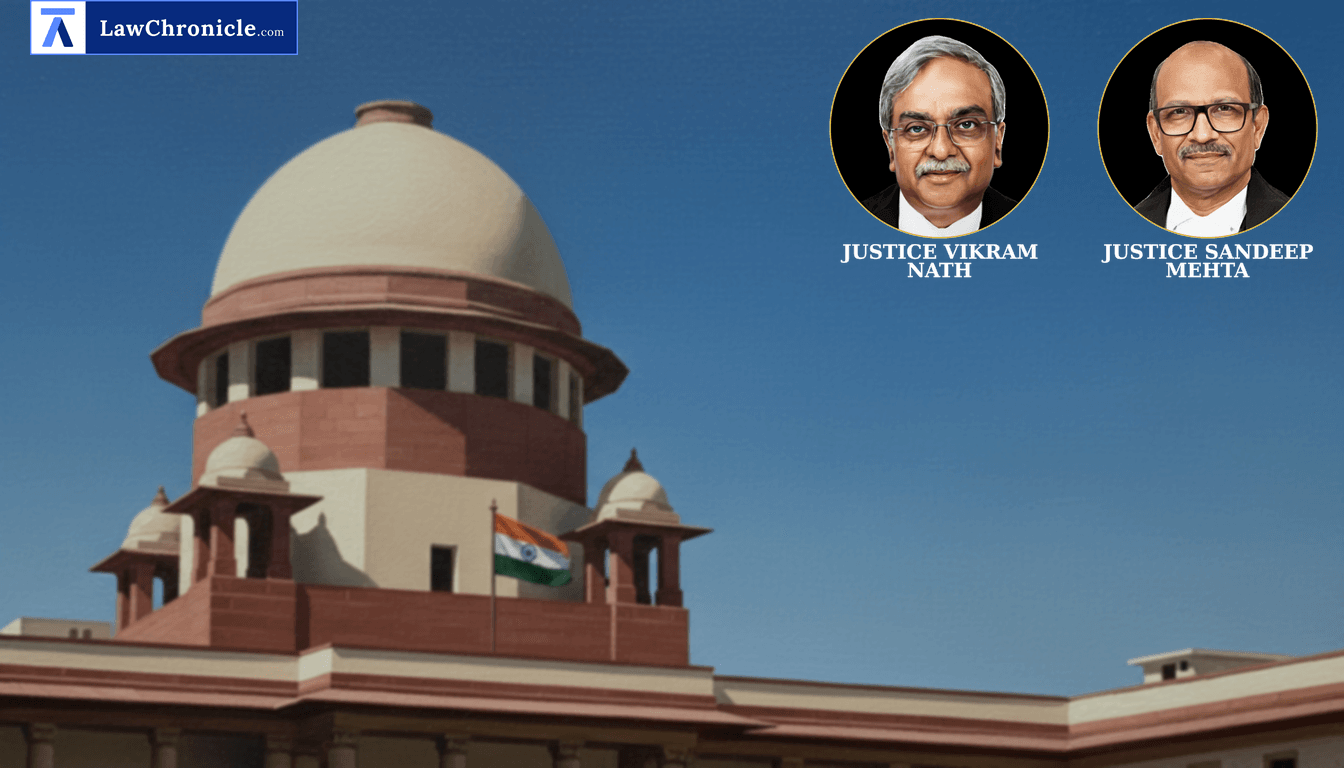
A bench of Justices Vikram Nath and Sandeep Mehta heard an appeal by three accused challenging an Allahabad High Court order that had upheld summoning orders under Section 3(1)(s) of the Scheduled Castes and Scheduled Tribes (Prevention of Atrocities) Act, 1989 read with Sections 323 and 504 IPC. The appeal arose from a trial court order summoning the appellants to face trial for alleged assault, caste-based abuses and related offences.
The Court allowed the appeal in part and quashed the proceedings under Section 3(1)(s) of the SC/ST Act while directing that the trial on the remaining IPC charges proceed. The Court noted that the offence under Section 3(1)(s) required that the abuse be hurled “in any place within public view,” and relied on earlier precedents to construe that phrase. The Court, in its reasoning, observed: “A perusal of the Application filed by the complainant under Section 156(3) of the CrPC reveals that the alleged casteist abuses were stated to have been used by the Appellants inside the premises of the complainant. This circumstance, on its face, does not satisfy the statutory requirement that the abuses were made ‘in any place within public view,’ which is an essential component of the offence under Section 3(1)(s) of the SC/ST Act. The house of the complainant cannot be considered to be within public view.” The Court further reiterated the test from earlier authorities: “If the alleged offence takes place within the four corners of the wall where members of the public are not present, then it cannot be said that it has taken place at a place within public view.”
Background
The dispute arose from allegations by Respondent No.2, a member of a Scheduled Caste employed as a sweeper, who said that on 23 July 2023 the first appellant and others hurled caste-based abuses, assaulted her, tore her clothes and threatened her inside her house and in its vicinity; she also alleged subsequent assault on her son. She filed an application under Section 156(3) CrPC which led to registration of complaint No.64/2023 under Sections 323 and 504 IPC and Section 3(1)(s) of the SC/ST Act. The appellants denied the allegations, contending false implication and pointing to a parallel FIR under Sections 307 and 308 IPC lodged against the complainant’s son for allegedly assaulting one appellant’s servant.
The Special Judge summoned the appellants on 12 September 2024. The appellants challenged the summoning under Section 14-A(1) of the SC/ST Act before the High Court, which dismissed their appeal and upheld the summoning, finding prima facie material that some of the alleged acts occurred in public view. The appellants then obtained leave to appeal to the Supreme Court.
The Supreme Court examined the complaint, the statutory text of Section 3(1)(s) — “abuses any member of a Scheduled Caste or a Scheduled Tribe by caste name in any place within public view” — and precedents including Karuppudayar and Hitesh Verma. Finding that the complaint, on its face, showed the casteist abuses were uttered inside the complainant’s premises and not “within public view,” the Court held the essential ingredient of the SC/ST offence was not prima facie satisfied. The Court observed that appellate powers should be exercised cautiously but found it appropriate to interfere in this limited respect. Accordingly, the proceedings under Section 3(1)(s) SC/ST Act were quashed, while trial on the IPC counts was directed to continue. The appeal stood partly allowed; other pending applications were disposed of.
Case Details: Case No.: 2025 INSC 1397 Case Title: Sohanvir @ Sohanvir Dhama & Ors. v. State of U.P. & Anr. Appearances: For the Petitioner(s): [Not indicated in the judgment] For the Respondent(s): [Not indicated in the judgment]
Similar Articles
 Breaking News


