


Executive Overreach Quashed: Karnataka High Court Invalidates Detention for Failure to Inform Detenu of Rights
 Copy Link
 Share
 Save
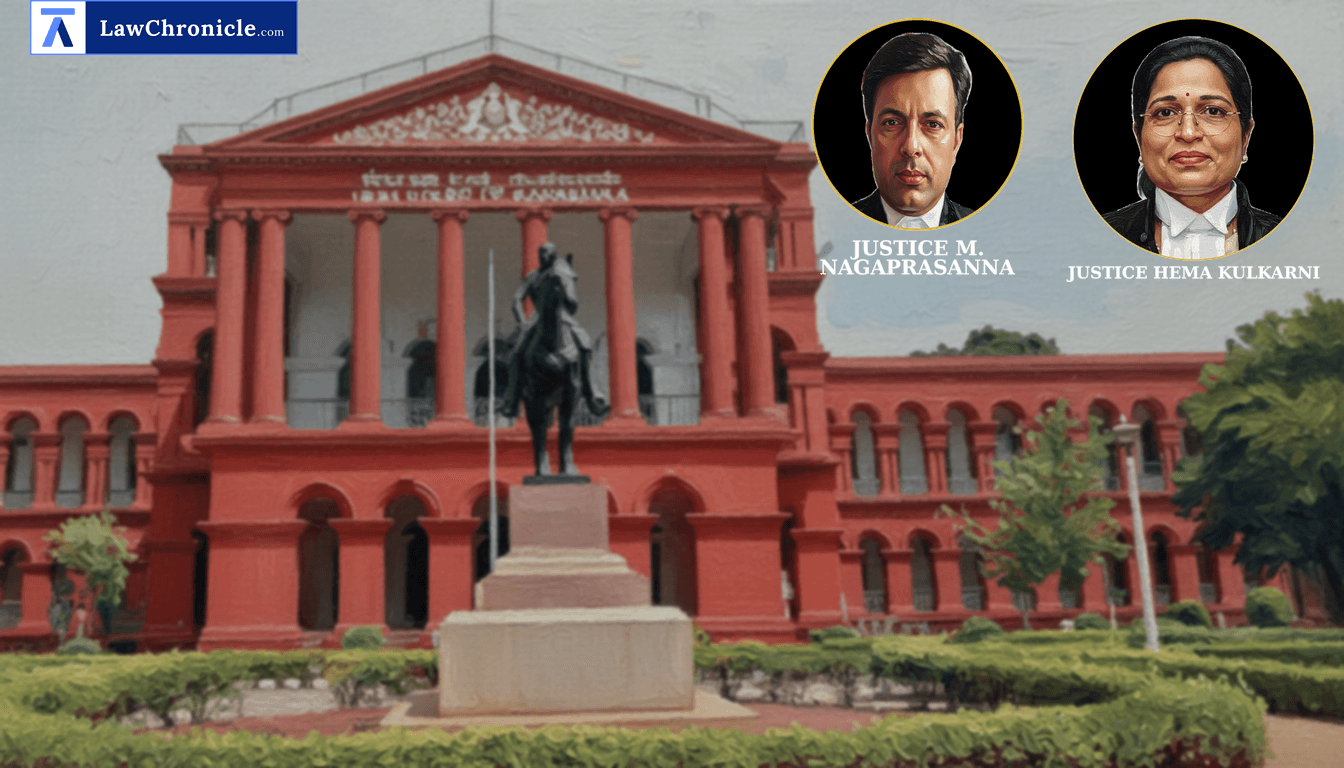
In a decisive blow to executive overreach, the Karnataka High Court has quashed a preventive detention order, ruling that the failure to inform a detenu of their right to represent to the Central Government constitutes a fatal violation of the Constitution of India, 1950. The Court further rebuked the state for using preventive detention as a 'backdoor' mechanism to circumvent judicial bail orders, emphasizing that extraordinary powers cannot replace ordinary criminal law remedies.
Justice M. Nagaprasanna and Justice Hema Kulkarni, presiding over a habeas corpus petition, scrutinized the legality of a detention order issued against an individual accused of narcotic offenses. The bench examined whether the Detaining Authority had fulfilled its constitutional and statutory obligations under the Prevention of Illicit Traffic in Narcotic Drugs and Psychotropic Substances Act, 1988 and the Constitution of India, 1950 while curtailing personal liberty without trial.
Key Takeaways
Mandatory Communication of Rights
Failure to inform a detenu of their specific right to make a representation to the Central Government under Section 12 of the Prevention of Illicit Traffic in Narcotic Drugs and Psychotropic Substances Act, 1988 renders the detention a nullity.
Bail Safeguards Preservation
Executive authorities cannot invoke preventive detention to bypass the 'twin conditions' satisfaction recorded by a court under Section 37 of the Narcotic Drugs and Psychotropic Substances Act, 1985.
Ordinary Law Primacy
If a detenu allegedly violates bail conditions, the proper legal recourse is an application for cancellation of bail, not the issuance of a preventive detention order.
Constitutional Imperatives
Procedural safeguards in preventive detention are not 'ornamental formalities' but sacrosanct requirements under Article 22(5) of the Constitution of India, 1950.
Constitutional Infirmity and Article 22(5)
The Court observed that while the State Government has the power to detain, the Prevention of Illicit Traffic in Narcotic Drugs and Psychotropic Substances Act, 1988 confers a concurrent power upon the Central Government to revoke or modify such orders. Consequently, the detenu must be explicitly informed of the right to approach the Central Government. The bench noted that such a right, if kept beyond the knowledge of the person, exists only on paper.
Referring to the precedent in KAMLESHKUMAR ISHWARDAS PATEL v. UNION OF INDIA ( "(1995) 4 SCC 51": 1995 CaseBase(SC) 518), the Court emphasized that the failure to communicate this right results in a denial of the fundamental right to make an effective representation. This principle was further bolstered by the Court's reliance on ALFIYA A. v. STATE OF KERALA ( "SLP (Crl.) No.8439 of 2026 decided on 28-07-2026": 2025 CaseBase(KER) 6500) and AMREEN v. COMMISSIONER OF POLICE, which established that the Detaining Authority's obligation is dual: communicating grounds and providing the earliest opportunity for representation.
Circumventing Judicial Bail: A Parallel Mechanism Rebuffed
A significant portion of the judgment addressed the state's attempt to detain an individual who had already been granted bail under the stringent provisions of Section 37 of the Narcotic Drugs and Psychotropic Substances Act, 1985. The Court highlighted that the prosecution had not sought cancellation of bail despite alleging violations of bail conditions.
The Court, in its reasoning, observed: "Preventive detention cannot become a convenient substitute for cancellation of bail, nor can the extraordinary power of detention be invoked as a device to neutralise or circumvent an order of a competent Court granting liberty to an accused. ... What could have been urged before the Court for cancellation of bail cannot be permitted to be metamorphose into a ground for preventive detention merely because the executive apprehends repetition of similar activity."
The bench also drew upon SUSHANTA KUMAR BANIK v. STATE OF TRIPURA ( "2022 SCC OnLine SC 1333": 2022 CaseBase(SC) 1088) and ROSHINI DEVI v. STATE OF TELANGANA ( "(2026) 7 SCC 302": 2026 CaseBase(SC) 69) to reiterate that when a person is enlarged on bail by a competent court, especially under the rigours of the Narcotic Drugs and Psychotropic Substances Act, 1985, great caution must be exercised before using the same charges to justify preventive detention.
Court Directions
The Court has following directions:
"(i) Writ Petition is allowed.
(ii) The detention order bearing No.Crime/Misc/64/NR/2026 dated 03-07-2026, Annexure-A passed by the 2nd respondent is hereby quashed.
(iii) Writ of Habeas Corpus issues to the 6th respondent to release the detenue - Raju Kale, forthwith.
(iv) Registry is directed to communicate the operative portion of the order to the 6th respondent, forthwith."
Ratio
Where a statute confers upon the Central Government the power to revoke a preventive detention order, the Detaining Authority is constitutionally mandated under Article 22(5) to inform the detenu of their right to make a representation to that specific authority. Furthermore, preventive detention cannot be used as a substitute for the cancellation of bail when ordinary criminal law remedies for breach of bail conditions are available and unexhausted.
Background
The petitioner, the wife of the detenu Raju Kale, challenged a detention order dated July 3, 2026, issued by the Inspector General of Police, Northern Range, Belagavi. The detention was based on three criminal cases registered under the Narcotic Drugs and Psychotropic Substances Act, 1985, including one where the detenu was already convicted and another where he was granted regular bail. The Detaining Authority argued that the detenu was a habitual offender whose activities were prejudicial to public health and the economy.
However, the Court found that the Detaining Authority failed to inform the detenu of his right to represent to the Central Government under Section 12 of the Prevention of Illicit Traffic in Narcotic Drugs and Psychotropic Substances Act, 1988. Citing Wahengbam Bimal Meitei V. District Magistrate, Imphal West District and Jaseela Shaji v. Union of India ( "(2024) 9 SCC 53": 2024 CaseBase(SC) 964), the Court held that even if the case was placed before an Advisory Board, it would not cure the initial constitutional defect. Finding the detention legally unsustainable, the High Court ordered the immediate release of the detenu.
Case Details:
Case No.: WRIT PETITION (HABEAS CORPUS) NO.100019 OF 2026
Case Title: SMT. MALA v. STATE OF KARNATAKA AND OTHERS
Appearances:
For the Petitioner(s): SRI PRUTHVIRAJ P. HITTALAMANI, ADVOCATE
For the Respondent(s): SRI RAKESH M. BILKI, GOVERNMENT ADVOCATE
Source: 2026 CaseBase(KAR) 21249
Similar Articles




 Breaking News


