


Fraud Vitiates Land Acquisition For Housing Societies: Supreme Court
 Copy Link
 Share
 Save
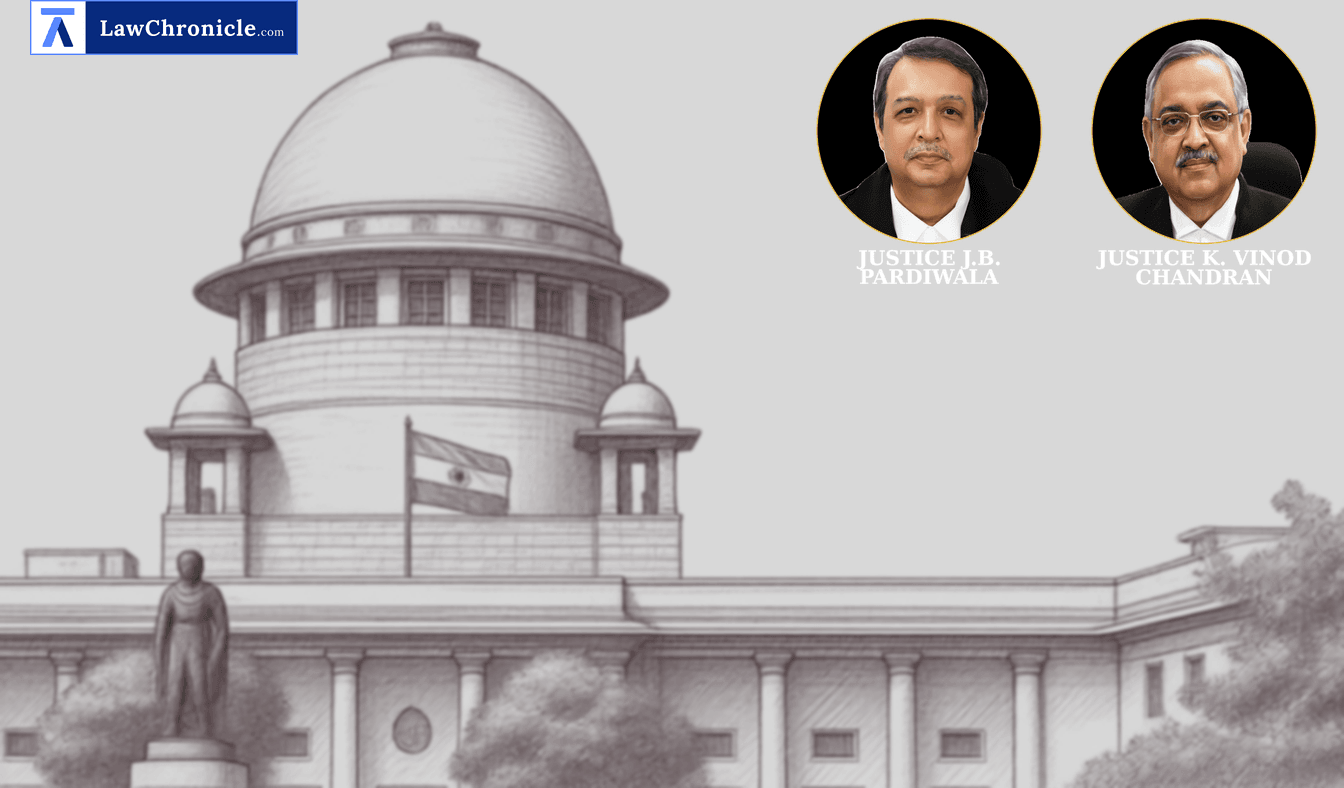
Defeating technical pleas of delay and res judicata, the Supreme Court has quashed fraudulent land acquisitions initiated for cooperative housing societies, ruling that systemic trickery and colourable exercise of power render state actions void ab initio. A Bench of Justice J.B. Pardiwala and Justice K. Vinod Chandran set aside a High Court Division Bench judgment that had dismissed land acquisition challenges solely on grounds of delay and res judicata.
Key Takeaways
- Fraud Overrides Procedural Bars: Delay, laches, and res judicata cannot validate acquisitions tainted by fraud or legal mala fides.
- Mandatory Prior Approval: Housing schemes under Section 3(f)(vi) of Land Acquisition Act, 1894 require concrete layout plans approved by the State before initiating acquisition.
- Prohibition of Middlemen: Engaging agents or private service providers to influence State acquisition machinery violates public policy and invalidates proceedings.
- Restoration to Landowners: Acquired lands must be restored to original owners regardless of whether all individual owners challenged the acquisition.
In its reasoning, the Supreme Court emphasized that public purpose cannot be manufactured through private arrangements. The Bench reasoned to observe that "An agreement with a third party to facilitate acquisition of lands for developing a housing scheme, with an undertaking to facilitate steps under the LA Act of 1894, even before such housing schemes were brought under the nomenclature of public purpose, clearly exposes the fraud intended to be carried out."
The Apex Court issued specific directions regarding the acquired property and compensation: The Court has following directions:
"The possession of the land shall be restored to the respective landowners, irrespective of the fact whether they had challenged the acquisition of their lands or not. On restoration of possession, they shall refund the amounts, if any received by them, as compensation from the Government, without any interest. We make it clear that this shall not facilitate any refund of the amounts received by them in any private transaction. The 4th respondent Society shall not have any claim over the lands acquired, even if possession handed over or the money refunded, since they facilitated the fraud and the colourable exercise of power by the Government Officers. If any of the plots are not resumed to the original landowners for reason of their inability or unwillingness to refund the amounts paid to them by the Government, the Government shall auction such lands and the proceeds shall be used for the purpose of victim compensation and remitted to the appropriate Head of Account at the directions of the Chief Justice of the High Court in consultation with the Karnataka Legal Services Authority. The auction shall be conducted by the Revenue Authorities but under the supervision of a Judicial Officer not below the rank of a District Judge (Selection Grade) as authorised by the Chief Justice."
Ratio
An exercise of eminent domain under Section 3(f)(vi) of Land Acquisition Act, 1894 for a cooperative housing society requires prior approval of a concrete housing scheme complete with a layout plan. Where acquisition proceedings are facilitated through middlemen or private service providers using undue influence, money power, or illegal agreements, the entire acquisition is vitiated by fraud and colourable exercise of power, rendering procedural defences like res judicata and delay completely inapplicable.
Background
The dispute pertained to land acquisition proceedings initiated in 1988 in Nelakadiranahalli Village, Karnataka, ostensibly for a cooperative housing society. The landowners challenged the acquisition notifications, alleging that the society had entered into illegal agreements with middlemen to influence state officials and acquire land under the guise of public purpose without prior approval of a valid housing layout scheme.
While a learned Single Judge of the High Court quashed the acquisition finding clear evidence of fraud based on the G.V.K. Rao Committee Report, a Division Bench reversed the ruling relying on Karnataka Gruha Nirmana Sahakara Sangha Limited, Peenya, Bangalore v. Karithimmaiah and Others, citing res judicata and delay. The High Court Bench also discussed decisions such as Meghmala & Ors. v. G. Narasimha Reddy & Ors. ( "(2010) 8 SCC 383": 2010 CaseBase(SC) 772) and A.C. Ananthaswamy and Ors. v. Boraiah (dead) by LRs. ( "(2004) 8 SCC 588": 2004 CaseBase(SC) 248) regarding res judicata.
On appeal, the Supreme Court examined several precedents, including H.M.T. House Building Cooperative Society v. Syed Khader & Ors. ( "(1995) 2 SCC 677": 1995 CaseBase(SC) 1519), Bangalore City Cooperative Hosing Society Ltd. v. State of Karnataka & Ors. ( "(2012) 3 SCC 727": 2012 CaseBase(SC) 588), Royal Orchid Hotels & Anr. v. G. Jayarama Reddy & Ors., Rattan Chand Hira Chand v. Askar Nawaz Jung (Dead) by LRs. & Ors. ( "(1991) 3 SCC 67": 1991 CaseBase(SC) 275), H.M.T. House Building Cooperative Society v. M. Venkataswamappa ( "(1995) 3 SCC 128": 1995 CaseBase(SC) 777), Vyalikaval House Building Co-Op. Society by its Secretary v. V. Chandrappa & Ors., B. Anjanappa & Ors. v. Vyalikaval House Building Cooperative Society Ltd. & Ors., Rajashekar & Ors. v. Trinity House Building Cooperative Society & Ors., and Uddar Gagan Properties Ltd. v. Sand Singh & Ors.. The Court distinguished the summary dismissal of prior challenges under Article 141 of Constitution of India, 1950 by referring to Kunhayammed & Ors. v. State of Kerala & Anr. ( "(2000) 6 SCC 359": 2000 CaseBase(SC) 4) on the doctrine of merger. Highlighting the fundamental legal maxim that fraud vitiates all solemn acts, the Bench relied on S.P. Chengalvaraya Naidu (Dead) by LRs. v. Jagannath (Dead) by LRs. ( "(1994) 1 SCC 1": 1993 CaseBase(SC) 552) and A.V. Papayya Sastry & Ors. v. Government of A.P. & Ors. ( "(2007) 4 SCC 221": 2007 CaseBase(SC) 1067) to hold that decisions obtained by suppressing material facts or through trickery are nullities.
Interpreting Section 23 of Contract Act, Section 12, Section 16, and Section 47 of Land Acquisition Act, 1894, as well as provisions under Code of Civil Procedure, 1908, Karnataka Cooperative Societies Act, 1959, and Bangalore Development Authority Act, 1976, the Supreme Court set aside the Division Bench judgment, restored the order of the Single Judge with enhanced costs, and ordered full restoration of possession to the original landowners.
Case Details:
Case No.: Civil Appeal Nos. 13744-13747 of 2015
Neutral Citation: 2026 INSC 1151
Case Title: N. Arasappa v. State of Karnataka & Ors.
Appearances:
For the Petitioner(s): Ms. Kiran Suri, Sr. Adv., Mr. Basava Prabhu S. Patil, Sr. Adv.
For the Respondent(s): Mr. Vikas Singh, Sr. Adv., Mr. Sanjay Hegde, Sr. Adv., Mr. Omar Hoda, AAG
Source: 2026 CaseBase(SC) 9057
Similar Articles

 Breaking News


