


Karnataka HC: Fraud Vitiates Decades-Old Land Acquisition
 Copy Link
 Share
 Save
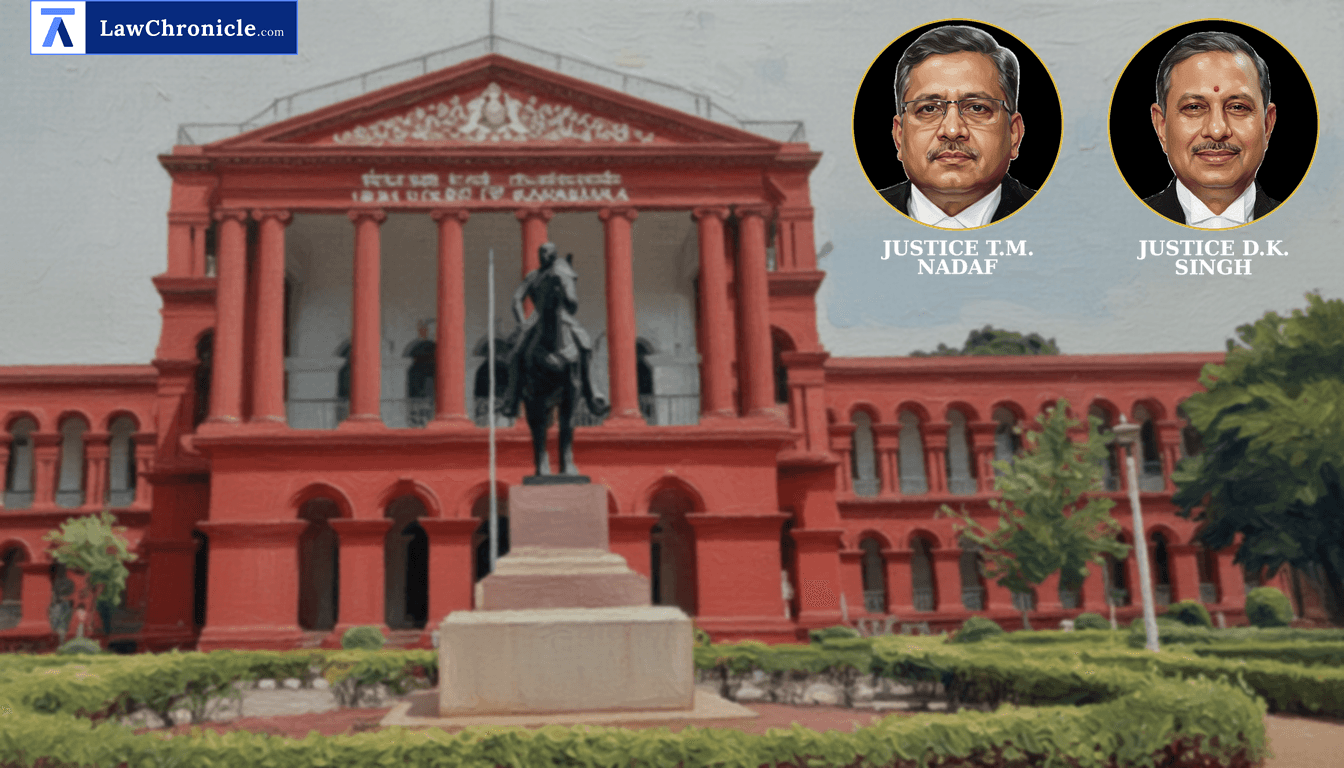
In a decisive blow to administrative fraud, the Karnataka High Court has quashed land acquisition proceedings finalized over thirty years ago, ruling that the doctrine of finality cannot protect judicial or executive acts secured through the systematic manipulation of official records.
Following a protracted legal battle, a Division Bench comprising Justice D K Singh and Justice T.M.Nadaf overturned a Single Judge’s order, establishing that subsequent revelations of fraud and the non-existence of compensation records fundamentally undermine any prior legal finality granted to state acquisitions.
The Facade of Legality and the Unravelling of Fraud
The dispute centered on approximately 10 acres of land in Hosahalli Village, which the State claimed to have acquired in 1988-1989 for the Ex-Servicemen House Building Co-operative Society. While the State and the Society maintained that a consent award was passed in 1990 and possession was transferred in 1991, recent disclosures from the Special Land Acquisition Officer (SLAO) revealed a startling absence of records concerning the award, compensation payments, or court deposits.
Extending the scrutiny further, the Court noted that the "consent award" was seemingly a fabrication where the Society's promoter, now absconding, withdrew the compensation from the Society itself, rather than the State paying the actual land owners. The Court remarked that payment of compensation must be real and not illusory to satisfy the constitutional and statutory requirements of the Land Acquisition Act, 1894.
Judicial Rebukes and Directions to the State
The Court took serious note of an affidavit by the SLAO which admitted that the land owners remained in physical possession and that the Society had performed no developmental work, contradicting decades of previous submissions made by the State in earlier rounds of litigation.
The Court has given the following directions:
"...allow this writ appeal granting the prayer sought for and set aside the impugned judgment and order dated 25.02.2025 passed by the learned Single Judge."
In its reasoning, the Court observed: "Fraud, suppression of material facts and manipulation of official records rarely admit to direct evidence. The existence of such circumstances is ordinarily discerned from the cumulative effect of the documentary material and the conduct of the parties... Since fraud strikes at the very root of every judicial and administrative action, the respondents cannot derive any advantage from the earlier proceedings founded upon such tainted material."
Overcoming the Bar of Res Judicata
Addressing the respondents' argument that the matter had attained finality through previous Supreme Court and High Court dismissals, the Bench clarified that the principle of 'finality of litigation' cannot be pressed to the extent of absurdity to protect a fraudster. Citing Vishnu Vardhan @ Vishnu Pradhan Vs State Of Uttar Pradesh & Others And Vipin Kumar V. Jaydeep & Others, the Court held that a judgment obtained by playing fraud on the court is a nullity and can be challenged at any time, even in collateral proceedings.
Key Takeaways:
Finality Does Not Immunize Fraud
Even if a case has been dismissed by the Supreme Court in the past, newly discovered evidence of state-sponsored fraud or record fabrication can be grounds to reopen and nullify the entire proceeding.
Compensation Must Be Real and Not Illusory
For an acquisition to be valid under Land Acquisition Act, 1894, the State must prove that the Collector tendered actual payment to the land losers; internal transfers within a private society do not constitute lawful compensation.
The 'Indore Development' Bar is Not Absolute
While Section 24(2) of the Right to Fair Compensation and Transparency in Land Acquisition, Rehabilitation and Resettlement Act, 2013 generally cannot revive stale claims as per Indore Development Authority Vs. Mohanlal And Others, it does not prevent the Court from quashing acquisitions that were fraudulent from their very inception.
Ratio Decidendi:
The exact rule of law established is that fraud is an extrinsic collateral act that vitiates all judicial and administrative acts, whether in rem or in personam. The principle of finality of litigation and the doctrine of res judicata do not apply where the foundation of the previous adjudication was based on suppressed facts or fabricated records, as fraud unravels everything it touches.
Background:
The appellant’s father originally owned the land, which was targeted for acquisition in 1988. Despite multiple previous attempts to challenge the acquisition all of which failed due to delay and laches the appellant persisted, eventually obtaining an endorsement in 2023 from the SLAO confirming that critical legal records were missing. This, combined with the findings of the GVK Rao Committee which had branded the beneficiary Society's operations as irregular, provided the fresh cause of action for this successful challenge.
Case Details:
Case No.: WRIT APPEAL NO. 791 OF 2025 (LA-RES)
Case Title: Sri V Sreenivasaiah v. The State Of Karnataka And Others
Appearances:
For the Petitioner(s): Smt. Mahalakshmi Pavani, Senior Advocate And Smt. Anitha Shenoy, Senior Advocate For Sri Srikanth M, Advocate
For the Respondent(s): Sri M N Sudev Hegde, Aga For R-1 To 4, R-7, R-9 And R10; Sri S S Naganand, Senior Advocate For Sri K R Krishna Murthy, Advocate For R-5; Sri Murugesh V Charati, Advocate For R-8
Source: 2026 CaseBase(KAR) 240




 Breaking News


