


Freebies to Doctors: SC directs formation of Committee to recommend Rules for Pharma Marketing
 Copy Link
 Share
 Save
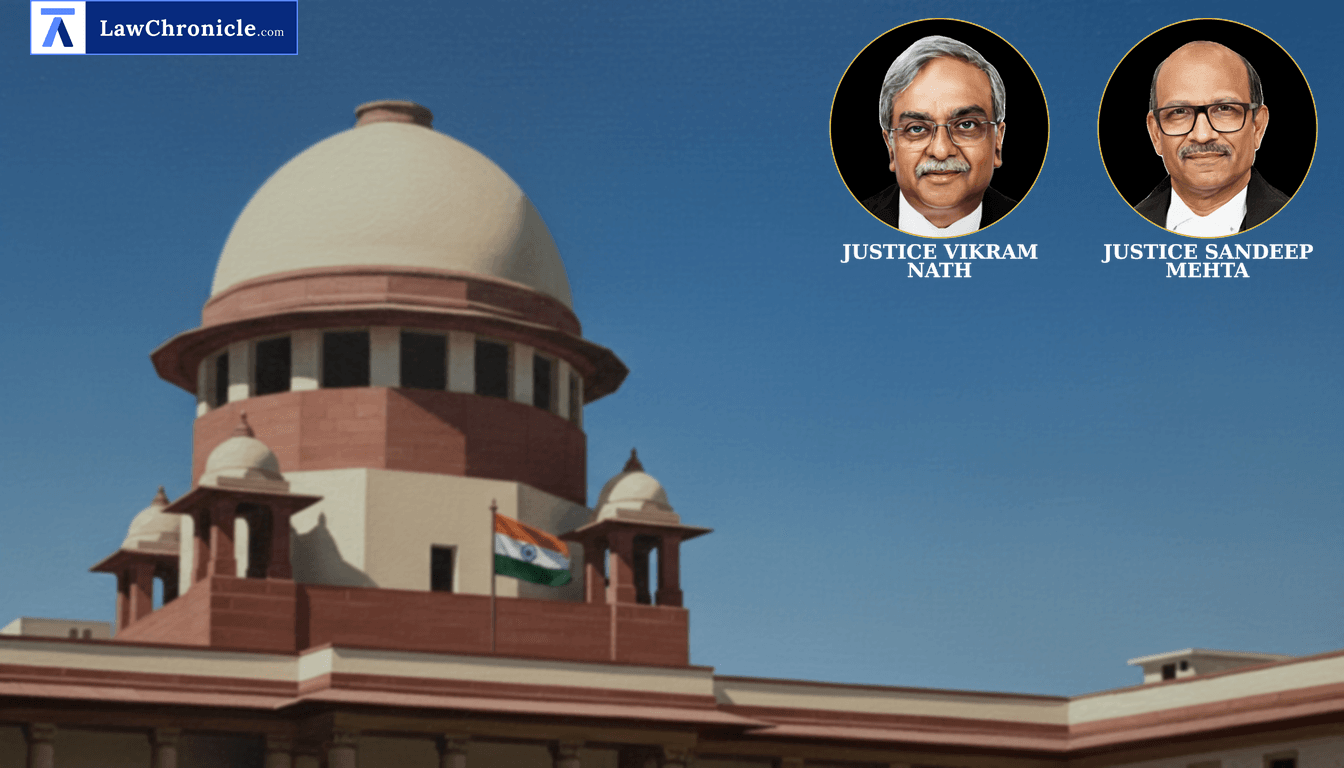
Addressing the persistent regulatory gap surrounding unethical drug promotion by offering freebies to doctors and medical practitioners, the Supreme Court has mandated the time-bound constitution of an expert committee to construct an enforceable framework against pharma-physician nexus.
In a writ petition preferred under Article 32 of the Constitution of India, a bench comprising Justice Vikram Nath and Justice Sandeep Mehta addressed the longstanding public interest issue of unregulated pharmaceutical marketing practices. The proceedings underscored the urgency of establishing statutory mechanisms to penalize pharma companies extending monetary inducements, gifts, and hospitality to healthcare professionals.
Key Takeaways
Institutional Policy Intervention: The Supreme Court directed the executive to establish a dedicated panel to overhaul pharma marketing practices within two weeks.
Time-Bound Recommendations: The newly proposed committee must submit comprehensive regulatory recommendations within two months of its first meeting.
Right to Health Integration: Reinforces that unchecked, unethical drug promotions directly infringe upon the Right to Life guaranteed under Article 21.
Regulatory Oversight: Closes the regulatory loop by focusing enforcement on pharmaceutical corporations rather than restricting ethics codes solely to medical practitioners.
Executive Policy Domain and Judicial Facilitation
While acknowledging the primary role of the executive in framing policy mechanisms, the bench highlighted that judicial restraint cannot translate into indifference when public health is compromised. The Supreme Court noted that the efficacy of any regulatory regime must be judged by its active enforcement and implementation rather than the mere presence of soft codes. The Bench observed that "In a sector which has a direct bearing upon the health and well-being of citizens, the efficacy of the regulatory framework cannot be assessed merely by the existence of prescribed norms; it must also be judged by their efficacy, implementation and enforcement. The material on record, therefore, warrants a careful examination of the measures required to strengthen the existing regulatory mechanism..."
Supreme Court Directions to curb Freebies to Doctors
The Apex Court issued the following directions to regulate pharma marketing practices:
"A. The Union of India shall, if not already constituted, constitute the Committee proposed by it within a period of two weeks from the date of this order.
B. The Committee so constituted shall undertake a holistic and comprehensive examination of all issues relating to unethical pharmaceutical marketing practices, including the adequacy of the existing statutory and regulatory framework, the efficacy of the mechanisms presently in place for monitoring, oversight and enforcement, and the measures required to ensure greater transparency, accountability and effective compliance, with a view to strengthening the regulatory framework and safeguarding the larger public interest.
C. The Committee shall take into consideration the material already placed on record before this Court by the petitioners and the intervenors, and shall also afford them a reasonable opportunity to place before it their respective views, suggestions and concerns. The Committee shall also provide an appropriate opportunity to other stakeholders concerned with the subject matter to place their representations, so as to enable a comprehensive and informed consideration of all aspects of the issues under examination.
D. The Committee shall duly consider the suggestions, representations and concerns placed before it by the petitioners, the intervenors and other stakeholders, and shall, upon an objective and comprehensive consideration thereof, make its recommendations to the Union of India regarding the appropriate regulatory and/or statutory framework for effectively regulating pharmaceutical marketing practices, keeping in view the need for transparency, accountability and effective enforcement.
E. For the purposes of undertaking an informed, comprehensive and objective examination of the issues, the Committee shall be at liberty to seek the assistance of such technical, professional and domain experts, institutions or bodies as it may consider necessary, and may obtain such expert inputs as may be required for a proper appreciation of the regulatory, medical, pharmaceutical and other relevant aspects arising for its consideration.
F. The Committee shall endeavour to complete the entire exercise in a time-bound manner and submit its recommendations to the Union of India within a period of two months from the date of its first meeting, after duly undertaking the consultative process and considering the material and suggestions placed before it.
G. The Union of India shall, upon receipt of the recommendations of the Committee, duly consider the same and take an appropriate and reasoned decision at the earliest, having regard to the constitutional mandate under Article 21 of the Constitution of India and the larger public interest involved in ensuring ethical, transparent and accountable pharmaceutical marketing practices."
Ratio
While formulation of regulatory policy for pharmaceutical marketing falls within the executive domain under the separation of powers doctrine, the constitutional court under Article 32 and Article 142 is empowered to facilitate a mandatory, time-bound consultative framework to ensure that public health and the fundamental Right to Life under Article 21 are protected against unregulated ethical violations.
Background
The writ petition was instituted by the Federation of Medical & Sales Representatives Association of India, a trade union registered under the Trade Unions Act, 1926, along with Jan Swasthya Abhiyan. The petitioners contended that while healthcare professionals are governed by disciplinary regulations under the Indian Medical Council (Professional Conduct, Etiquette And Ethics) Regulations, 2002, pharmaceutical companies face no corresponding statutory penal enforcement for offering inducements.
The petitioners submitted that voluntary arrangements like the Uniform Code for Pharmaceutical Marketing Practices failed due to lack of statutory sanctions. In response, the Union of India submitted that consultations were conducted and referred to past evaluations under the Essential Commodities Act, 1955 and the Drugs and Cosmetics Act, 1940. The executive pledged to constitute a three-member committee to evaluate statutory enforcement models on freebies to doctors, while the UCPMP, 2024 operates in the interim. Taking the Union's affidavit on record, the Supreme Court directed a structured stakeholder consultation and ordered a compliance affidavit to be filed within two weeks following the expiry of the committee's two-month deadline. The matter has been listed for further consideration on January 29, 2027.
Case Details:
Case No.: Writ Petition (C) No(s). 323 of 2021
Neutral Citation: 2026 INSC 1097
Case Title: Federation of Medical & Sales Representatives Association of India & Ors. v. Union of India & Ors.
Appearances:
For the Petitioner(s): Mr. Sanjay Parikh, Senior Advocate; Mr. Kaleeswaram Raj, Advocate
For the Respondent(s): Mr. Tushar Mehta, Solicitor General; Mr. K.M. Nataraj, Additional Solicitor General; Mr. Kapil Sibal, Senior Advocate; Mr. Kavin Gulati, Senior Advocate; Mr. Gaurav Sharma, Senior Advocate
Source: 2026 CaseBase(SC) 8245
Similar Articles
 Breaking News


