


Gauhati HC: Excavated Earth Reuse Not Automatically Exempt From Royalty
 Copy Link
 Share
 Save
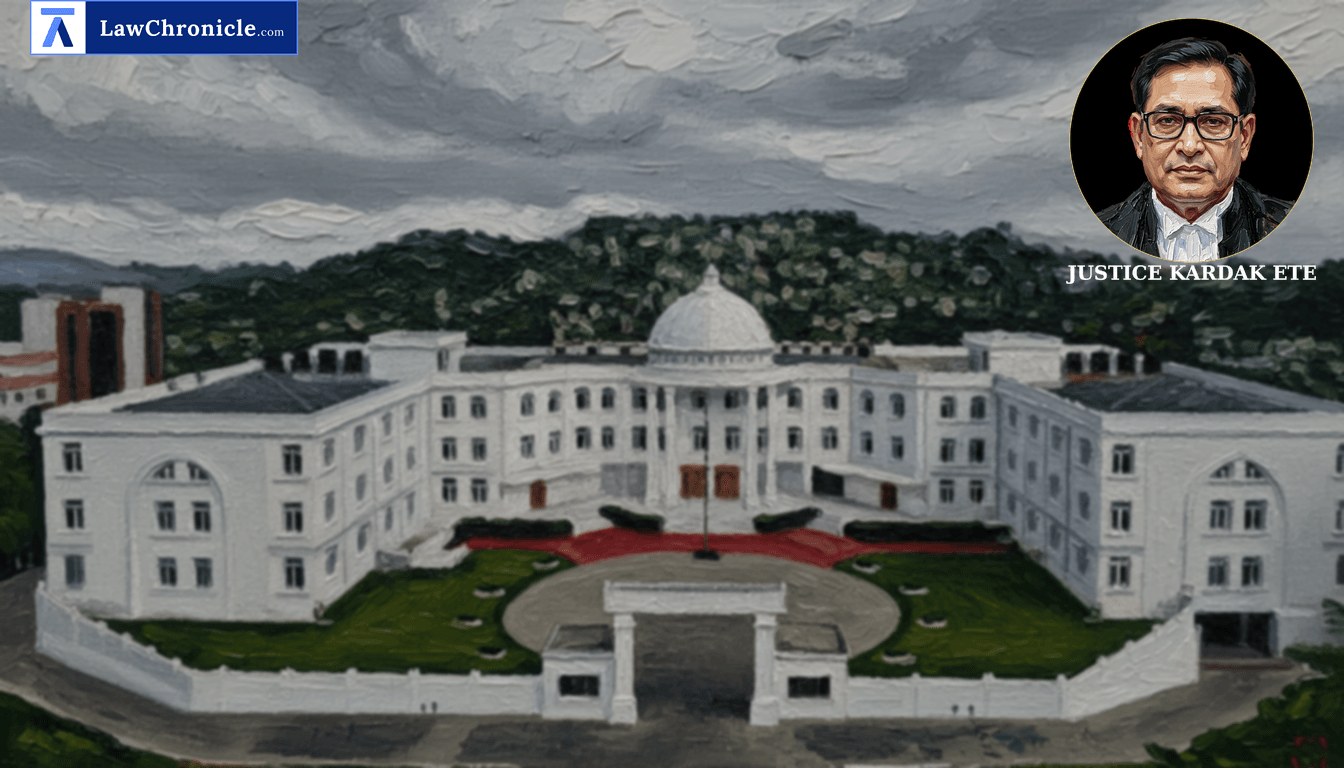
The Gauhati High Court has delivered a decisive blow to construction firms seeking blanket exemptions from forest royalties, ruling that the internal reuse of excavated earth within a project site does not bypass statutory levy requirements without rigorous documentary substantiation. This judgment reinforces the State’s power to regulate minor minerals under the Mines and Minerals (Development and Regulation) Act, 1957, effectively preventing contractors from evading public revenue through unsubstantiated claims of 'cut-and-fill' operations.
Justice Kardak Ete, presiding over the matter, scrutinized the demand raised against a construction firm involved in a major National Highway project. The court emphasized that while legal principles regarding site reuse exist, they are not a shield against the procedural mandates of the Assam Minor Mineral Concession Rules, 2013.
Court Rejects Claims of Unilateral Assessment
The Court observed that the assessment by forest officials was not an arbitrary exercise but a structured process involving field inspections and record reconciliation. The petitioner had argued that the demand for Rs. 1.45 Crores was legally unsustainable since the earth was reused within the project's 'Right of Way'. However, the Bench noted that the petitioner failed to provide satisfactory statutory documentation, such as transit challans or lifting permits, for a significant portion of the minerals used.
In its reasoning, the Court observed: "The contention of the petitioner that no royalty is payable for earth excavated and re-used within the same site cannot be accepted as a blanket proposition in the facts of the present case. The applicability of the said principle depends upon proper verification of source-wise excavation and utilisation, supported by contemporaneous measurement records and engineering data. In the present case, the respondents have recorded that the claim of internal utilisation is not fully substantiated by documentary evidence in respect of the entire quantity."
Validity of Penal Actions Under Minor Mineral Rules
The Court upheld the invocation of Rule 63 and Rule 64 of the Assam Minor Mineral Concession Rules, 2013, which deal with unauthorized mining. It clarified that these rules are triggered whenever extraction occurs without a valid mineral concession, regardless of whether a formal declaration of 'illegal mining' is made. The Court further noted that the petitioner had been afforded reasonable opportunities, including notice prior to inspection and the chance to submit detailed objections.
The Court has the following directions:
"The writ petition is dismissed. However, it is clarified that the dismissal of this writ petition shall not preclude the petitioner from availing such remedies as may be available in law before the appropriate forum for adjudication of disputed factual issues relating to quantification of liability, if so advised. There shall be no order as to costs."
Background:
The dispute arose from an EPC contract awarded to the petitioner in 2017 for the four-laning of NH-37 from Rangagara to Kaliabor Tiniali. The Divisional Forest Officer, Nagaon, raised a demand of Rs. 1,45,84,055/- citing non-payment of royalty, GST, and penalties for earth used in the project. The petitioner relied on Promoters & Builders Association of Pune vs. State of Maharashtra to argue that soil excavated and reutilized at the same site cannot be taxed. They further cited State of Assam vs. Muslim Ali and Dipayan Paul and Chanchal Paul JV vs. State of Assam to argue against unilateral deductions by the State.
The respondents, represented by Standing Counsel for the Forest Department and NHIDCL, contended that the petitioner failed to produce valid permits for 80,282.04 CuM of earth. They argued that under Section 15 of the Mines and Minerals (Development and Regulation) Act, 1957 and Rule 5 of the Assam Minor Mineral Concession Rules, 2013, the contractor is legally bound to pay royalty and obtain permits in advance. The High Court found that the issues raised by the petitioner involved disputed questions of fact regarding technical measurement data, which could not be adjudicated under Article 226 of the Constitution of India.
Key Takeaways:
Documentation is Mandatory for Exemptions
Contractors cannot claim royalty exemptions for reused earth based solely on the 'site reuse' principle without maintaining precise contemporaneous records and statutory permits.
Statutory Primacy Over Contractual Silence
Even if a contract is silent on specific royalty deductions, the State's power under the Assam Minor Mineral Concession Rules, 2013 to recover dues for unauthorized mineral extraction remains intact.
Limited Scope of Writ Jurisdiction
High Courts will not interfere in technical assessments of earthwork volumes or mineral quantities, as these constitute 'disputed questions of fact' better suited for civil or departmental adjudication.
Ratio Decidendi:
The right to claim exemption from royalty for excavated earth reused within a project site is contingent upon the contractor's ability to substantiate such reuse through valid statutory documentation and verified measurement records under the prevailing Minor Mineral Concession Rules. The absence of such documentation transforms the extraction into 'unauthorized mining,' attracting penal consequences under the Mines and Minerals (Development and Regulation) Act, 1957.
Case Details:
Case No.: WP(C)/3206/2023
NeutralCitation: 2026:GAU-AS:9437
Case Title: SIMPLEX INFRASTRUCTURES LTD VERSUS THE STATE OF ASSAM AND 5 ORS
Appearances:
For the Petitioner(s): DR. ASHOK SARAF (Senior Counsel), MR G N SAHEWALLA (Senior Counsel), MS. S. TODI, MR. H. K. SARMA, MR M SAHEWALLA, MS G DUGAR, MR. S CHETIA, MR P BARUAH, MR. N N DUTTA, MR S J SAIKIA, MR P K BORA, MR. G. DUTTATRAY, B SARMA
For the Respondent(s): MR. D. GOGOI (SC, FOREST), MR. C. BARUAH (SC, NHIDCL), MR. U. DAS (Senior Government Advocate)
Source: 2026 CaseBase(GAU) 1
Similar Articles


 Breaking News


