


Contractual Royalty Rates Cannot Override Statutory Amendments: SC
 Copy Link
 Share
 Save
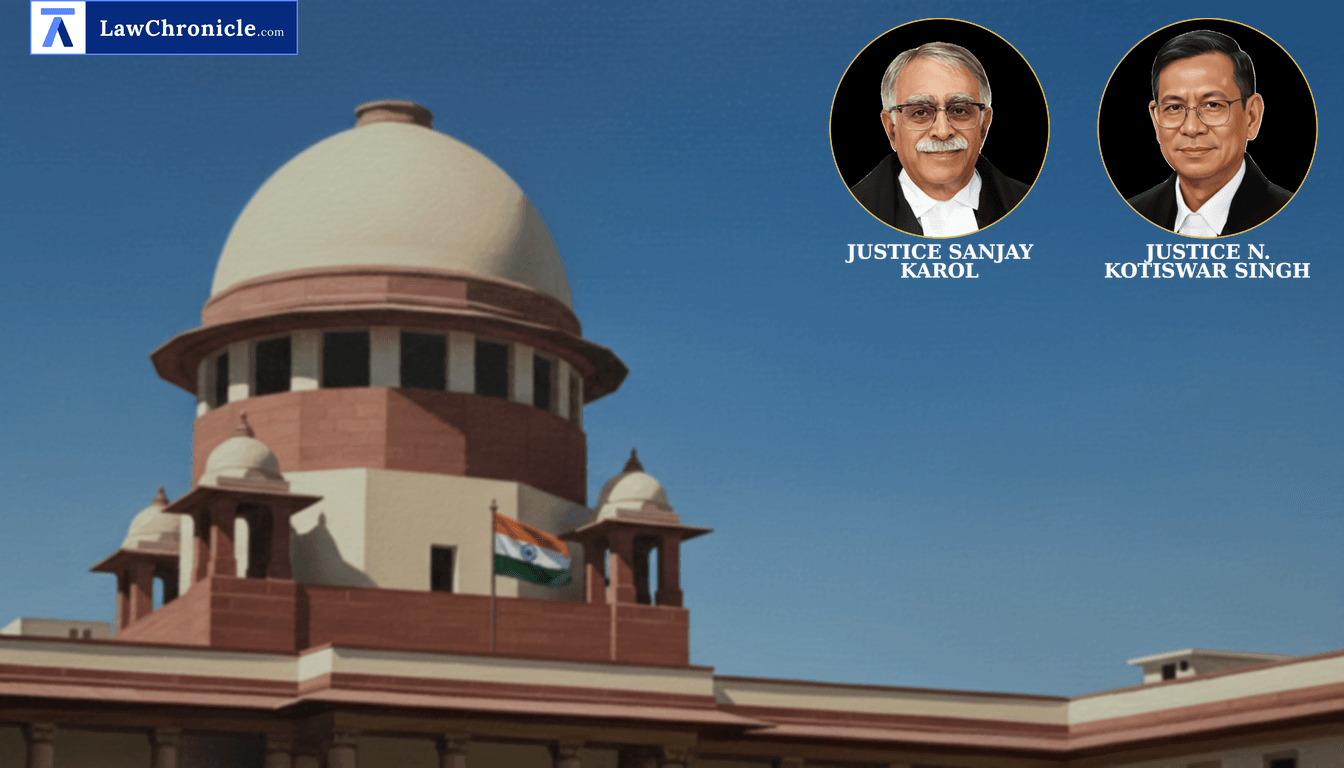
The Supreme Court has clarified that royalty rates fixed in tender agreements must yield to subsequent statutory amendments, as royalty liability is linked to the removal of minerals rather than the date of the contract.
Justice Sanjay Karol and Justice Nongmeikapam Kotiswar Singh set aside a Karnataka High Court order that had protected a successful bidder from an increase in royalty from 10% to 15%. The Bench emphasized that under Mines and Minerals (Development and Regulation) Act, 1957, royalty becomes payable on the removal or consumption of minerals, and a prior contract cannot freeze the statutory rate applicable at the time of dispatch.
The Link Between Royalty and Mineral Dispatch
The Court observed that royalty is a statutory import and its 'crystallisation' at the time of auction is not a recognized legal concept. Relying on the principles laid down in Mineral Area Development Authority v. SAIL, the Court noted that royalty represents a return for the privilege of removing minerals and is generally determined based on the quantity removed.
The Court, in its reasoning, observed: "In that view of the matter, the payment is to be made on the date of the movement of the minerals. If the date of the movement is after the enhancement in royalty, a contract entered into prior to the statutory change cannot be limiting its impact. In other words, the appellant was correct in deducting the additional 5% royalty from the security deposit of the respondent."
Statutory Amendments Overriding Contractual Clauses
While the tender agreement included a provision for a contingency deposit to meet future tax variances, the appellant argued that such clauses cannot limit the State's power to collect statutory dues. The Court agreed, stating that if the increase resulted from any method other than a statutory amendment, contractual limits might have applied, but a change to Mines and Minerals (Development and Regulation) Act, 1957 must prevail over private agreements.
The Court has the following directions:
"Resultantly, the appeal is allowed. Impugned judgment, the particulars of which are mentioned in paragraph 1 is quashed and set aside. Pending application(s), if any, shall stand disposed of."
Background:
The dispute originated from an e-auction conducted by a Monitoring Committee constituted by the Supreme Court in an earlier litigation to sell iron ore stocks in Karnataka. The respondent emerged as a successful bidder and paid the sale price along with 10% royalty as per the then-applicable rates. However, before the mineral was fully transported, the Central Government amended the Second Schedule of the Mines and Minerals (Development and Regulation) Act, 1957 on September 1, 2014, increasing the royalty to 15%.
When the respondent sought a refund of its security deposit, the Director of Mines and Geology deducted the 5% difference in royalty for the mineral moved after the amendment. The respondent challenged this before the High Court of Karnataka, which ruled in its favor, holding that imposing a higher royalty than what was applicable at the time of the bid acceptance was unjust. The State then appealed to the Supreme Court, which has now restored the deduction.
Case Details:
Case No.: Civil Appeal No of 2026 (@ SLP (C) No. 16259 of 2019)
NeutralCitation: 2026 INSC 627
Case Title: THE DIRECTOR OF MINES AND GEOLOGY v. M/s BMM ISPAT LTD & ANR.
Appearances:
For the Petitioner(s): Mr. Devdutt Kamat, Senior Advocate
For the Respondent(s): Ms. Kiran Suri, Senior Advocate
Source: 2026 CaseBase(SC) 529

 Breaking News


