Gauhati High Court Rules Computer-Generated NRC Data Inadmissible Evidence
 Copy Link
 Share
 Save
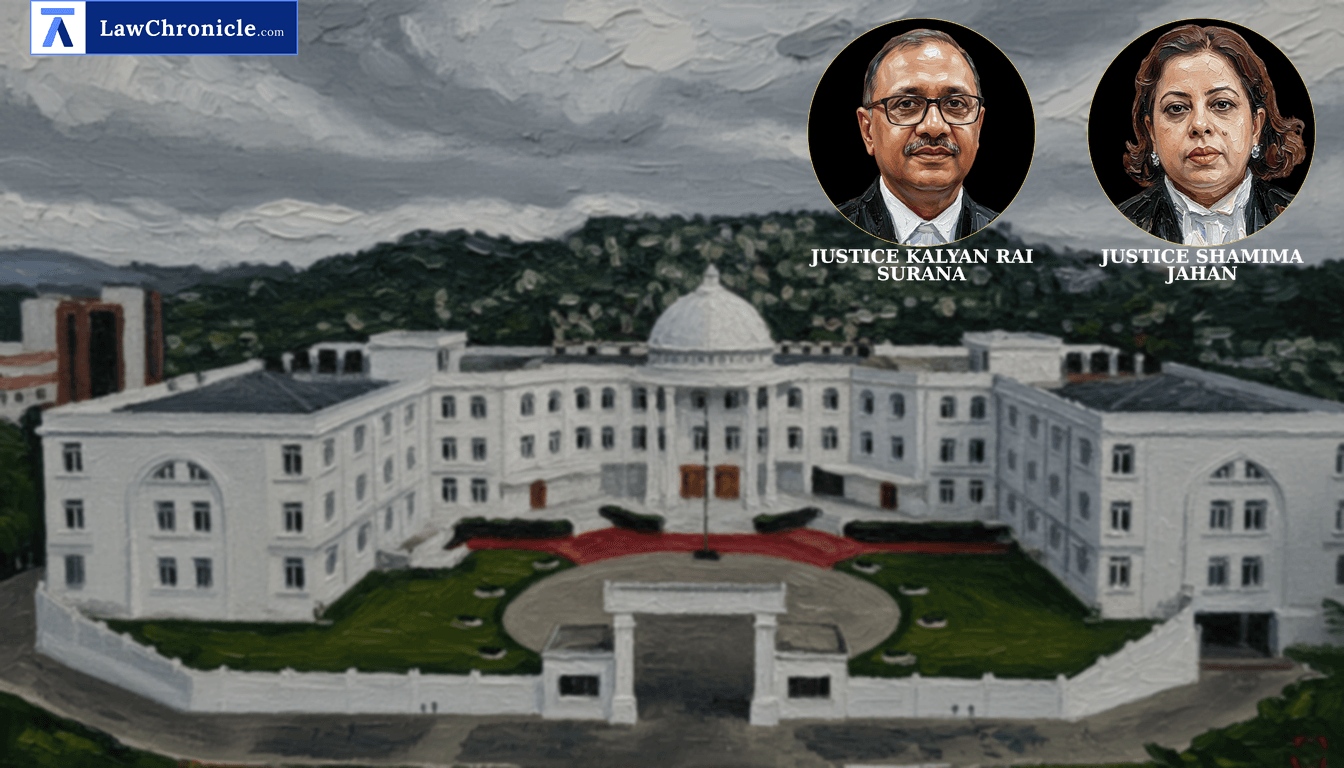
In a decisive reinforcement of the evidentiary standards for citizenship claims, the Gauhati High Court has ruled that computer-generated National Register of Citizens (NRC) data and Election Photo Identity Cards (EPIC) are insufficient to discharge the burden of proof under the Foreigners Act, 1946 without corroborating primary evidence. The judgment underscores that even oral testimonies of projected parents cannot substitute for a consistent documentary trail to establish a link with ancestors for proving Indian citizenship.
A Division Bench of Justice Kalyan Rai Surana and Justice Shamima Jahan adjudicated the matter, hearing a writ petition challenging a Foreigners Tribunal's opinion that had declared the petitioner a foreigner. The Court meticulously examined whether discrepancies in age and residency across different voter lists could be ignored while determining the legal status of an individual in Assam.
Admissibility of Digital Records and Burden of Proof
The Court dismissed the petitioner's reliance on computer-generated NRC extracts, citing that such documents lack evidentiary value unless supported by specific certifications. It noted that the burden remained squarely on the individual to provide an unbroken chain of documentation connecting them to ancestors present in India prior to the 1971 cutoff date.
The Court, in its reasoning, observed: "The NRC legacy data, besides being inadmissible evidence, is a computer generated statement and therefore, the provision of Sub- Section 65-B (4) of the Evidence Act, 1872 would be applicable... NRC extract produced to prove domicile in India is inadmissible in evidence. Moreover, the NRC of 1951 was prepared under the Census Act, 1948 and as per the provision of Section 15 of the said Act, the records of census are not open to inspection nor are they admissible in evidence."
The Court has the following directions:
"The Registry shall return back the learned Tribunal’s records along with a copy of this judgment and order, so that the learned Tribunal may make it a part of the record. The learned Standing Counsel for the respondents shall also transmit a downloaded copy of this order to the respective respondent authorities."
Background: Discrepancies in Linkage and Documentation
The dispute originated when the Deputy Commissioner of Police, Kamrup (M), referred the petitioner’s case to Foreigners Tribunal No. 4. The petitioner claimed citizenship through his father, Mohiruddin Sheikh, and grandfather, Pasan Ali, presenting various voter lists (1966 to 2017), a 1973 sale deed, and a school certificate. However, the Tribunal found significant age variations in the records specifically regarding the mother, Faziron Nessa and noted that the family had moved across three different villages (Dhobakura, Ghugudoba, and Hashdoba) without documented proof of relocation.
The High Court relied on Sirajul Hoque v. State of Assam & Ors. ( "(2019) 5 SCC 534": 2019 CaseBase(SC) 2048) and Abdul Matali v. Union of India & Ors. to affirm that while minor spelling errors in names may be overlooked if the family identity is established, the petitioner in this case failed to show a consistent presence of family members across the documents. Referring to Abdul Mojid @ Mojid Ali v. Union of India and Md. Babul Islam v. Union of India & Ors., the Court reiterated that PAN cards and EPICs are post-reference documents and do not constitute proof of citizenship. Furthermore, relying on Basiron Nessa v. Union of India & Ors., the bench held that the petitioner failed to show any "patent error" in the Tribunal's decision that would warrant interference under the extraordinary jurisdiction of Constitution of India.
Key Takeaways:
Strict Adherence to Section 65-B of Evidence Act
Printouts from official websites or computer-generated legacy data are not admissible unless they comply with the statutory requirements for electronic records.
Census Records Immunity Under Section 15
NRC data of 1951, being a product of the Census Act, 1948, remains protected from being used as evidence in judicial or quasi-judicial proceedings.
Limitations of Oral Testimony in Citizenship Cases
Oral evidence from a projected father is insufficient to prove citizenship if it is not supported by admissible and relevant documentary evidence showing a clear link to the ancestors.
Certiorari Jurisdiction Boundaries
High Courts will not act as appellate bodies to re-weigh evidence under Constitution of India unless the lower tribunal’s decision is based on a manifest error or ignorance of law.
Ratio Decidendi:
The core legal holding established is that the burden of proof under Section 9 of the Foreigners Act, 1946 is not discharged by presenting inconsistent voter lists or uncertified electronic records. Mere oral testimony or post-reference documents like PAN cards cannot establish a legal link to an ancestor when the documentary trail is interrupted by unexplained age variations and residency shifts.
Case Details:
Case No.: WP(C)/5471/2019
NeutralCitation: 2026:GAU-AS:9434
Case Title: Aminul Hoque v. The Union of India and 7 Ors.
Appearances:
For the Petitioner(s): Mr. M.U. Mahmud, Ms. F.N. Zaman, Mr. S. Islam, Ms. R. Ahmed, Advocates
For the Respondent(s): Mr. B. Deka, CGC; Mr. A.I. Ali, Standing Counsel; Mr. J. Payeng, Standing Counsel; Ms. R.B. Bora, Govt. Advocate
Source: 2026 CaseBase(GAU) 4
Similar Articles
 Breaking News