


Gujarat HC: No Injunction Relief for Parties Challenging 1971 Sale Deed After Decades
 Copy Link
 Share
 Save
The Gujarat High Court has shut the doors on litigants attempting to stall eviction through eleventh-hour injunctions, ruling that decades-long delays in challenging property titles disentitle parties from seeking discretionary relief under the Constitution of India. The court emphasized that clarifcatory orders from the Supreme Court in related proceedings cannot be weaponized to revive stale claims or obstruct the final stages of execution proceedings in property disputes.
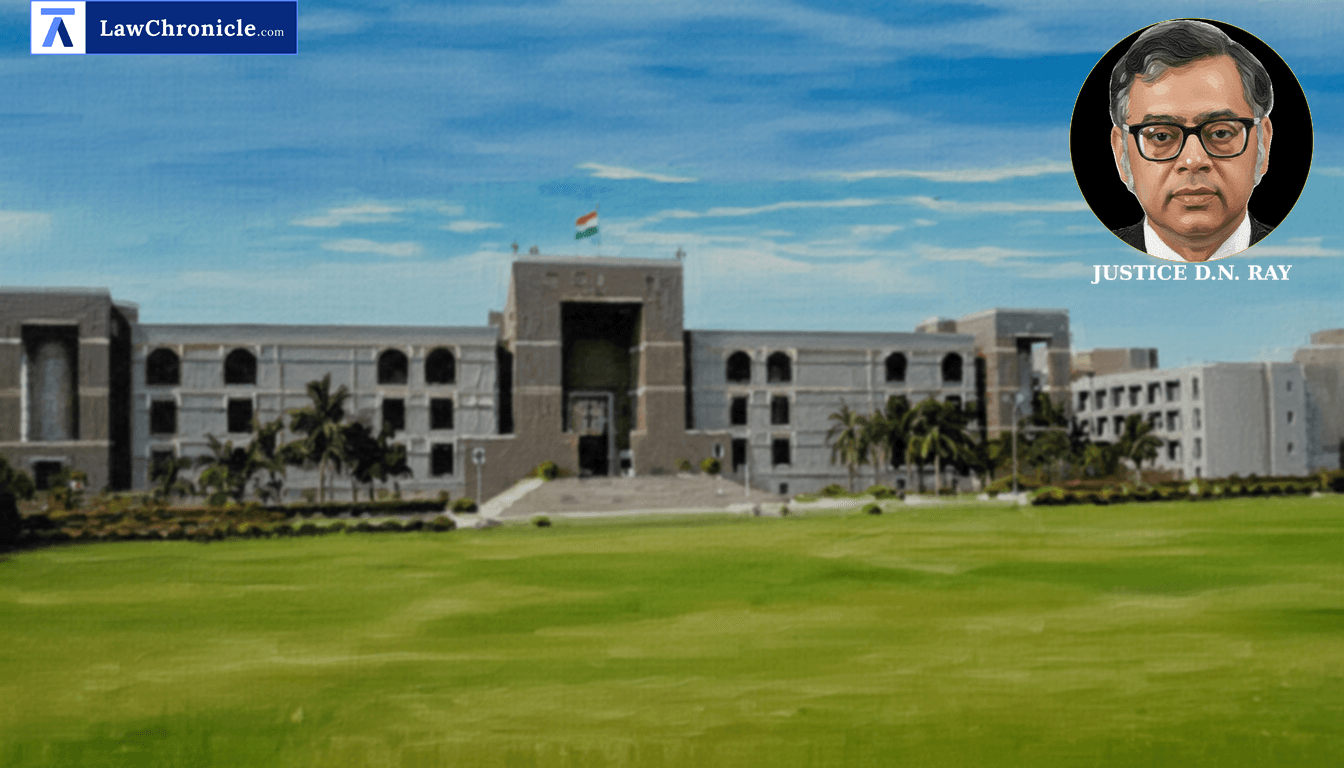
A Single Judge bench of Justice D.N. Ray heard the challenge against the rejection of an injunction application (Exh. 5) in a Regular Civil Appeal. The petitioners sought to stay a decree passed against them in a suit involving property rights and tenancy claims, primarily relying on subsequent clarifications issued by the Apex Court regarding the impact of its prior judgments on third parties.
Key Takeaways
Bar on Discretionary Relief for Laches
Litigants who fail to diligently prosecute their claims for over two decades lose their standing to seek equitable and discretionary remedies like stay of execution.
Limited Scope of Apex Court Clarifications
Clarificatory orders passed by the Supreme Court to protect non-parties are specific to the suits mentioned therein and cannot be broadly applied to different appellate proceedings.
Non-Interference Under Article 227
High Courts will not exercise supervisory jurisdiction to correct trial court findings unless there is an egregious error or a total failure of justice.
Court Observations on Laches and Judicial Conduct
The Court observed that the petitioners had failed for more than twenty years to effectively challenge the 1971 sale deed. Even after the restoration of their original suit from 1995, they had not served summons on the respondents. The bench noted that the execution of the decree had reached a final stage, making it inappropriate to grant a stay at this juncture.
The Court, in its reasoning, observed: "...the petitioners are not entitled for any discretionary relief where the execution itself is at a final stage. Further, within the limited scope of interference under Article 227 of the Constitution of India, particularly, where no egregious error/circumstances warranting interference have been shown by the petitioners herein, the present petition lacks merits..."
Regarding the petitioners' reliance on Civil Appeal Nos. 14140-14141 of 2024 and its subsequent clarification, the Court held that the Supreme Court's direction that the civil suit be decided on its own merits without being influenced by its judgment was specifically intended for the suit mentioned in that order, and did not impact the current appeal which was a continuation of a different civil suit.
Ratio
The High Court held that discretionary relief under the supervisory jurisdiction of the High Court cannot be granted to a party that has displayed gross negligence or delay (laches) in pursuing its legal remedies, especially when such relief is sought to stall the execution of a decree that has reached finality. Furthermore, a clarification by the Supreme Court regarding the non-binding nature of its observations on third parties applies strictly to the litigation specified in that clarification.
Background
The dispute originated from a challenge to an order rejecting an injunction in Regular Civil Appeal No. 73 of 2025. The petitioners claimed ownership of certain land through ancestral devolution and challenged a suit filed under the Bombay Rent Act, asserting they were owners and occupants rather than tenants. However, a sale deed dated 24.06.1971 existed in favor of the respondent. While the petitioners had filed Civil Suit No. 188 of 1995 to challenge this sale deed, that suit had remained at a nascent stage for 31 years.
The Trial Court had decreed the suit against the petitioners, partly relying on observations in Civil Appeal Nos. 14140-14141 of 2024. Although the Supreme Court later clarified in its order dated 20.07.2026 that Civil Appeal Nos. 14140-14141 of 2024 should not influence the "civil suit, if any, filed by the applicants," the High Court found that this clarification did not save the petitioners' current appeal. The Court concluded that the petitioners were attempting to use the clarification to bypass their own failure to prosecute their 1995 suit diligently.
Case Details:
Case No.: R/SPECIAL CIVIL APPLICATION NO. 16955 of 2025
Neutral Citation: 2026:GUJHC:69862
Case Title: Heirs Of Deceased Jayantibhai Kalubhai Bharvad & Ors. Versus M/S Himanshu Textile And Manufacturing Co. A Partnership Firm & Ors.
Appearances:
For the Petitioner(s): Ms Jaikriti Sinh S. Jadeja, Advocate For Mr Samir Afzal Khan; Mr Tattvam K Patel
For the Respondent(s): Mr Shalin Mehta, Senior Counsel With Ms Yukta Sumara; Mr Siddharth R Kheskani; Mr Harsh N Parekh; Priyal M Parikh
Source: 2026 CaseBase(GUJ) 31976
Similar Articles
 Breaking News


