


Gujarat HC Upholds Acquittal in Suicide Case, Clarifies Bar for Section 306
 Copy Link
 Share
 Save
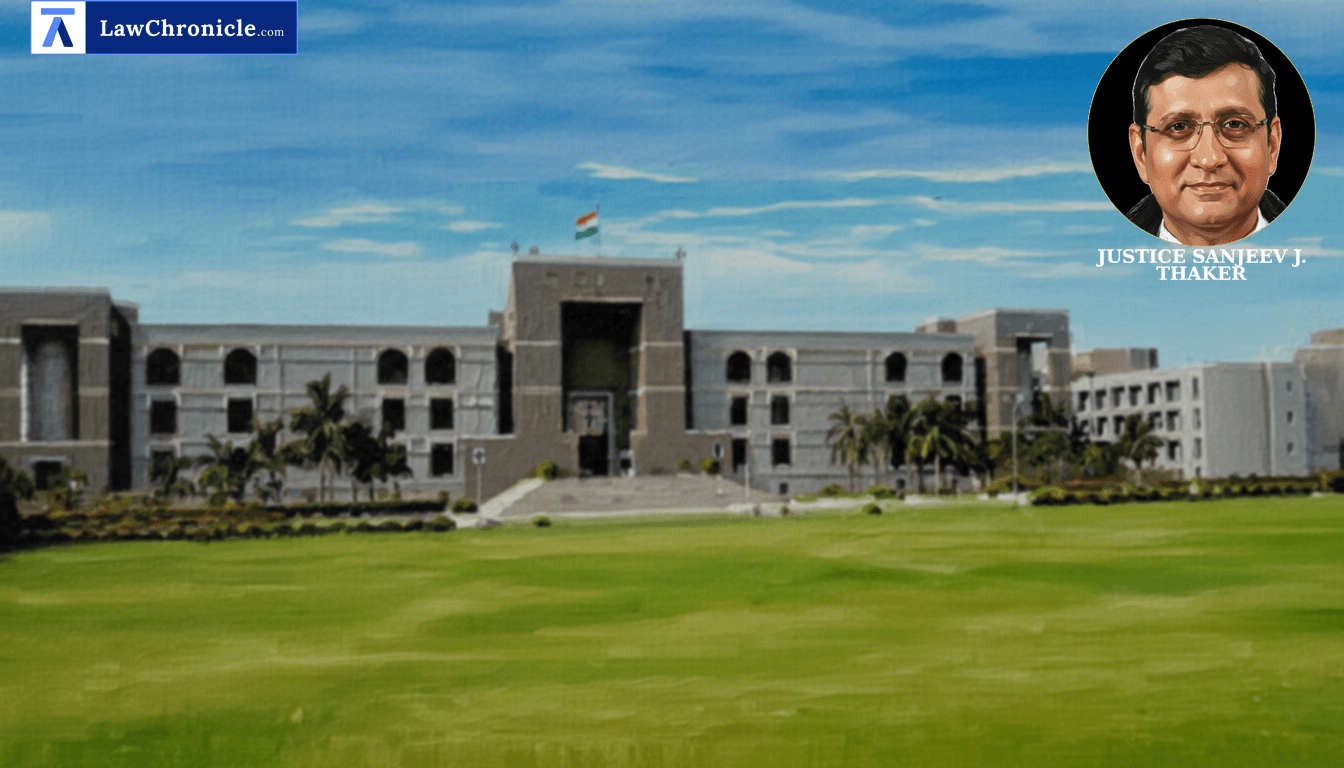
A bench of Honourable Mr. Justice Sanjeev J. Thaker heard an appeal under Section 378 of the Code of Criminal Procedure, 1973, challenging the order of acquittal in a Sessions trial that arose from allegations framed under Sections 498(A), 306, and 114 of the Indian Penal Code, 1860. The appeal contested the trial Judge's finding that the prosecution had not proved abetment of suicide beyond a reasonable doubt.
The Court summarised its holding by endorsing the trial Court's approach and dismissed the appeal, observing that the prosecution had not established the necessary proximate conduct or motive to sustain a conviction under Section 306 of the Indian Penal Code, 1860. The Court, in its reasoning, observed: "The evidence on record and the glaring omission on the prosecution as pointed out above leaves no room of doubt that the order passed by the trial Court is as per law. The trial Court has rightly held that there was no positive evidence on record to prove that the accused by way of the conduct or spoken words, overtly or covertly, actually aided and abetted or instigated the deceased in such a manner that it leaves no other option for the deceased but to commit suicide. In the present case, the prosecution has also not been able to prove the clear motive of the accused to commit offence of abatement. There is also no close connection between the accused’s action and the deceased’s choice to commit suicide. In view of the said fact, the prosecution has not been able to prove that the accused have stimulated the deceased to commit suicide." The judgment also noted that "Therefore, read as a whole, it can be said that mere occurrence of a suicide does not automatically trigger rigours of the Section" and emphasised that "Abetment, as understood in criminal jurisprudence, is not a broad moral expression but a term of precise statutory meaning." The Court therefore held that the ingredients of Section 306 of the Indian Penal Code, 1860 were not made out on the material before it.
Background
The appeal arose from Sessions Case No.69 of 2007 in which the deceased was alleged to have set herself on fire after repeated harassment, and the accused were charged under Sections 498(A), 306 and 114 of the Indian Penal Code, 1860. The prosecution examined nine witnesses and produced documentary evidence including postmortem notes, inquest panchnama and FSL reports, but the Court recorded significant omissions in investigation: no dying declaration was recorded, the treating doctor for the deceased was not examined and medical records of the deceased's treatment were not produced. The trial Court had acquitted the accused on the ground that there was no proximate positive act or instigation by the accused that could be fairly said to have driven the deceased to suicide. On appeal the State argued that contradictions should not have led to acquittal and that the cumulative evidence established abetment, but the High Court found no basis to displace the trial Court's conclusion.
In explaining the legal approach the Court relied on precedent authorities as follows: it followed the test of instigation and requirement of active role explained in Mahendra K.C. v. State of Karnataka and another ( "(2022) 2 SCC 129": 2021 CaseBase(SC) 811) and supplemented that reasoning with the articulation in Mahendra Awase v. State of Madhya Pradesh that abetment requires active conduct proximate to the act of suicide. The Court referred to Amalendu Pal alias Jhantu versus State of West Bengal ( "(2010) 1 SCC 707": 2009 CaseBase(SC) 286) and Rajesh v. State of Haryana ( "(2020) 15 SCC 359": 2019 CaseBase(SC) 1134) for the proposition that mere harassment without a proximate positive act is insufficient to sustain Section 306. The judgment noted the emphasis in Amudha v. State ( "2024 INSC 244": 2024 CaseBase(SC) 456) on proximate conduct, and relied on appellate standards discussed in State of Karnataka Vs. Hemareddy and Ram Kumar v. State of Haryana ( "AIR 1995 SC 280": 1995 CaseBase(PNH) 181) concerning deference to trial findings and scope of reappraisal. The High Court also cited Rajesh Singh & Others vs. State of Uttar Pradesh ( "(2011) 11 SCC 444": 2011 CaseBase(SC) 1057) and Bhaiyamiyan Alias Jardar Khan and Another vs. State of Madhya Pradesh on the limits of disturbing an acquittal and on evaluating reasons given by the trial Court, and followed the principles in Chandrappa v. State of Karnataka ( "(2007) 4 SCC 415": 2007 CaseBase(SC) 278) regarding the appellate court's powers. Finally, the Court took guidance from Constable 907 Surendra Singh and Another V/s State of Uttarakhand in underlining that interference with an acquittal is warranted only where the judgment is perverse or neglects material evidence.
Applying those principles to the evidence, the High Court concluded that the prosecution had not proved mens rea or proximate acts of instigation, and that no suicide note or direct statement admissible as a dying declaration had been obtained. The appeal was dismissed and records were remitted to the trial Court. No interim directions were issued and no liberty beyond the usual rights to seek review or appropriate remedies was granted.
Case Details:
Case No.: R/CRIMINAL APPEAL NO. 2164 of 2008
NeutralCitation: 2026:GUJHC:28599
Case Title: STATE OF GUJARAT Versus GIRJABEN HIRALAL BUDDHSING PRAJAPATI & ORS.
Appearances:
For the Petitioner(s): MS MEGHA CHITALIYA, APP
For the Respondent(s): MS MOHINI J BHAVSAR
Source: 2026 CaseBase(GUJ) 219
Similar Articles
 Breaking News


