


Madras High Court allows refund of advance but refuses specific performance; modifies trial court's interest award
 Copy Link
 Share
 Save

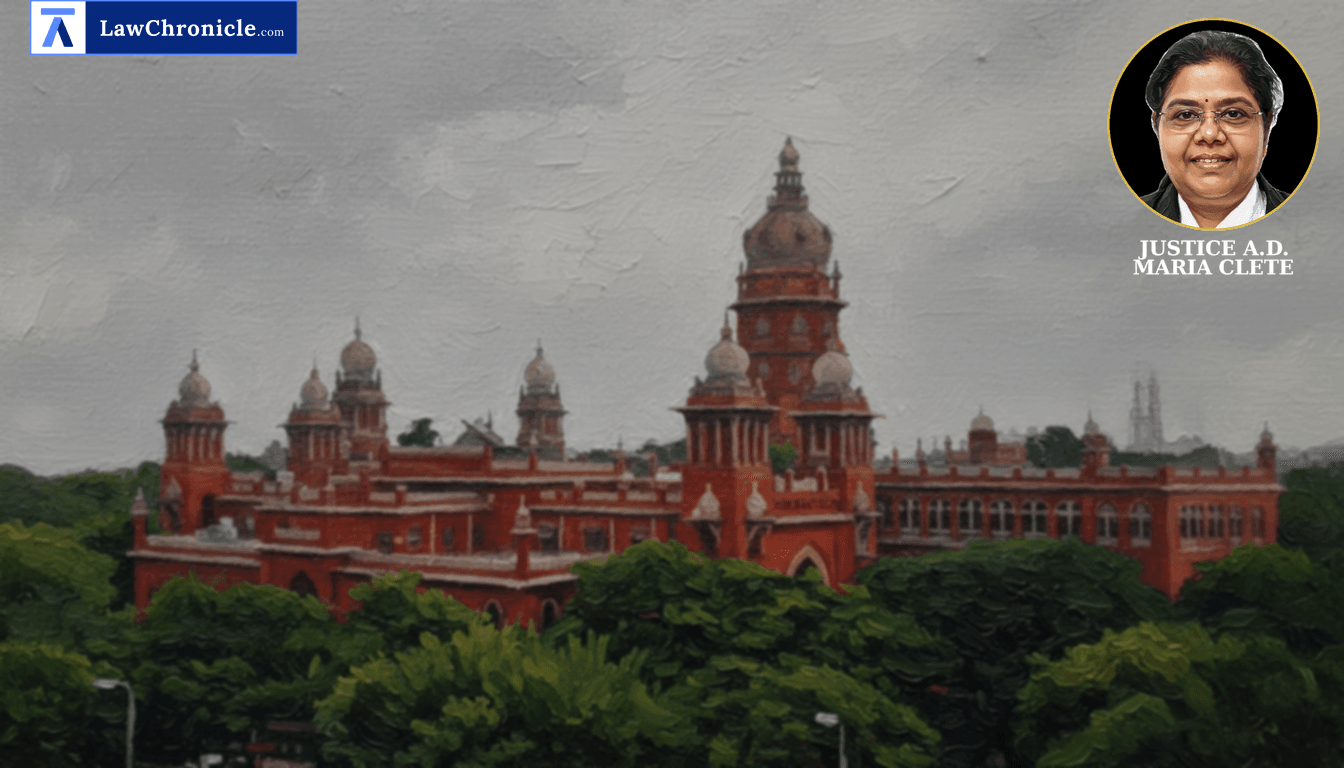
A Single Judge bench of Justice R. Sakthivel heard the first appeal challenging the judgment and decree dated January 24, 2020 of the Additional District and Sessions Court, Mayiladuthurai in O.S. No.27 of 2014 arising from a dispute over an alleged agreement for sale of immovable property and the claim for specific performance.
The Court held that the document marked Ex.A.1 was a genuine agreement for sale executed after receipt of Rs.3,00,000 as advance and that an unregistered agreement could be admitted in evidence in a suit for specific performance under the proviso to Section 49 of the Registration Act. However, the Court affirmed the Trial Court's finding that the plaintiff had not proved readiness and willingness to perform his part of the contract and therefore was not entitled to a decree for specific performance. The Court modified the Trial Court's order on alternative relief and directed refund of the advance with interest from the date of the plaint. The Court, in its reasoning, observed: "Under the circumstances, as per the proviso to Section 49 of the Registration Act, an unregistered document affecting immovable property and required by the Registration Act or the Transfer of Property Act to be registered, may be received as evidence of a contract in a suit for specific performance ... the unregistered agreement to sell in question shall be admissible in evidence in a suit for specific performance and the proviso is exception to the first part of Section 49." The Court therefore concluded that Ex.A.1 was a sale agreement in its true sense, but that the plaintiff had failed to prove readiness and willingness to perform his obligations.
Background:
The plaintiff-appellant K. Eswaran sued the defendants S. Janakiraman and S. Santhi for specific performance and permanent injunction, alleging that the first defendant agreed to sell a suit property for Rs.14,00,000 and accepted Rs.3,00,000 as advance under a Sale Agreement dated July 24, 2014, with time fixed for execution of sale deed within three months. The defendants contended that the transactions constituted loans and security—the first defendant had borrowed Rs.3,00,000 from the plaintiff and his father and the written instrument was executed only as security. At trial the plaintiff produced Ex-A.1 (agreement for sale), Ex-A.2 (pre-suit notice) and Ex-A.4 (reply to the notice), while the defendants relied on Ex-B.1 and other material including a Pokkiam (security) agreement and pleaded that the agreement was unregistered and therefore unenforceable as a contract for sale.
The Trial Court found that the document was executed as security for a loan of Rs.3,00,000 and dismissed the claim for specific performance, but granted alternative relief directing repayment of the loan with interest at 12% from the date of agreement till decree and 6% thereafter. On appeal the High Court examined (i) whether Ex.A.1 was in truth an agreement for sale or only security for loan, (ii) whether the plaintiff proved readiness and willingness to perform, and (iii) whether the Trial Court's decree required interference. The High Court held that Ex.A.1 was a sale agreement, observing that the defendants' own notice (Ex-B.1) acknowledged an offer to purchase and receipt of Rs.3,00,000; it relied on the proviso to Section 49 and recent authority to admit the unregistered agreement in evidence. The Court also held that, under Section 16(c) of the Specific Relief Act, the plaintiff had to plead and prove readiness and willingness and, in absence of bank books or statements, such readiness could not be inferred: "the readiness and willingness cannot be inferred." Consequently, specific performance was refused.
On the question of alternate relief, the High Court found the Trial Court erred in awarding interest from the date of the agreement when there was no agreed term; it modified the decree to direct repayment of Rs.3,00,000 with interest at 12% per annum from the date of the plaint until realisation. The appeal was therefore partly allowed; there was no order as to costs and the connected miscellaneous petition was closed. The judgment recorded that during proceedings the defendant had deposited the decree amount in Court.
Case Details:
Case No.: A.S. No.225 of 2021
Case Title: K. Eswaran v. S. Janakiraman & S. Santhi
Appearances:
For the Petitioner(s): Mr. P. Gopalan; Mr. J. Ram
For the Respondent(s): Mr. A. Muthukumar; (Respondent 2: Served – No appearance)
Similar Articles
 Breaking News


