


Absence of Express Enforcement Clause No Bar to Specific Performance: SC
 Copy Link
 Share
 Save
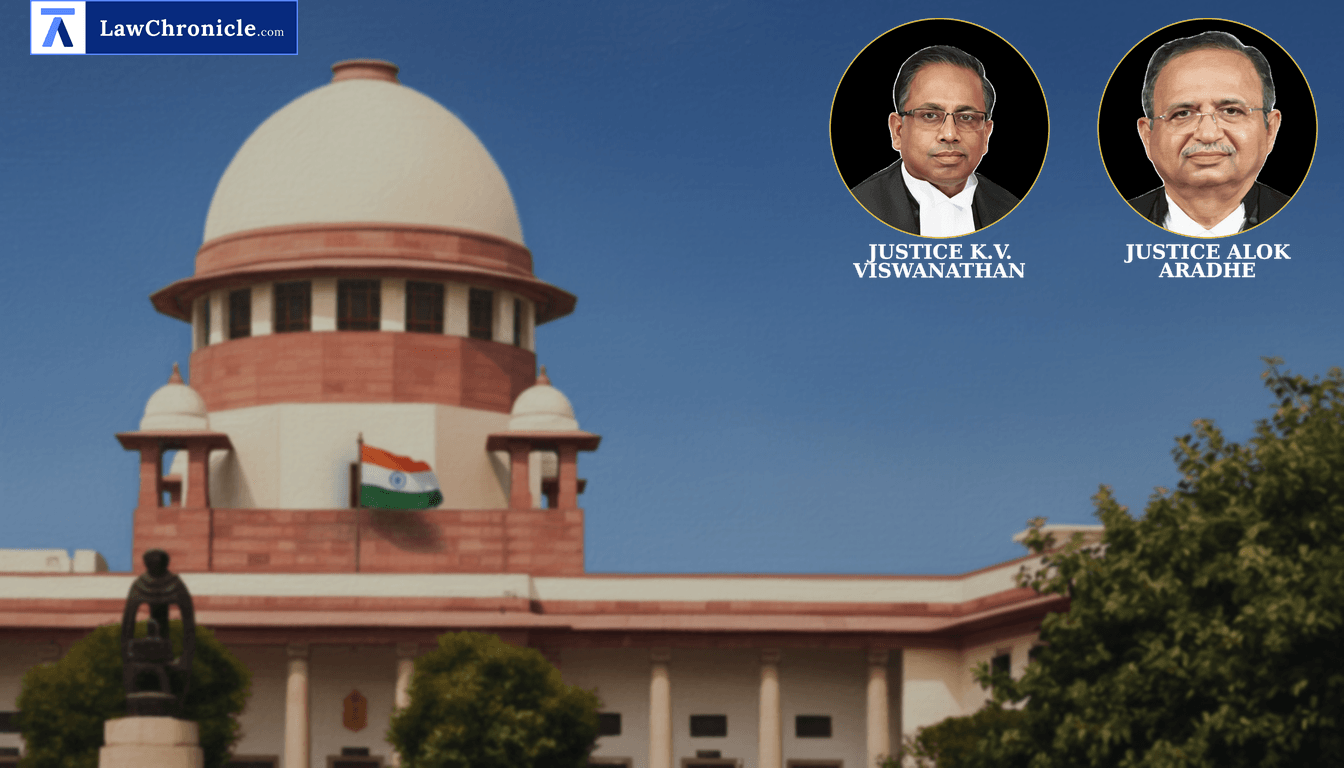
The Supreme Court has clarified that a contract for the sale of immovable property remains specifically enforceable even if it lacks an express clause for court intervention, provided the named sum for breach is intended to secure performance rather than offer an exit option.
In a decisive ruling, a bench of Justice K.V. Viswanathan and Justice Alok Aradhe set aside a High Court judgment that had erroneously characterized an earnest money refund clause as an alternative to performance, reinforcing the principle that specific performance is the rule in property transactions unless a clear 'option to walk away' is established.
The Enforcement of Specific Relief and Earnest Money
The dispute centered on whether the absence of a specific clause allowing a party to approach the court for execution barred the remedy of specific performance. The Court scrutinized an agreement where the respondent had agreed to sell his half-share in a property but later claimed the agreement was merely security for a travel arrangement. While the High Court viewed the refund of earnest money as the only available remedy, the Supreme Court disagreed.
The Court, in its reasoning, observed: "Section 23 of the Specific Relief Act, 1963, which re-enacts in more explicit terms, the principle earlier contained in Section 20 of the Specific Relief Act, 1877, provides that a contract otherwise proper to be specifically enforced may be so enforced notwithstanding that a sum is named in it as payable in the event of breach, unless the court is satisfied, having regard to the terms of the contract and the attending circumstances, that the sum was named only to give the defaulting party an option of paying money in lieu of performance and not merely to secure performance."
High Court Transgressed Limits of Second Appeal
The Supreme Court found that the High Court had improperly reappraised facts in a second appeal under Section 100 of the Code of Civil Procedure, 1908. Despite concurrent findings by lower courts regarding the genuineness of the agreement and the appellant's readiness and willingness, the High Court had entertained suspicions of fraud without finding any perversity in the lower courts' logic.
As part of its adjudication, the Court noted: "The findings on execution of the Agreement, on the appellant’s readiness and willingness, and on the falsity of the respondent's defence were pure findings of fact, unassailable in second appeal, and the High Court erred in reopening them without so much as characterising them as perverse."
The Court has the following directions:
"The judgment dated 08.02.2019 passed in RSA No. 3619 of 2012 (O&M) and Order dated 10.07.2019 passed in RA-RS No.87 of 2019 passed by the High Court are quashed and set aside. The judgment and decree dated 01.05.2012 passed by the First Appellate Court in C.A. No.0100204 of 2010 is restored."
Key Takeaways
Security for Performance vs. Option to Pay
Naming a sum for breach in a contract does not automatically defeat specific performance unless the contract explicitly grants the party an option to pay money instead of performing.
Transfer of Undivided Shares is Valid
A co-owner's undivided share is a legally recognized marketable subject of transfer, and agreements involving such shares are not inherently suspicious.
Limitations on Second Appeals
High Courts cannot interfere with concurrent findings of fact under Section 100 of Code of Civil Procedure, 1908 unless such findings are vitiated by perversity or lack of evidence.
Ratio
A contract for the transfer of immovable property is specifically enforceable under Section 23 of the Specific Relief Act, 1963 despite the naming of a penalty or liquidated damages, unless it is proven that the payment was intended as a substitute for performance. Furthermore, the High Court cannot disturb concurrent findings of fact in a second appeal absent a specific finding of perversity.
Background:
The appellant entered into an agreement to sell in 2003 for a property in Jalandhar, paying a substantial earnest money amount of Rs. 9,00,000. When the respondent failed to execute the sale deed, the appellant sued for specific performance. The Trial Court granted only a refund, but the First Appellate Court decreed specific performance. However, the High Court reversed this, citing the absence of an enforcement clause and the joint nature of the property. The Supreme Court relied on precedents like M.L. Devender Singh & Ors. v. Syed Khaja and Kamal Kant Jain v. Surinder Singh (Dead) Through LRs. to hold that naming damages does not bar specific performance. It also referenced Sitaram Motilal Kalal v. Santanuprasad Jaishankar Bhatt ( "AIR 1966 SC 1697": 1966 CaseBase(SC) 294) regarding the binding nature of signatures and Sidheshwar Mukherjee v. Bhubneshwar Prasad Narain Singh & Ors. ( "AIR 1953 SC 487": 1953 CaseBase(SC) 98), M.V.S. Manikayala Rao v. M. Narasimhaswami & Ors., and Ramdas v. Sitabai & Ors. ( "(2009) 7 SCC 444: AIR 2009 SC 2735": 2009 CaseBase(SC) 923) to affirm the validity of transferring undivided shares. The Supreme Court ultimately allowed the appeal, restoring the decree for specific performance.
Case Details:
Case No.: CIVIL APPEAL NOS. 2448 - 2449 OF 2023
NeutralCitation: 2026 INSC 700
Case Title: Jaspal Singh V. Ashwani Kumar
Appearances:
For the Petitioner(s): Shri R.K. Kapoor, learned counsel
For the Respondent(s): Ms. Nina R. Nariman, learned counsel
Source: 2026 CaseBase(SC) 656
Similar Articles




 Breaking News


