


High Courts Cannot Modify One-Time Settlement Terms Under Article 226: Karnataka HC
 Copy Link
 Share
 Save
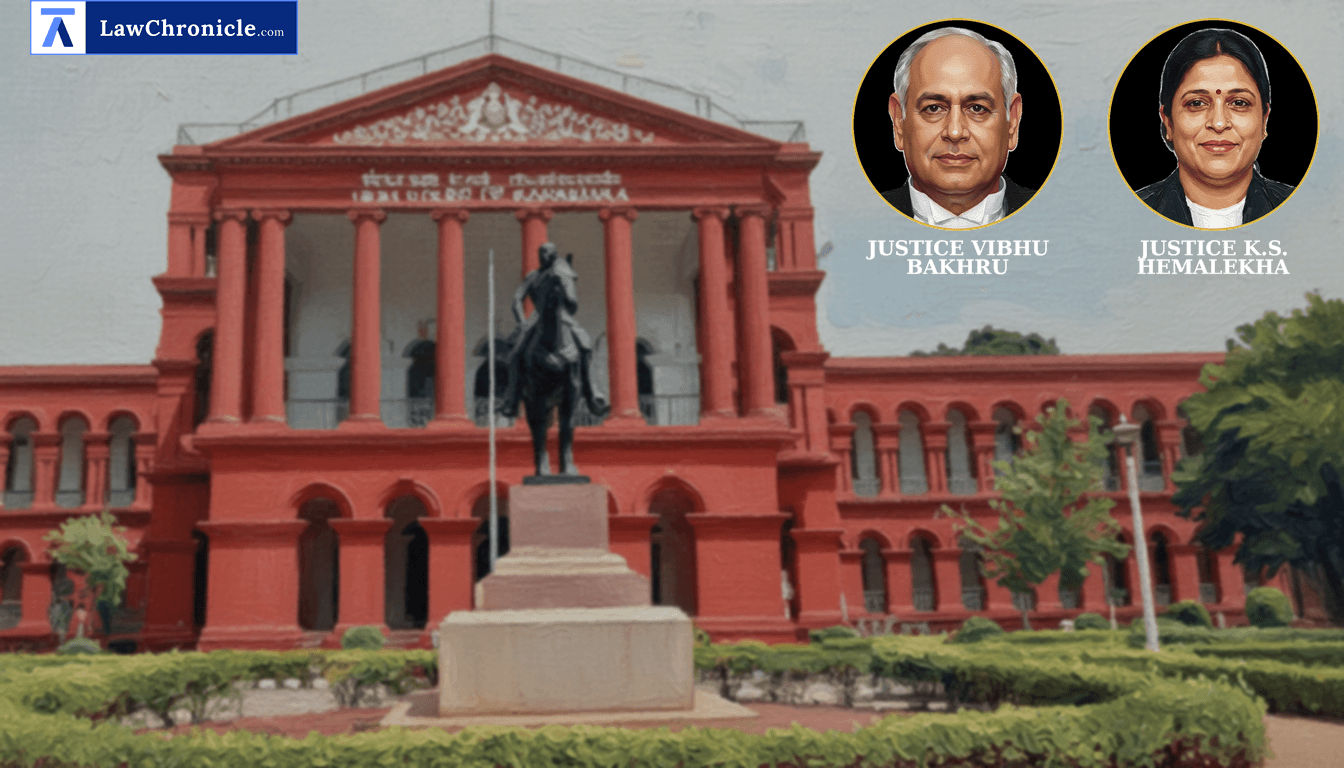
Reaffirming strict judicial discipline in banking recovery matters, the High Court of Karnataka has ruled that writ courts exercising jurisdiction under Article 226 cannot compel financial institutions to alter or accept delayed One-Time Settlement payments with interest. Reversing a Single Judge order, the Court underscored that High Courts must exercise self-restraint and avoid interfering with statutory recovery frameworks where efficacious alternate remedies exist.
A Division Bench comprising Chief Justice Vibhu Bakhru and Justice K.S. Hemalekha set aside an order that had effectively forced a bank to accept delayed settlement instalments beyond agreed timelines. Hearing an appeal by Canara Bank, the Bench highlighted that writ courts cannot substitute contract terms or bypass specialized statutory forums constituted for debt recovery dispute resolution.
High Court Restraint in Statutory Recovery Proceedings
The Court noted that the Securitisation And Reconstruction Of Financial Assets And Enforcement Of Security Interest Act, 2002 establishes a comprehensive and independent mechanism for addressing grievances arising from recovery proceedings. It observed that entertaining writ petitions against Section 14 orders, without extraordinary circumstances or statutory exceptions, directly undermines the legislative framework.
The Court, in its reasoning, observed: "In our view, while dealing with the petitions involving challenge to the action taken for recovery of the public dues, etc. the High Court must keep in mind that the legislations enacted by Parliament and State Legislatures for recovery of such dues are a code unto themselves inasmuch as they not only contain comprehensive procedure for recovery of the dues but also envisage constitution of quasi-judicial bodies for redressal of the grievance of any aggrieved person. Therefore, in all such cases, the High Court must insist that before availing remedy under Article 226 of the Constitution, a person must exhaust the remedies available under the relevant statute."
Reiterating the binding precedents in United Bank Of India vs. Satyawati Tondon ( "(2010) 8 SCC 110": 2010 CaseBase(SC) 387), South Indian Bank Limited and Others vs. Naveen Mathew Philip and Another, and PHR Invent Educational Society vs. UCO Bank and Others ( "(2024) 6 SCC 579": 2024 CaseBase(SC) 62), the Bench held that extraordinary writ powers under Article 226 of the Constitution of India, 1950 should not be invoked in commercial disputes between lenders and borrowers when effective statutory remedies are readily available.
Court's Stance on Modification of Settlement Terms
Addressing the substantive issue regarding the settlement, the Bench stressed that courts cannot rewrite contracts or force a bank to keep an compromised offer alive indefinitely when a borrower fails to adhere to timelines. The Court observed that if an offer is not paid within the stipulated or agreed period, the lender retains the absolute right to terminate the compromise arrangement.
The Court has following directions:
"32. In view of the above, the impugned order is set aside.
- We clarify that this judgment will not preclude the parties from availing their remedies, including in respect of the OTS proposal. All rights and contentions of the parties are reserved.
- The appeal is allowed in the aforesaid terms."
Key Takeaways
- No Rewriting of OTS Contracts: High Courts cannot modify the terms of an One-Time Settlement or force banks to accept belated payments by imposing interest.
- Strict Adherence to Statutory Remedies: Borrowers challenging Section 14 measures under the Securitisation And Reconstruction Of Financial Assets And Enforcement Of Security Interest Act, 2002 must approach the Debts Recovery Tribunal under Section 17 rather than filing writ petitions under Article 226.
- Bank's Right to Cancel OTS: Failure to comply with agreed payment schedules gives financial institutions the unfettered right to terminate compromise arrangements.
- Limited Scope of Judicial Review: Factual disputes concerning officer authorization and contract validity cannot be summarily decided in writ proceedings.
Ratio
Writ courts under Article 226 of the Constitution of India, 1950 cannot modify contractual terms of a One-Time Settlement scheme, nor can they compel a financial institution to accept delayed payments with interest. Furthermore, High Courts must exercise self-restraint and decline writ petitions challenging Securitisation And Reconstruction Of Financial Assets And Enforcement Of Security Interest Act, 2002 proceedings when effective alternate statutory remedies under Section 17 are available, unless exceptional circumstances exist.
Background:
The dispute arose after respondents availed OCC and OD loans amounting to Rs. 75 lakh from Canara Bank, securing the facilities by mortgaging land in Bengaluru. Following repayment defaults, the Bank classified the account as a Non-Performing Asset (NPA) on May 30, 2019, and issued a demand notice under Section 13(2) of the Securitisation And Reconstruction Of Financial Assets And Enforcement Of Security Interest Act, 2002. Subsequent non-payment led to symbolic possession under Section 13(4) and an order dated March 13, 2020, by the Chief Judicial Magistrate under Section 14, appointing an Advocate Commissioner to take physical possession.
The respondents challenged the Section 14 order before a Single Judge of the High Court, asserting that they had secured an OTS for Rs. 58 lakh and made partial payments. The Bank opposed the petition, contending that the branch official who acknowledged the proposal lacked authority to grant an OTS, no formal sanction was issued, and the borrower failed to adhere to payment schedules. Nevertheless, the Single Judge directed the Bank to accept the OTS amount along with 12% interest per annum on delayed payments and restrained further recovery actions.
In appeal, the Division Bench found that the Single Judge erred by bypassing the statutory remedy under Section 17 of the Securitisation And Reconstruction Of Financial Assets And Enforcement Of Security Interest Act, 2002, as the case did not fall under any recognized exceptions articulated in PHR Invent Educational Society vs. UCO Bank and Others ( "(2024) 6 SCC 579": 2024 CaseBase(SC) 62). It further held that the Single Judge effectively imposed a modified contract on the Bank. Consequently, the High Court allowed the appeal and set aside the impugned order, while reserving liberty for parties to pursue appropriate statutory remedies.
Case Details:
Case No.: WRIT APPEAL NO.1948 OF 2025 (GM-RES)
Case Title: CANARA BANK v. M/S. SLN HOLLOW BLOCKS AND EARTH MOVERS AND ANR.
Appearances:
For the Petitioner(s): Sri Vikram Unni Rajagopal, Advocate
For the Respondent(s): Sri Prakash T, Advocate
Source: 2026 CaseBase(KAR) 4895
Similar Articles

 Breaking News


