


Illegitimacy Allegations Require High Standard Of Proof, Not Summary Findings: Allahabad HC
 Copy Link
 Share
 Save
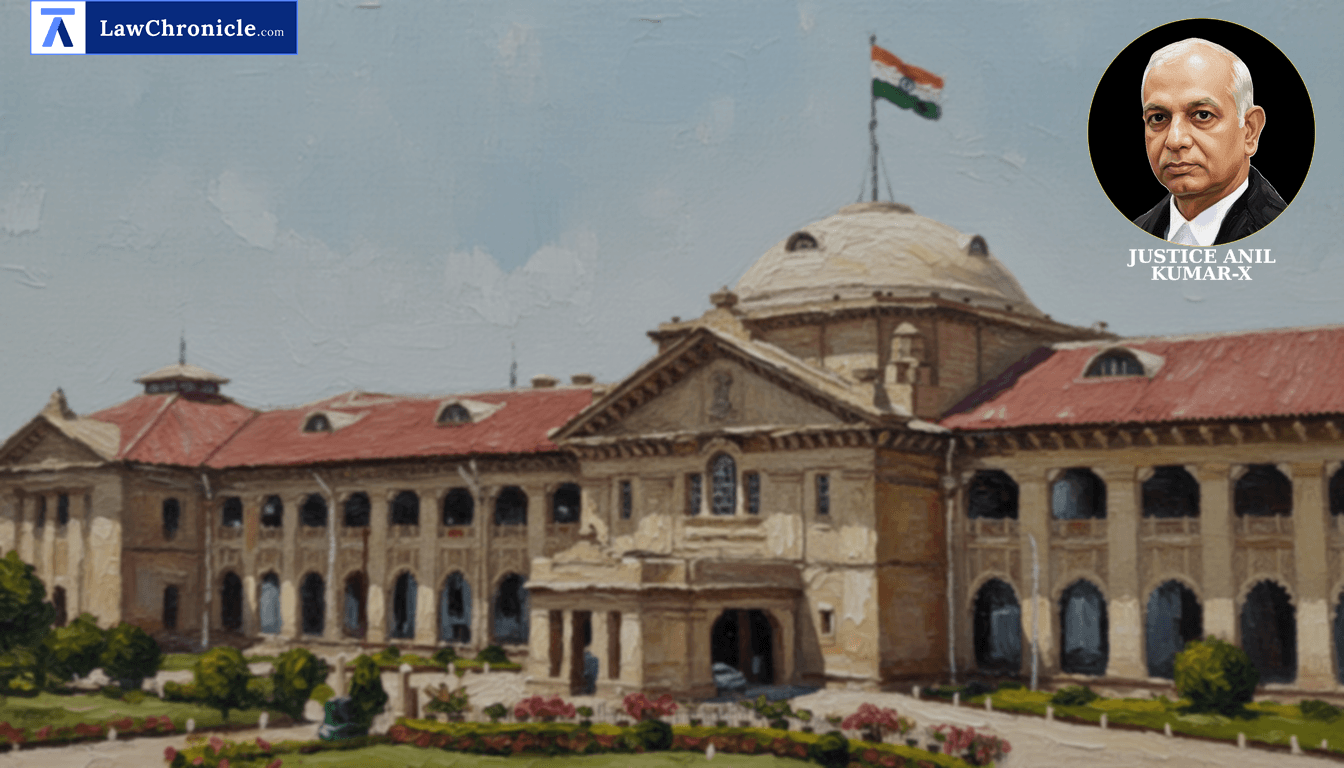
The Allahabad High Court has fortified the legal sanctity of matrimonial status and legitimacy, ruling that summary findings in maintenance proceedings cannot displace formal civil status or proprietary rights. The Bench held that a Brahmin widow does not lose her legal character merely due to allegations of a subsequent relationship, nor can the statutory presumption of legitimacy be upended by bald assertions of concubinage.
Deciding a decades-old dispute over succession and legal character, a Bench of Justice Anil Kumar-X set aside a trial court decree that had barred a woman of her status as a widow and declared her children illegitimate. The Allahabad High Court emphasized that civil courts must independently adjudicate status based on cogent evidence rather than relying on summary findings from criminal proceedings.
Key Takeaways
Primacy of Statutory Presumptions
Legitimacy of children born during a valid marriage is protected by a heavy statutory burden that cannot be displaced by mere allegations of illicit relationships.
Limited Scope of Summary Orders
Findings recorded in maintenance proceedings under the Code of Criminal Procedure are for limited purposes and do not operate as res judicata in regular civil suits concerning title or status.
Indefeasibility of Widowhood Status
Once a valid marriage and the death of a spouse are admitted, the legal status of a widow is established and cannot be extinguished by subsequent personal conduct or social belief.
Strict Adherence to Specific Relief Act
Plaintiffs seeking declarations of status must also pray for necessary consequential reliefs, such as challenging mutation entries, to satisfy the requirements of Specific Relief Act, 1963.
Evidentiary Inadequacy in Challenging Legitimacy
The Allahabad High Court observed that the plaintiff failed to adduce the quality of evidence required to dislodge established legal statuses. It noted that the plaintiff admitted the marriage of the first defendant and the death of her husband, which logically concluded her status as a widow. The Bench remarked that "The status of widow is a legal status arising from marriage and the death of the husband. It cannot be extinguished merely because an individual or even society chooses, according to personal belief, conduct or convenience, not to recognise such status."
Regarding the legitimacy of the children, the Allahabad High Court invoked Section 112 of the Indian Evidence Act, 1872, noting that the plaintiff failed to prove non-access between the mother and the alleged father at the relevant time. The Bench further clarified that "An allegation of illegitimacy is a serious allegation carrying legal and social consequences. It cannot be established merely by suspicion, allegation or proof of an alleged relationship of the mother with another person."
Inadmissibility of Criminal Court Findings in Civil Status Suits
The Allahabad High Court criticized the trial court's heavy reliance on a 1963 order passed under Section 488 of the Code of Criminal Procedure. It clarified that such proceedings are summary in nature and do not fall under the jurisdictions contemplated by Section 41 of the Indian Evidence Act, 1872 for judgments in rem. The Allahabad High Court held that "A proceeding under Section 488 Cr.P.C. does not fall within any of the jurisdictions contemplated by Section 41. Its determination, therefore, cannot be treated as conclusive proof of the legal status... in the present civil proceedings."
The Bench accordingly allowed the appeal and set aside the judgment and decree passed by the Trial Court, dismissing the suit filed by the respondent.
Ratio
A declaration of 'legal character' under Section 34 of the Specific Relief Act, 1963 cannot be granted in isolation from necessary consequential reliefs. Furthermore, the legal status of widowhood and the statutory presumption of legitimacy under Section 112 of the Indian Evidence Act, 1872 constitute binding legal conditions that can only be displaced by establishing legally recognized facts through cogent evidence in a civil court, independent of summary findings recorded by criminal courts in maintenance proceedings.
Background
The dispute originated from Original Suit No. 491 of 1988, where the plaintiff, Harishankar Pandey, sought to declare that Rajeshwari Devi was not the widow of Vindhyachal Pandey and that her sons were illegitimate. The plaintiff claimed that following Vindhyachal's death in 1938, Rajeshwari entered into a relationship with Ram Awadh Pandey (the plaintiff's father), thereby losing her status and rendering her children illegitimate legal heirs. The trial court had decreed the suit, relying on a 1963 maintenance case where it was observed that Ram Awadh had kept Rajeshwari as a concubine.
The appellants challenged this, arguing that the trial court ignored mutation entries and a prior compromise. They contended that findings under the Code of Criminal Procedure were not binding. The Allahabad High Court agreed, noting that Vimal Chand Ghevarchand Jain v. Ramakant Eknath Jajoo ( "(2009) 5 SCC 713": 2009 CaseBase(SC) 167) and Steel Authority of India Ltd. v. Union of India ( "(2006) 12 SCC 233": 2006 CaseBase(SC) 156) prohibit mutually destructive pleas, and Mahabir Jute Mills Ltd. v. Firm Kedarnath reinforces the definition of legal character as a person's individual status. Finding the evidence insufficient and the suit barred by the proviso to Section 34 of the Specific Relief Act, 1963, the Allahabad High Court set aside the decree.
Case Details:
Case No.: FIRST APPEAL No. - 91 of 2001
Case Title: Rajeshwari Devi And Others vs. Hari Shankar Pandey And Another
Appearances:
For the Petitioner(s): A.K.Ray, Anil Kumar Ray
For the Respondent(s): A.N.Bhargava, Giridhary Lal Choudhary, Rajesh Kumar Singh, S.B.Singh, S.K.Chaubey, S.P.Pandey, Vikas Upadhyay
Source: 2026 CaseBase(ALL) 1187
Similar Articles



 Breaking News


