


Industrial Tribunals Can Restrain Strikes Violating Statutory Curbs: Karnataka HC
 Copy Link
 Share
 Save
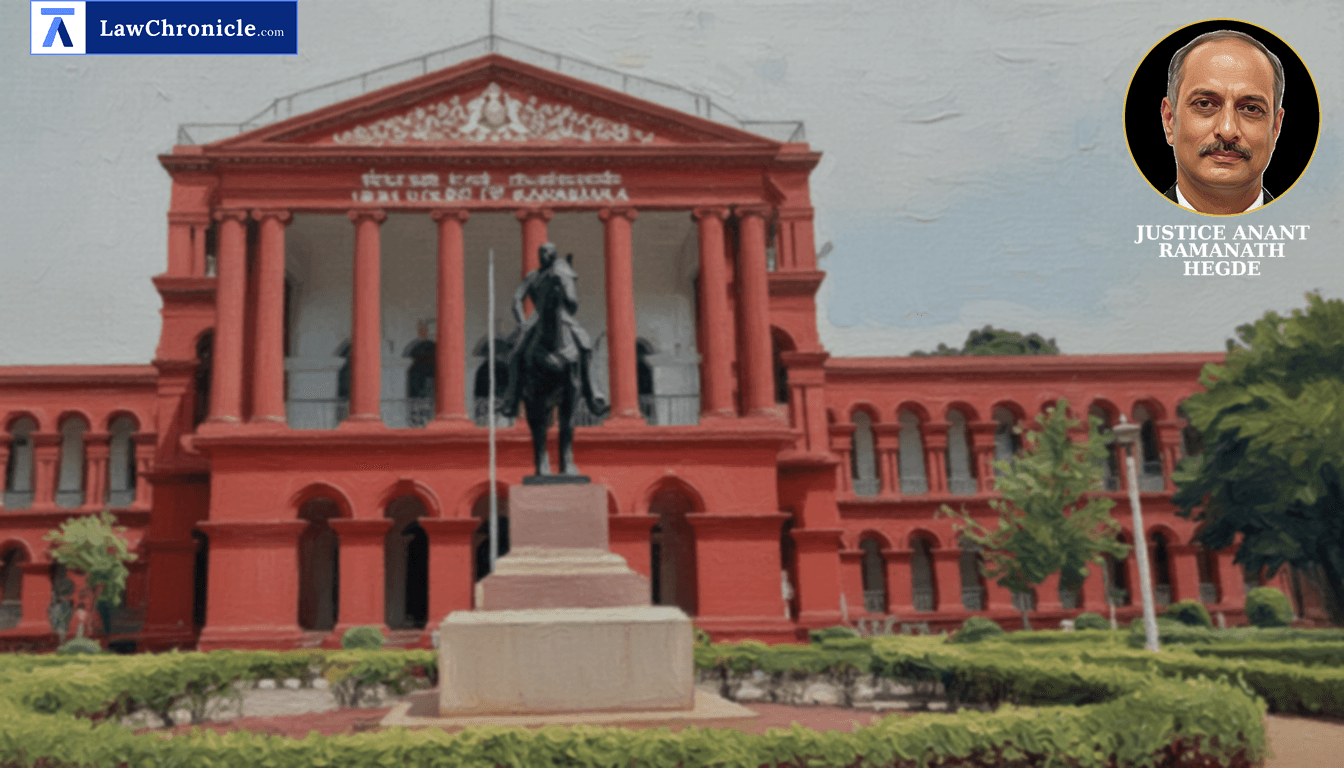
In a decisive clarification of labor laws, the Karnataka High Court has ruled that Industrial Tribunals possess the power to restrain illegal strikes during conciliation, closing a potential legislative vacuum in the new Industrial Relations Code, 2020 framework.
Justice Anant Ramanath Hegde, presiding as a single-judge bench, addressed the maintainability of writ petitions against workers' unions and the jurisdictional boundaries of statutory tribunals. The Court navigated the transition from the Industrial Disputes Act, 1947 to the Industrial Relations Code, 2020, specifically interpreting the enforcement of strike prohibitions.
Writ Not Maintainable Against Private Workers' Union
The petitioner, a private automotive electronics company, sought a writ of certiorari and mandamus to quash a strike notice and restrain the workers' union from proceeding with a strike during pending conciliation proceedings. The Court, however, declined to exercise its extraordinary jurisdiction under Article 226 of the Constitution of India.
Citing the precedent in S. Shobha Vs. Muthoot Finance Ltd. ( "2025 SCC OnLine SC 177": 2025 CaseBase(SC) 272), the bench observed that a body must discharge a public duty to be amenable to writ jurisdiction. The Court held that despite being recognized under the Industrial Relations Code, 2020, a workers' union does not partake the character of an instrumentality of the State.
The Court, in its reasoning, observed: "Applying the aforesaid test, it is evident that respondent No.2-Union does not qualify as a body discharging public duty or public function. Admittedly, the Union is neither the ‘State’ nor an instrumentality or agency of the State. It is neither a statutory authority nor a body substantially funded by the State. Nor is it a body required by statute to discharge any public function."
Tribunals Empowered to Enforce Strike Prohibitions
While dismissing the writ petition, the High Court identified a critical pathway for employers. It held that Section 97 of the Industrial Relations Code, 2020 expressly bars Civil Court jurisdiction, but Section 44 and Section 53 of the same Code empower the Industrial Tribunal to adjudicate the illegality of a strike even while conciliation is ongoing.
Addressing the Company's concern that Section 53(6) of the Code prevents approaching the Tribunal until conciliation fails, the Court applied a harmonious construction to prevent a "legislative gap." The Court held that for the limited purpose of enforcing the prohibition under Section 62(1)(d) of the Industrial Relations Code, 2020, an aggrieved party can move the Tribunal immediately.
Court Directions
The Court has the following directions:
"(i) The writ petition is dismissed as not maintainable.
(ii) Liberty is reserved to the petitioner to approach the competent Industrial Tribunal under the Industrial Relations Code, 2020, seeking such relief as may be available in law in respect of the alleged violation of Section 62(1)(d), provided the statutory prohibition under the said provision is still operative.
(iii) If such an application is filed, the Tribunal shall confine its adjudication to the question whether the proposed or continuing strike is in violation of Section 62(1)(d) of the Industrial Relations Code, 2020 and shall not adjudicate the merits of the strike notice or the substantive industrial dispute which is the subject matter of conciliation.
(iv) Any proceeding instituted before the Tribunal solely for enforcement of the prohibition under Section 62(1)(d) shall cease to survive upon expiry of the statutory period prescribed thereunder.
(v) Since respondent No.2-Union was restrained by an interim order of this Court from proceeding with the strike, the period during which the interim order remained in operation shall stand excluded while reckoning the period prescribed under Section 62 of the Industrial Relations Code, 2020.
(vi) All contentions of the parties relating to the merits of the substantive industrial dispute are kept open.
(vii) Pending interlocutory applications, if any, stand disposed of accordingly. "
Key Takeaways
No Writ Against Unions
Trade Unions are not 'State' under Constitution of India; hence, writs cannot be issued to restrain strikes unless a public duty is involved.
Tribunal's Emergency Powers
Industrial Tribunals can intervene during pendency of conciliation to stop strikes that violate Section 62 of the Industrial Relations Code, 2020, ensuring statutory prohibitions are not toothless.
Civil Court Bar Confirmed
Section 97 of the Industrial Relations Code, 2020 acts as a total bar on Civil Courts regarding industrial matters, including injunctions against strikes.
Interim Period Exclusion
Time spent litigating in a wrong forum (like a High Court via writ) under an interim stay can be excluded from the statutory notice period for a strike, following the principle in M/s Style (Dress Land) v. Union Territory, Chandigarh and Another.
Ratio
An Industrial Tribunal, being the specialized adjudicatory forum under Section 44(7)(c) of the Industrial Relations Code, 2020, has the jurisdiction to decide the 'illegality or otherwise of a strike' and can exercise limited jurisdiction to enforce the statutory prohibition contained in Section 62(1)(d) even during the pendency of conciliation proceedings, notwithstanding the general procedural bar under Section 53(6).
Background:
The dispute involved Bosch Automotive Electronics India Pvt Ltd and its employees' union regarding a charter of demands and a subsequent strike notice dated February 23, 2026. Conciliation proceedings commenced on March 3, 2026, but the Union intended to strike from March 9, 2026. The Company argued that Section 62(1)(d) of the Industrial Relations Code, 2020 prohibits strikes during conciliation and sought High Court intervention. The Court analyzed whether the Code provided a remedy. It concluded that while the High Court isn't the forum, the Industrial Tribunal (or existing Labour Courts under Industrial Disputes Act, 1947 per Section 104) is competent to provide relief.
Case Details:
Case No.: Writ Petition No. 8044 OF 2026 (L-RES)
Case Title: Bosch Automotive Electronics India Pvt Ltd. V. Addl. Labour Commissioner And Another
Appearances:
For the Petitioner(s): Sri. C.K. Subramanya, Advocate For Sri. B.C. Prabhakar, Advocate
For the Respondent(s): Sri. M. Rajakumar, Aga For R1; Smt. Maitreyi Krishnan, Advocate For R2
Source: 2026 CaseBase(KAR) 2626
Similar Articles

 Breaking News


