


Review Power Cannot Be Exercised To Rehear Or Substitute Views: Madras HC
 Copy Link
 Share
 Save
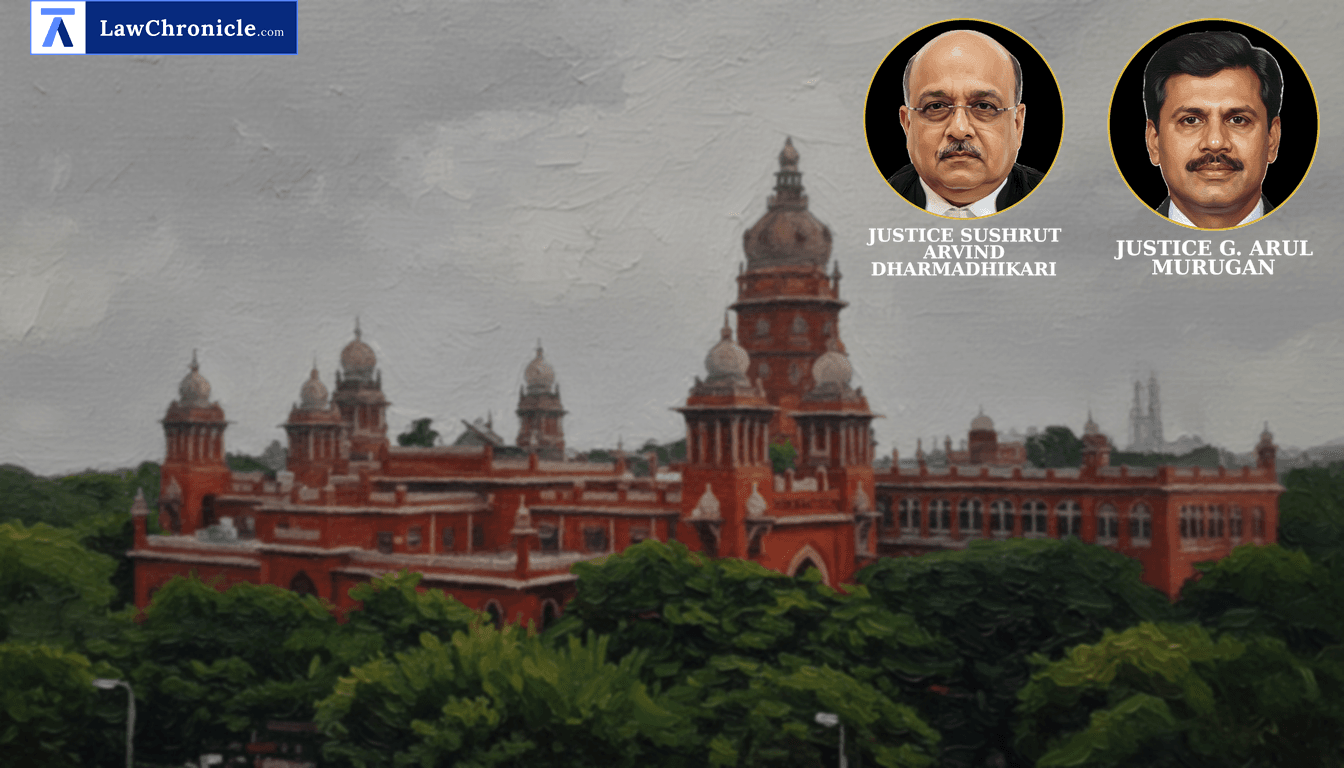
Refusing to re-examine an earlier order passed in a trade union jurisdiction dispute, the Madras High Court held that review jurisdiction cannot be invoked to rehear matters or substitute judicial views under the guise of correcting errors. The ruling reinforces strict limits on review proceedings where underlying civil disputes have already been validly transferred to industrial tribunals.
A Division Bench comprising Chief Justice Sushrut Arvind Dharmadhikari and Justice G. Arul Murugan declined to review or clarify a prior order passed under Section 114 read with Order 47 Rule 1 of the Civil Procedure Code and Article 226 of the Constitution of India in a matter concerning forum jurisdiction under the Industrial Relations Code, 2020.
Key Takeaways
Strict Limits on Review Jurisdiction: Review powers cannot be utilized as an appeal in disguise or to rehear concluded arguments.
No Interference with Transferred Matters: Where civil suits stand already transferred to an Industrial Tribunal via separate judicial orders, review proceedings will not disturb such transfers.
Questions of Law Kept Open: Jurisdictional and statutory interpretation issues under the Industrial Relations Code, 2020 remain open for determination in appropriate legal forums.
Court's Reasoning on Review Jurisdiction
The Madras High Court emphasized the well-settled principles governing review applications. The Court noted that the power of review is strictly circumscribed and cannot be converted into an appellate exercise.
The Court, in its reasoning, observed: "...the scope of review is very limited. It is well settled that the power of review can be exercised for the correction of a mistake, but not to substitute a view. The review court does not sit in appeal over its own order. A rehearing of the matter is impermissible. It constitutes an exception to the general rule that once a judgment is signed or pronounced, it should not be altered. An error which has to be established by a long-drawn process of reasoning on points where there may conceivably be two opinions can hardly be said to be an error apparent on the face of the record."
The Court has the following directions:
"Accordingly, the review application and W.M.P.No.25503 of 2026 seeking clarification are dismissed. It is made clear that all legal questions regarding jurisdiction and statutory interpretation under the Industrial Relations Code, 2020, remain open for adjudication in appropriate proceedings. There shall be no order as to costs. Consequently, W.M.P. No.25117 of 2026 stands closed."
Ratio
The power of review is strictly confined to correcting errors apparent on the face of the record and cannot be exercised to rehear a matter, substitute a judicial view, or sit in appeal over the court's own order, especially when parallel judicial orders transferring proceedings have already taken effect.
Background
The dispute arose out of a writ petition where third-party review applicants and the writ petitioner sought review and clarification of an order dated April 27, 2026. The review applicants contended that civil court jurisdiction over trade union disputes under Section 22 of the Industrial Relations Code, 2020 was not saved under Section 104(1A) of the Code, as civil courts do not function under repealed labour laws.
It was further highlighted that prior to the writ disposal, a learned Single Judge had already transferred the civil suits (O.S. No. 842 of 2026 and O.S. No. 5938 of 2025) from the XVI Assistant City Civil Court, Chennai, to the Industrial Tribunal, Chennai, where they were re-numbered as O.P. Nos. 10 and 11 of 2026.
Although arguments were advanced drawing upon Section 6 of the General Clauses Act, 1897 and transitional notifications under Section 103 of the Industrial Relations Code, 2020 to protect ongoing litigations, the High Court held that since the suits stood transferred pursuant to a binding judicial order in revision petitions, disturbing the writ order in review was inappropriate. Consequently, both the review application and the clarification petition were dismissed.
Case Details:
Case No.: Rev.Aplw.No.107 of 2026 and W.M.P.Nos.25117 and 25503 of 2026
Case Title: Metropolitan Transport Corporation Oozhiyar Munnetra Sangam v. D. Arumugam and Others
Appearances:
For the Petitioner(s): Mr. V. Prakash, Senior Counsel for Mr. S. Gokul
For the Respondent(s): Mr. K. Sudalai Kannu (for R1), Mr. AR.L. Sundaresan, Additional Solicitor General of India assisted by Mr. Kumaraguru, Senior Panel Counsel (for R2/Union of India), Mr. K. Kumaran, Addl Government Pleader (for R3)
Source: 2026 CaseBase(MAD) 8869
Similar Articles
 Breaking News


