


Infertility Treatment Proves Intent To Preserve Marriage; Not Cruelty: Madras HC
 Copy Link
 Share
 Save
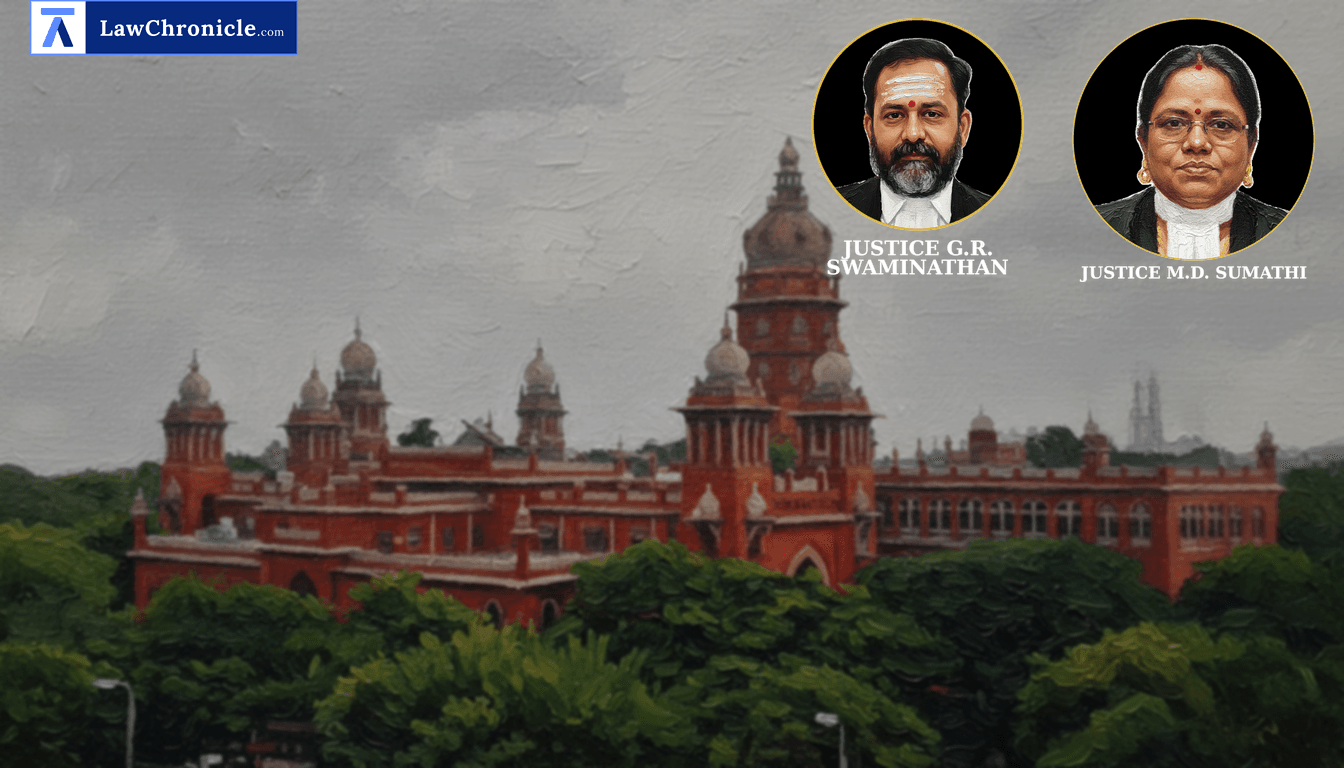
The Madras High Court has delivered a landmark empathetic ruling, declaring that a wife's willingness to undergo painful fertility treatments constitutes a definitive attempt to save a marriage, effectively shielding women from divorce petitions grounded in childlessness-related emotional strain. By elevating medical struggles above matrimonial fault, the bench has restricted the ability of spouses to weaponize the physical and emotional trauma of infertility as a ground for legal dissolution.
A bench of Justice G.R. Swaminathan and Justice M.D. Sumathi heard the appeal against a Family Court order that had dismissed a husband's plea for divorce. The Madras High Court examined whether the cumulative difficulties arising from a lack of conception and the subsequent medical journey could satisfy the legal threshold of cruelty required for a decree of divorce under the Hindu Marriage Act, 1955.
Key Takeaways
- Infertility Not a Matrimonial Fault
The inability to conceive cannot be converted into a legal ground for divorce, as marriage is not reduced to the sole object of procreation. - Medical Perseverance as Marital Intent
Willingness to undergo invasive assisted reproductive procedures is viewed as affirmative evidence of a spouse's desire to preserve the matrimonial bond. - Strict Proof for Allegations of Impotency
Serious allegations involving character assassination or accusations of impotency require high standards of independent corroboration and cannot be accepted on bald statements. - Emotional Strain Protection
Courts must distinguish between the ordinary emotional stress of medical difficulties and intentional matrimonial cruelty.
Judicial Protection of Women's Reproductive Journey
The Madras High Court emphasized that the physical and emotional burden of fertility treatment is borne disproportionately by women. The Court, in its reasoning, observed: "The woman has to place her own body through repeated injections, hormonal medication, scans, blood tests, medical procedures and, at times, painful and invasive treatment... a woman who repeatedly subjects herself to painful treatment in the hope of building a family with her husband cannot simultaneously be portrayed as a person who has abandoned the matrimonial bond."
The Madras High Court noted that the Family Courts Act, 1984 and the Hindu Marriage Act, 1955 require proof of a continuous course of conduct that makes living together impossible. In this case, the husband failed to prove his allegations of public humiliation and assault. The Court has following directions:
Ratio
Medical conditions such as childlessness and the resulting emotional strain from fertility treatments do not constitute matrimonial cruelty under Section 13(1)(ia) of the Hindu Marriage Act, 1955. Furthermore, a spouse's active participation in assisted reproductive procedures serves as evidence of an intention to maintain the marriage, negating allegations of desertion or cruelty. Separation due to medical disagreements, when one party remains willing to reunite, does not meet the threshold of irretrievable breakdown of marriage as a substitute for statutory cruelty.
Background
The parties were married in 2007. The husband filed for divorce alleging that the wife subjected him to mental cruelty, including making disparaging remarks about his family, suspecting his character, and calling him impotent in public. He specifically relied on an incident in 2016 where he claimed the wife assaulted him with footwear. The wife denied all allegations, contending that her objections were only regarding his drinking habits. She highlighted that she had undergone surgery for a fibroid growth and fertility treatments to save their marriage.
The Family Court at Theni dismissed the husband's petition, finding no independent corroboration for the alleged cruelty. The Madras High Court, while relying on the principles laid down in Samar Ghosh v. Jaya Ghosh ( "(2007) 4 SCC 511": 2006 CaseBase(SC) 1119), affirmed that matrimonial cruelty must be assessed based on the whole relationship. The Bench concluded that the husband was essentially trying to convert the unfortunate circumstance of childlessness into a matrimonial fault, which is legally impermissible.
Case Details:
Case No.: CMA(MD) NO. 724 of 2022
Neutral Citation: 2026:MHC:4039
Case Title: V.S.Ananda Raj v. A.Sridevi
Appearances:
For the Petitioner(s): Mr.R.Murali
For the Respondent(s): Mrs.S.Vaidurya
Source: 2026 CaseBase(MAD) 24844
Similar Articles

 Breaking News


