


Karnataka HC: Clever Drafting Cannot Revive a Barred Partition Suit
 Copy Link
 Share
 Save
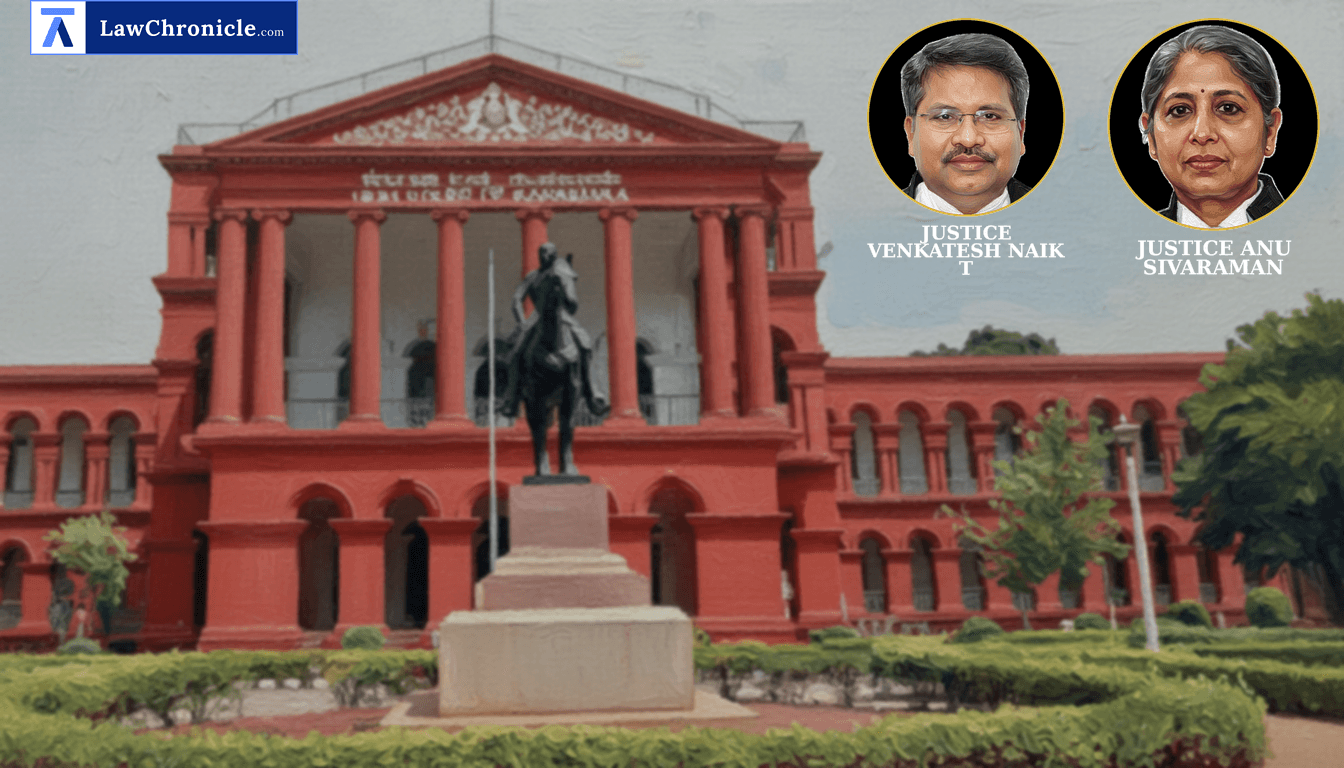
The Karnataka High Court dismissed a partition suit initiated 15 years after a registered family partition, clarifying that litigants cannot use 'clever drafting' to bypass the law of limitation or create an illusory cause of action.
A Division Bench comprising Justice Anu Sivaraman and Justice Venkatesh Naik T heard the regular first appeal challenging a trial court order that had rejected the plaint. The Bench emphasized that once a party has signed a registered document, a suit for partition cannot be maintained without specifically seeking the cancellation of such registered instruments within the prescribed period of limitation.
Failure to Challenge Registered Instruments
The Court observed that the plaintiffs had failed to pray for the cancellation of the registered partition deed dated 22.09.2010. Instead, they sought partition by treating the property as joint family property, despite having signed the partition and mortgage documents. The Bench noted that the suit was filed in 2025, long after the three-year limitation period prescribed under the Limitation Act, 1963 for challenging registered instruments.
Observations on Order VII Rule 11
While discussing the scope of Code of Civil Procedure, 1908, the Court relied on several precedents to reiterate that sham litigation must be dismissed at the threshold to save judicial time. The Court, in its reasoning, observed: "A perusal of the cause of action pleaded by the plaintiffs in the light of Order VII, Rule 11(a) of CPC, plaintiff No.1 was signatory/executant of the registered partition deed. He must have necessarily and specifically pray for cancellation of the deed or declaration that it is not binding upon him. In the absence of such relief, no cause of action is disclosed for a suit for partition."
The Court has the following directions:
"i. The appeal is dismissed.
ii. No order as to costs.
Pending interlocutory applications, if any, shall stand dismissed."
Background: The Family Dispute and SARFAESI Proceedings
The dispute centered on a property that was part of a Hindu Undivided Joint Family. In 1999, a release deed was executed, followed by a registered partition in 2010. The property was allotted to the mother (Defendant No. 2), who subsequently mortgaged it multiple times to The Bangalore City Co-operative Bank (Defendant No. 7) to secure loans. Plaintiff No. 1 had signed as a consenting witness to these mortgages.
In 2025, the property was sold to Defendant No. 1, who also mortgaged it. Upon default, the bank initiated proceedings under the Securitisation and Reconstruction of Financial Assets and Enforcement of Security Interest Act, 2002 and took physical possession. The plaintiffs then filed for partition, alleging the transactions were namesake and they were unaware of the nature of the documents they signed.
The Court referred to Dahiben v. Arvindbhai Kalyanji Bhanusali to explain the mandatory nature of Order VII Rule 11 of Code of Civil Procedure, 1908, stating that if a suit appears to be barred by limitation from the averments in the plaint, it must be rejected. It also relied on Uma Devi and Others v. Anand Kumar and Others and Sri Narasimha Murthy and Others v. Sri Mallesh and Others to highlight that registered documents are deemed to be within the knowledge of the executants and cannot be challenged after 45 years or long delays.
Case Details:
Case No.: RFA No. 315 of 2026
Case Title: SRI MANJUNATH C. M. AND ANOTHER v. SMT. RASHMI N. AND OTHERS
Appearances:
For the Petitioner(s): SRI P. NARAYANAPPA, ADVOCATE
For the Respondent(s): SRI K. VIJAYA KUMAR, ADVOCATE FOR R-1; SMT. H.R. UMADEVI, ADVOCATE FOR R-7
Source: 2026 CaseBase(KAR) 210
Similar Articles


 Breaking News


