


Karnataka High Court Rejects 20-Year-Old Partition Claim as 'Artful Pleading'
 Copy Link
 Share
 Save
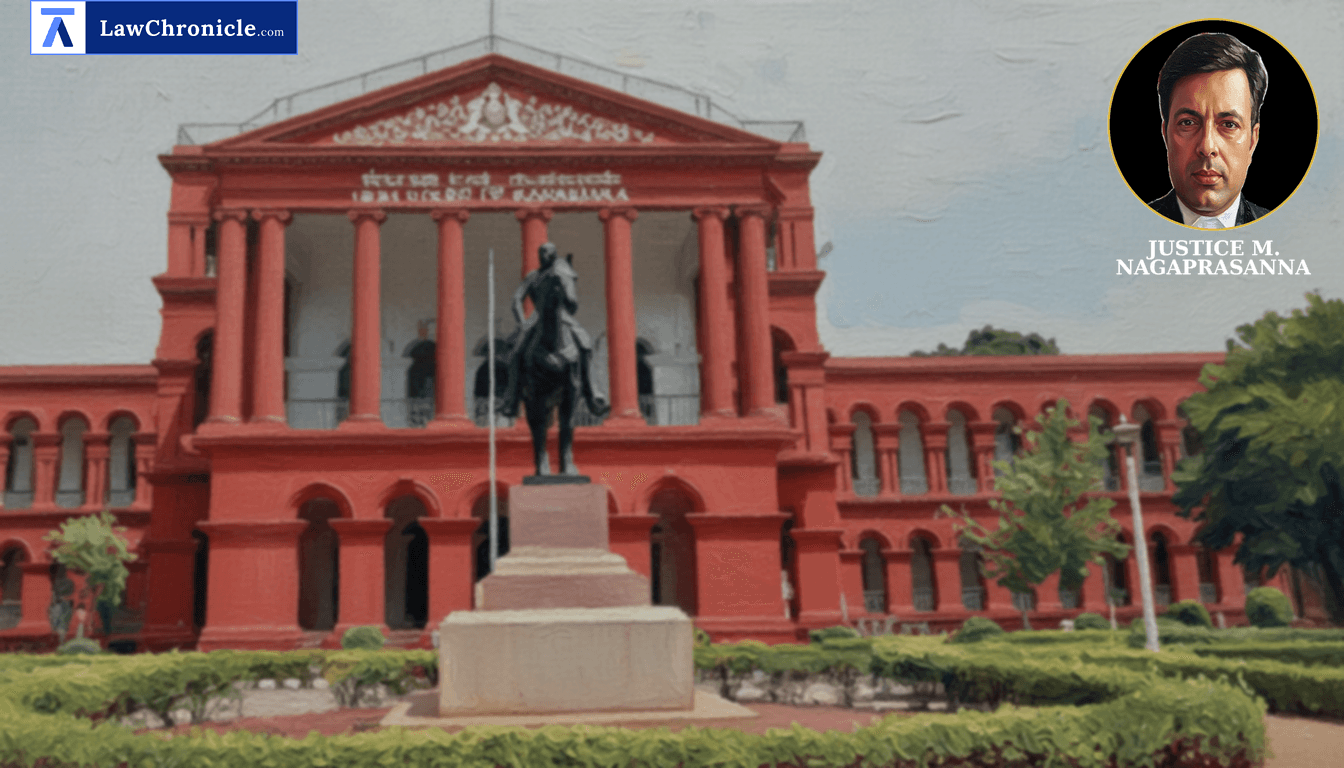
The Karnataka High Court has held that a partition suit filed two decades after the execution of a registered partition deed constitutes an abuse of the judicial process. The Court emphasized that "clever drafting" cannot be used to create an illusory cause of action for claims that have long since become time-barred or otherwise ceased to exist in the eyes of the law.
Justice M. Nagaprasanna, presiding over the matter, set aside a trial court order that had initially refused to reject the plaint. The Court observed that when a party has enjoyed the benefits of a registered partition for years, they cannot suddenly profess ignorance of the instrument to initiate fresh litigation. The High Court's intervention came in a revision petition filed under Section 115 of the Code of Civil Procedure, 1908.
The Doctrine of Constructive Notice and Limitation
The Court noted that the deceased husband of the first plaintiff was himself a signatory to the registered partition deed in 2004. Referring to the Transfer Of Property Act, 1882, the Court reiterated that the registration of a document serves as constructive notice to the world. Consequently, the plaintiffs' claim that they only discovered the partition recently was deemed 'implausible' and a 'fallacy'.
Identifying the legal principle behind the decision, the Court, in its reasoning, observed: "The judicial process cannot be permitted to become a refuge for claims which are long extinguished in law, but are sought to be resurrected through the alchemy of artful pleadings. The Apex Court has unequivocally held that, where clever drafting creates a mere mirage of a cause of action, concealing beneath its veneer an action hopelessly barred by limitation, the Court must pierce the veil of such pleadings and reject the plaint at its inception."
Impact of Registered Instruments on Future Claims
While discussing precedents, the Court referred to RAMISETTY VENKATANNA v. NASYAM JAMAL SAHEB ( "2023 SCC OnLine SC 521": 2023 CaseBase(SC) 998) and UMA DEVI v. ANAND KUMAR, noting that suits intended to unsettle rights that attained finality decades earlier must be nipped in the bud. The Court also relied on the principles laid down in Madanuri Sri Rama Chandra Murthy v. Syed Jalal ( "(2017) 13 SCC 174 : (2017) 5 SCC (Civ) 602": 2017 CaseBase(SC) 641) and Dahiben v. Arvindbhai Kalyanji Bhanusali regarding the scope of Order VII Rule 11 of the Code of Civil Procedure, 1908, which mandates the rejection of plaints that are manifestly vexatious or barred by limitation. The Court further cited NIKHILA DIVYANG MEHTA v. HITESH P. SANGHVI ( "2025 SCC OnLine SC 779": 2025 CaseBase(SC) 411) to dismiss the argument that limitation is always a mixed question of law and fact requiring trial.
Court Directions
The Court has the following directions:
"(i) Civil Revision Petition is allowed.
(ii) Application filed by the petitioners/defendants under Order VII Rule 11 CPC in I.A.No.III is allowed. The plaint in O.S.No.25803 of 2024 stands rejected."
Background:
The dispute originated when the widow and children of late P.A. Babu filed O.S.No.25803 of 2024, seeking a half-share in family properties and a permanent injunction. They alleged that a 2004 registered partition deed was fraudulent and that they were unaware of it until the defendants filed their written statement. The defendants (petitioners herein) argued that P.A. Babu was a signatory to the 2004 deed, had received his share, and never challenged it during his lifetime.
The trial court had rejected the defendants' application under Order VII Rule 11 (a) and (d) of the Code of Civil Procedure, 1908, stating the issue of limitation required a full trial. However, the High Court disagreed, finding the suit to be an attempt to reopen a concluded chapter of family history. The Court held that since the 2004 deed was registered and acted upon for 20 years, the current suit was ex-facie barred by the Limitation Act, 1963 and lacked a sustainable cause of action. The suit was also evaluated regarding court fees under the Karnataka Court Fees And Suits Valuation Act, 1958.
Case Details:
Case No.: CIVIL REVISION PETITION No.63 OF 2025 (IO)
Case Title: SRI P.A.MANJUNATH AND OTHERS v. MAMATHA AND OTHERS
Appearances:
For the Petitioner(s): SRI VIKRAM HUILGOL, SR.ADVOCATE A/W SRI MURALI N., ADVOCATE
For the Respondent(s): SRI G.KRISHNAMURTHY, SR.ADVOCATE A/W SRI MUNIRAJU K., ADVOCATE FOR R-1; R2 AND 3 ARE MINORS REPRESENTED BY R-1
Source: 2026 CaseBase(KAR) 194
Similar Articles
 Breaking News


