


Karnataka High Court Quashes Reservation Hike Beyond 50% Ceiling Rule
 Copy Link
 Share
 Save
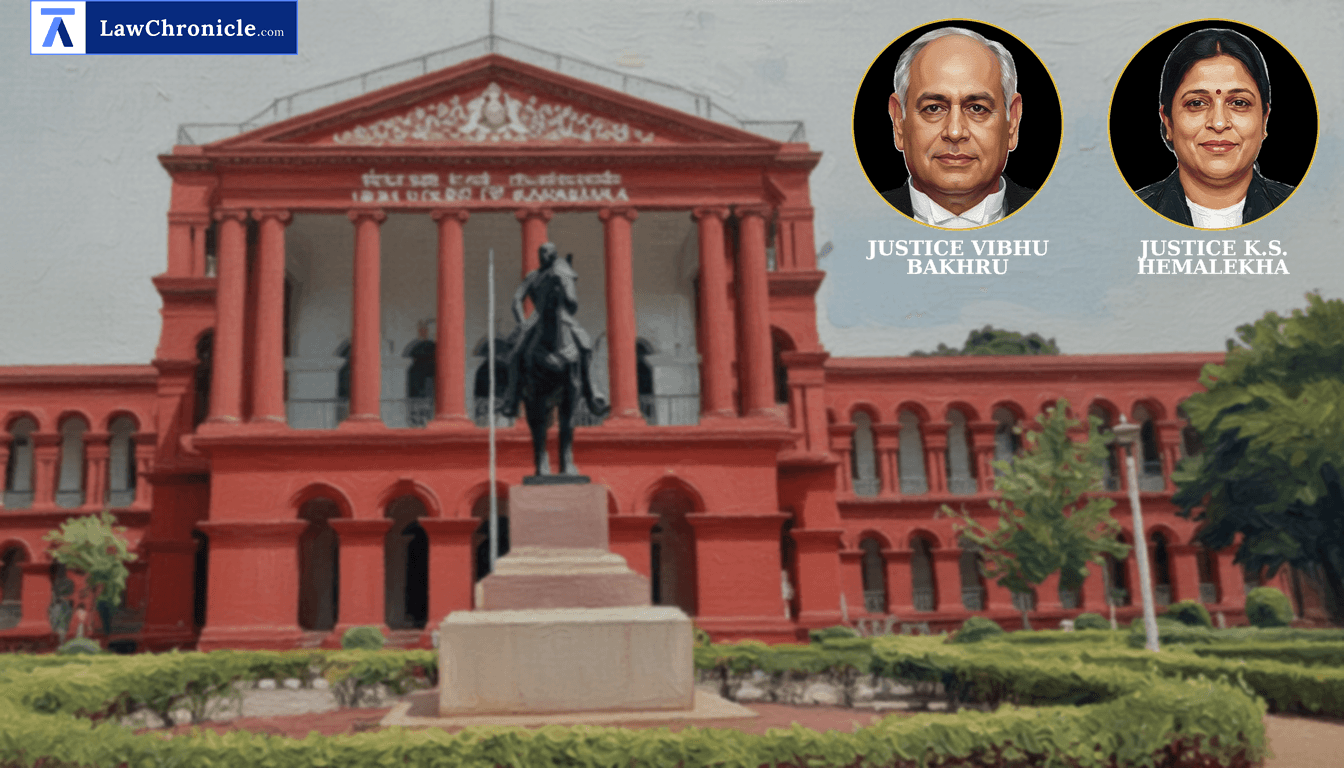
The Karnataka High Court struck down the state's legislative attempt to increase reservation for Scheduled Castes and Scheduled Tribes beyond the 50% ceiling, ruling that such a breach without establishing 'extraordinary circumstances' is a fatal violation of the constitutional guarantee of equality. This decision reinforces the numerical benchmark as a non-negotiable guardrail against the destruction of the equal opportunity clause.
A Division Bench comprising Chief Justice Vibhu Bakhru and Justice K.S. Hemalekha heard the challenge against the Karnataka Scheduled Castes And Scheduled Tribes (Reservation Of Seats In Educational Institutions And Of Appointments Or Posts In Services Under State) Act, 2022. The Court was tasked with determining whether the State could validly increase reservations for SCs from 15% to 17% and STs from 3% to 7%, taking the aggregate reservation in the State to 56%, thereby breaching the established 50% limit.
Key Takeaways
50% Limit Is Binding Law
Through a rigorous analysis of precedents, the Court reaffirmed that the 50% ceiling is not a mere rule of prudence but a binding constitutional requirement.
Population Not An Extraordinary Circumstance
The Court clarified that a mere increase in population or the inclusion of more castes in the reserved list does not constitute 'extraordinary circumstances' justifying a breach of the 50% rule.
Adequate vs. Proportionate Representation
The judgment emphasizes that Article 16(4) guarantees 'adequate representation' and not 'proportionate representation' based on population metrics.
Consultation With National Commissions Mandatory
The Court underscored that the State is constitutionally mandated to consult National Commissions on major policy matters affecting SC/ST communities prior to enacting legislation.
Court Observations and Directions
The Court observed that the 50% ceiling rule is the result of striking a balance between the competing concepts of equality of opportunity for all citizens and the necessity for affirmative action. The Court, in its reasoning, observed: "The 50% rule is founded on the principle of balance. The fact that the population of the reserved classes has increased would not warrant the said principle being abandoned... To change the 50% limit is to have a society which is not founded on equality but based on caste rule."
The Court further noted that the State failed to demonstrate any 'extraordinary situations' such as geographic isolation or complete exclusion from the mainstream that would warrant such a departure. The Court has following directions:
"Section 3 of the Act, insofar as it takes the aggregate reservation beyond the ceiling of 50%, is struck down as it violates Articles 14 and 15 of the Constitution. Section 4 of the Act is also struck down as unconstitutional, as it violates Articles 14 and 16 of the Constitution."
Ratio
The 50% ceiling limit on reservations under Articles 15(4) and 16(4) of the Constitution of India, 1950 is a firm rule of equality that constitutes part of the basic structure. A subjective opinion of the State regarding 'inadequate representation' based on proportionate population does not constitute an 'extraordinary circumstance' to breach this limit. Any reservation in excess of 50% without proving extenuating, characteristic, and inherent aspects akin to far-flung areas being kept away from national life is ultra vires the Constitution.
Background
The dispute arose following the enactment of the Karnataka Scheduled Castes And Scheduled Tribes (Reservation Of Seats In Educational Institutions And Of Appointments Or Posts In Services Under State) Act, 2022, which sought to enhance the reservation quota for SCs and STs based on the recommendations of the Nagamohan Das Commission Report and Adi Committee Report. The State argued that the increase was necessitated by demographic changes recorded in the 2011 Census and earlier reports like the Ratnaprabha Committee Report.
Petitioners, including engineering graduates and social workers, challenged the Act on the grounds that it was a 'fraud on the Constitution' and ignored the mandate of M.R. Balaji v. State of Mysore ( "AIR 1963 SC 649 : 1963 Supp. (1) SCR 439": 1962 CaseBase(SC) 121) and Indra Sawhney v. Union of India ( "1992 Supp (3) SCC 217": 1992 CaseBase(SC) 156). They argued that the State's reliance on 'proportionate representation' was legally flawed. The State defended the move by citing the 103rd Constitutional Amendment and the decision in Janhit Abhiyan v. Union of India ( "(2023) 5 SCC 1": 2022 CaseBase(SC) 246), arguing that the 50% rule was no longer inflexible.
The Court analyzed a series of landmark cases, including M. Nagaraj v. Union of India ( "(2006) 8 SCC 212": 2006 CaseBase(SC) 359), Dr. Jaishri Laxmanrao Patil v. Chief Minister ( "(2021) 8 SCC 1": 2020 CaseBase(SC) 652), and Pattali Makkal Katchi v. A. Mayilerumperumal ( "(2023) 7 SCC 481": 2022 CaseBase(SC) 752), to trace the evolution of the 50% rule. It specifically noted that while B.K. Pavitra v. Union of India ( "(2019) 16 SCC 129": 2019 CaseBase(SC) 1992) allowed for certain procedural changes, it did not permit the obliteration of the 50% numerical benchmark. Ultimately, finding no 'extraordinary circumstances,' the Court struck down the impugned provisions.
Case Details:
Case No.: WP No. 200448 of 2025 C/W WP No. 25515 of 2025
Case Title: Mahendra Kumar Mitra v. State of Karnataka and Others
Appearances:
For the Petitioner(s): Sri Mahendra Kumar Mitra (Party-in-Person), Sri P.S. Rajagopal (Senior Advocate) with Sri Vinayaka S. Pandit (Advocate)
For the Respondent(s): Prof. Ravivarma Kumar (Senior Advocate) with Ms. Ashwini O. (Special Counsel), Sri Harsha P. Banad (CGSC)
Source: 2026 CaseBase(KAR) 26197
Similar Articles

 Breaking News


