


Kerala High Court Directs Speaker To Decide On MLA Disqualification Following Conviction
 Copy Link
 Share
 Save
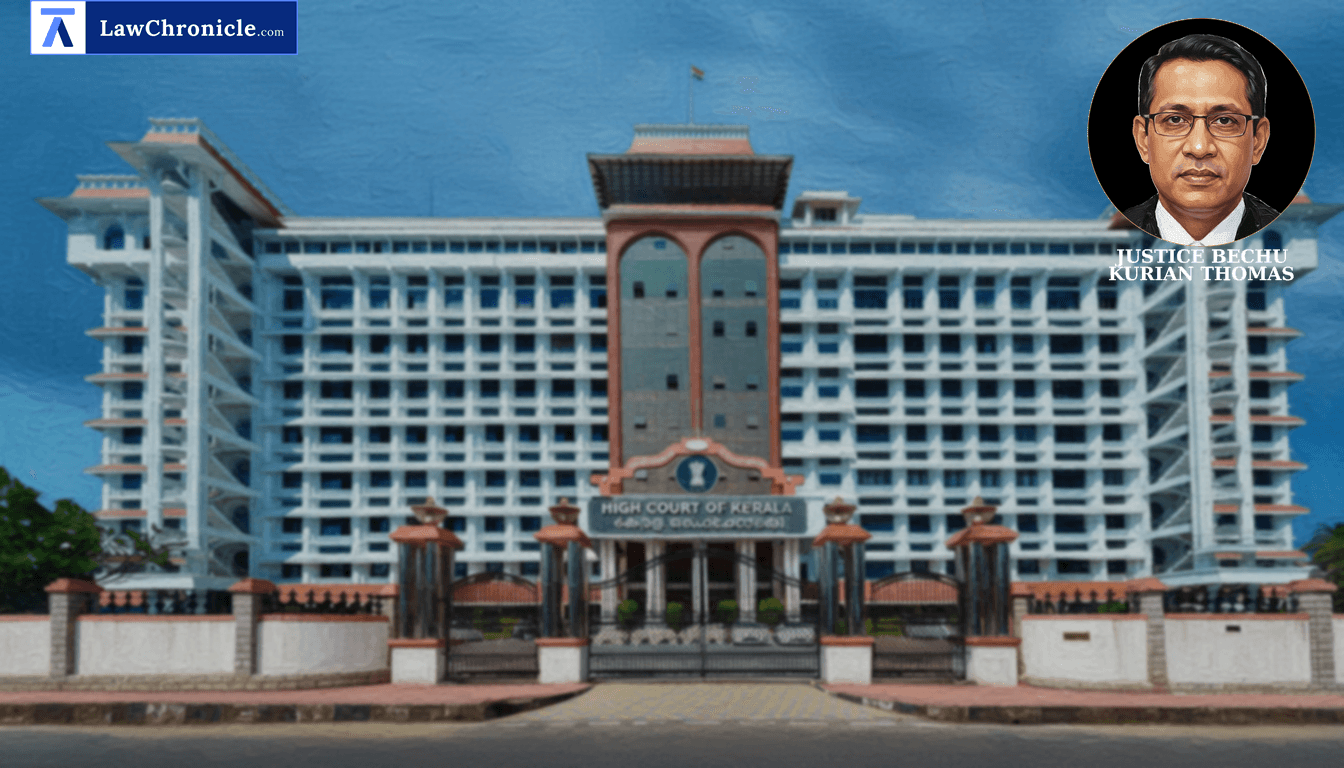
The Kerala High Court has underscored the procedural urgency following the criminal conviction of an elected representative, directing the Speaker of the Legislative Assembly to take appropriate action on a representation seeking the disqualification of a sitting member. This intervention reaffirms the immediate legal consequences of criminal sentencing on legislative membership under parliamentary statutes and constitutional mandates.
A Single Judge bench of Justice Bechu Kurian Thomas presided over the writ petition challenging the continued status of an MLA from the Pala constituency. The court was tasked with addressing the failure of statutory authorities to notify a vacancy despite multiple criminal convictions against the sitting member in Mumbai courts.
Key Takeaways
Immediate Disqualification
Disqualification under federal election law is triggered immediately upon conviction and sentencing, rather than waiting for exhaustive judicial reviews.
Speaker's Administrative Duty
Legislative heads are duty-bound to process notifications of vacancy once informed of a member's conviction by competent authorities or the Election Commission.
Gubernatorial Reference
Under the constitutional framework, specific disputes regarding a member's disqualification must ultimately be referred to the Governor for a final decision.
Judicial Scrutiny of Legislative Vacancy
The court noted that the petitioner had already approached the Speaker via a formal representation to declare the seat vacant following four separate criminal judgments. The bench observed that the mechanism for such notifications is already streamlined by judicial precedents and administrative instructions.
The Court has following directions:
"Accordingly, there will be a direction to the 3rd respondent to take appropriate steps as he deems fit on Ext.P6, in accordance with law, bearing in mind the provisions of the Constitution of India as well as the Representation of People Act, 1951, at the earliest, without undue delay."
The Court, in its reasoning, observed: "The disqualification as prescribed by the Representation of People Act, 1951 read with the Constitution of India is immediate on conviction and sentence. However, if a question arises as to whether a Member of the House of Legislature has become subject to any of the disqualifications, the said question will have to be referred for the decision of the Governor, as per Article 192 of the Constitution of India."
Ratio
Upon the conviction and sentencing of an elected member to imprisonment for two years or more, the disqualification under Section 8(3) of the Representation of People Act, 1951 is immediate. While the Speaker or Chairman must be informed to issue a notification of vacancy, any substantive dispute regarding the factum of disqualification must be resolved by the Governor under Article 192 of the Constitution of India.
Background
The petitioner, Dinesh Menon, moved the High Court seeking a Writ of Mandamus to declare the 4th respondent, Mani C. Kappan, disqualified as a Member of the Legislative Assembly. The petitioner contended that the 4th respondent suffered four separate convictions and sentences from the Metropolitan Magistrate, Borivali, Mumbai, on September 1, 2026. It was argued that under Section 8(3) of the Representation of People Act, 1951, the disqualification is automatic and the seat must be declared vacant.
The 4th respondent countered the maintainability of the petition, arguing that the power to decide on disqualification rests solely with the Governor and that sentences from separate proceedings cannot be aggregated. The court referred to the landmark ruling in Lily Thomas v. Union of India and Others ( "(2013) 7 SCC 653": 2013 CaseBase(SC) 367), which removed the stay on immediate disqualification, and Lok Prahari, through its General Secretary S.N. Shukla v. Election Commission of India & Others ( "AIR 2018 SC 4675": 2018 CaseBase(SC) 756), which approved the Election Commission's instructions for Speakers to be notified of such convictions within seven days. While refusing to comment on the merits of the conviction itself, the Court directed the Speaker to act on the pending representation at the earliest.
Case Details:
Case No.: W.P.(C) No.31188 of 2026
Neutral Citation: 2026:KER:76276
Case Title: Dinesh Menon v. State of Kerala & Others
Appearances:
For the Petitioner(s): Sri.V.Sethunath, Shri.Thomas Abraham, Shri.Sreeganesh U., Shri.Shamnas S.
For the Respondent(s): Sri.Jaju Babu (Advocate General), Sri.Sachin Ramesh (Government Pleader), Shri.Deepu Lal Mohan (SC, ECI), Sri.Santhosh Mathew (Sr. Counsel), Adv.Ummul Fida, Shri.Deepu Thankan, Smt.Lakshmi Sreedhar, Smt.P.Parvathy, Smt.Pooja Chandran, Smt. T. J. Jubil
Source: 2026 CaseBase(KER) 24376
Similar Articles
 Breaking News


