


Limb Loss Compensation Must Ensure Dignity and Lifelong Mobility: Kerala HC
 Copy Link
 Share
 Save
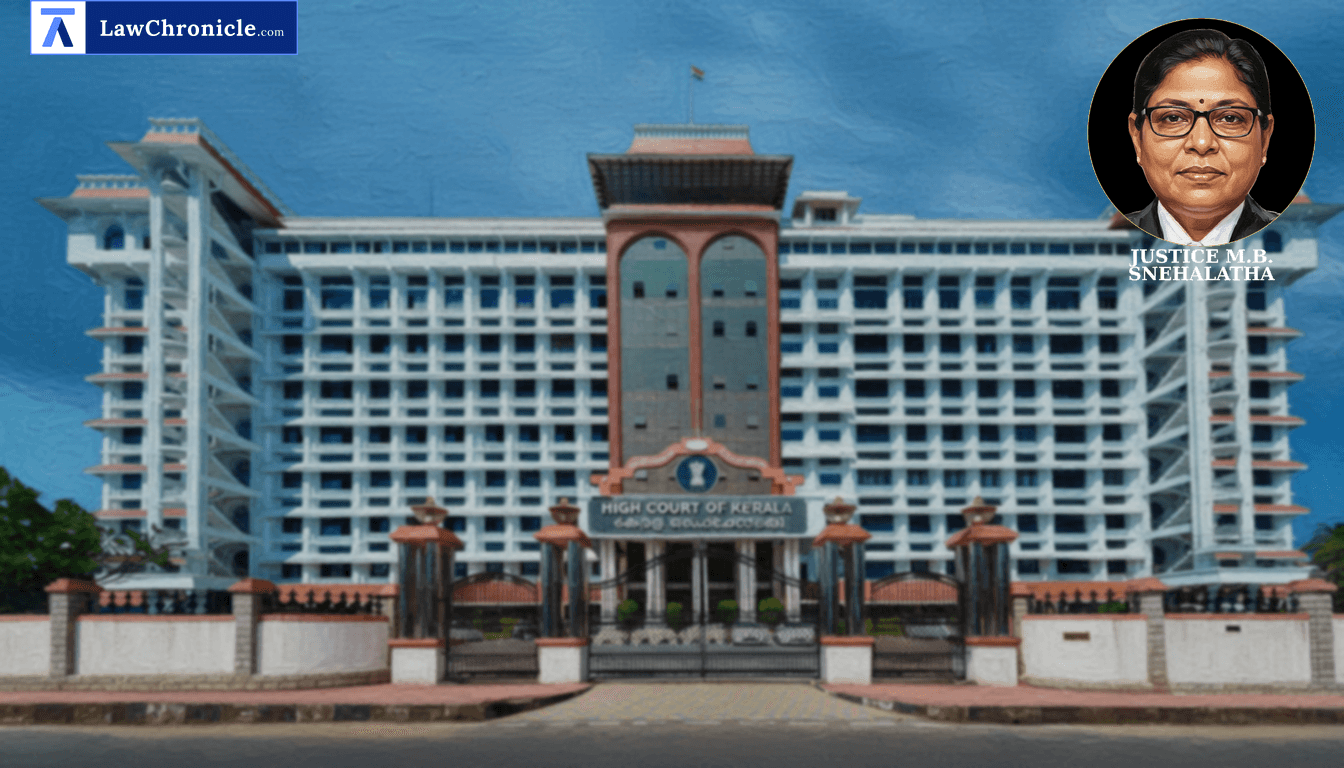
The Kerala High Court, while emphasizing the need to ensure “just compensation” for accident victims, has ruled that awards for prosthetic limbs must be realistic, future-oriented, and account for periodic replacements to maintain a claimant’s dignity and independence.
Justice M.B. Snehalatha, presiding as a single-judge bench, heard an appeal seeking enhancement of compensation for a young man whose right leg was amputated following a motor vehicle accident. The Court emphasized that compensation under the Motor Vehicles Act, 1988 is not merely a mathematical exercise but a mandate to restore the aggrieved person to their pre-accident position as closely as possible.
The Mandate of Just Compensation
The Court observed that for a young individual, the loss of a limb has far-reaching consequences on earning capacity, social confidence, and marriage prospects. It clarified that a prosthetic limb is not a one-time expense but requires maintenance and replacement throughout the victim's life.
The Court, in its reasoning, observed: "A prosthetic limb is not a one-time expense. It requires periodic replacement, maintenance, physiotherapy and adaptation over the claimant's lifetime. Therefore, the Courts/Tribunals must adopt a humane and realistic approach while assessing compensation. Merely awarding the present cost of an artificial limb would be wholly inadequate. A young person will require several replacements in the course of his life, particularly because prosthetic technology advances and wear and tear make periodic renewal inevitable."
Consolidated Awards for Prosthetic Maintenance
Drawing parity from the principles laid down by the Supreme Court in Prahlad Sahai v. Haryana Roadways ( "2026 (3) KHC 370": 2026 CaseBase(SC) 342) and Mohd. Sabeer @ Shabir Hussain v. Regional Manager, U.P. State Road Transport Corporation ( "2022 KHC OnLine 7267": 2022 CaseBase(SC) 531), the High Court adopted a five-year replacement cycle based on an assumed life expectancy of 70 years. The Court rejected the insurance company's reliance on cheaper government-notified rates, holding that claimants are entitled to reasonable private options that meet their functional needs.
The Court has the following directions:
"The insurance company shall deposit the said amount within two months from the date of receipt of a copy of this judgment, failing which the interest shall run at 8% per annum. Amount enhanced under other heads shall carry interest at 8% per annum from the date of petition and it shall be deposited within two months from the date of receipt of a copy of this judgment."
Background:
The dispute arose from a 2008 accident where the appellant, then 24 years old, was hit by a rashly driven car, leading to the amputation of his right leg above the knee. While the Motor Accidents Claims Tribunal, Thalassery, initially awarded ₹19,54,900, the appellant challenged the amount as meager, particularly regarding the notional income and the cost of the prosthetic leg.
The appellant argued that as a coffee shop manager in Sharjah, his income was significantly higher than the ₹4,500 monthly notional income fixed by the Tribunal. The High Court, while noting the lack of salary documentation, increased the notional income to ₹7,000 and applied future prospects as per National Insurance Company Limited v. Pranay Sethi and others ( "(2017) 16 SCC 680": 2017 CaseBase(SC) 551).
Ultimately, the High Court enhanced the total compensation to ₹54,98,840, specifically awarding ₹24,00,000 for eight prosthetic limbs and ₹6,00,000 for maintenance, noting that for a 24-year-old, mobility is an integral part of the right to a dignified life.
Case Details:
Case No.: MACA NO. 949 OF 2015
NeutralCitation: 2026:KER:35025
Case Title: UMMER C.K. v. THE ORIENTAL INSURANCE COMPANY LTD.
Appearances:
For the Petitioner(s): SRI.M.B.SOORI, SHRI.BALAMURALI K.P., SMT.HARIPRIYA.M
For the Respondent(s): SMT.LATHA SUSAN CHERIAN
Source: 2026 CaseBase(KER) 263
Similar Articles
 Breaking News


