


Madras HC: Insurance Company Liable Based on Cover Note Despite Registration Delay
 Copy Link
 Share
 Save
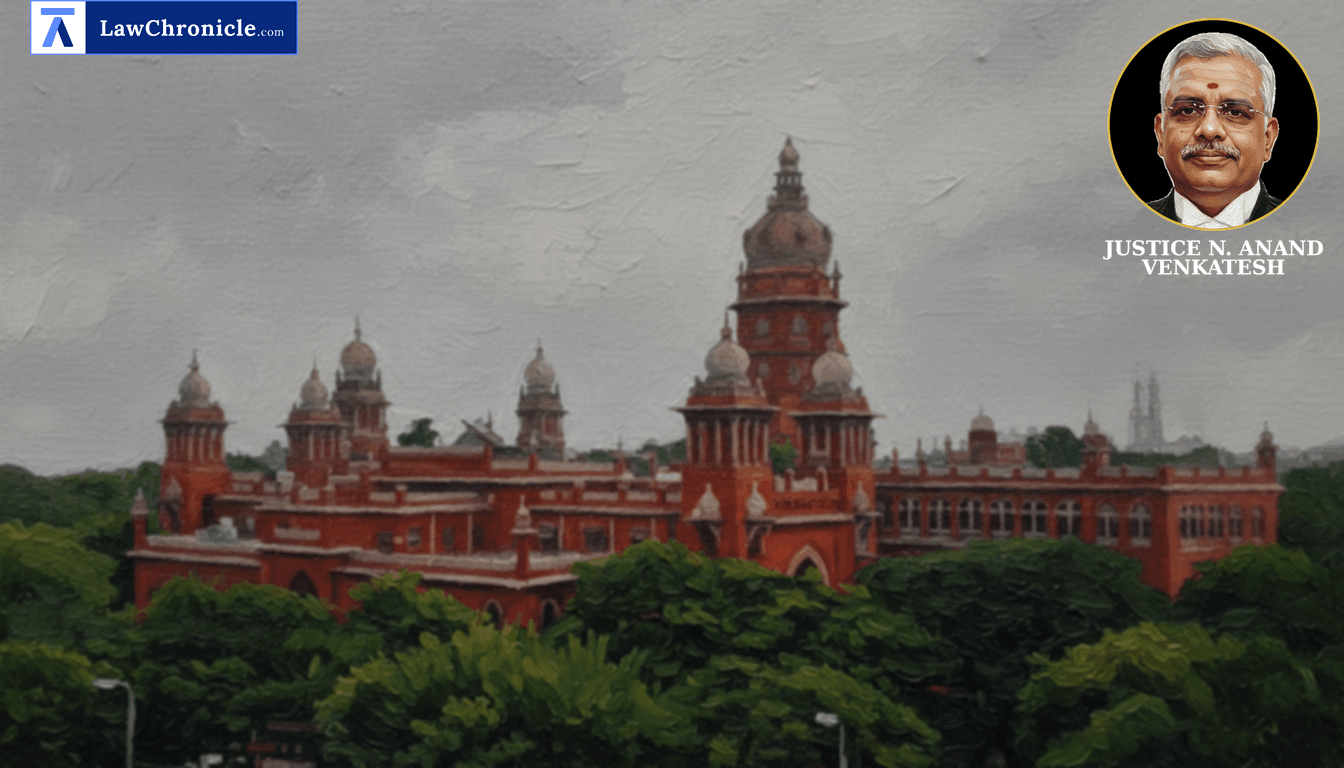
The Madras High Court has reinforced the evidentiary value of insurance cover notes in motor accident claims, ruling that insurers cannot evade liability if a valid cover note exists at the time of the accident, even if formal registration and subsequent policies are in another name. Holding that the principle of preponderance of probabilities must favor third-party claimants, the court set aside a tribunal's order that had exonerated the insurance provider despite matching chassis and engine details on preliminary sale documents.
Justice N. Anand Venkatesh heard the appeal preferred by the claimant against the judgment of the Motor Accidents Claims Tribunal, Chennai. The primary issue before the Court was whether the Motor Vehicles Act requires the insurance company to indemnify the owner when the vehicle is covered by a valid cover note but the formal policy and registration were completed post-accident in a different person's name.
Court Rejects Insurer's Plea on Lack of Ownership Proof
The High Court scrutinized the evidence, including the Sale Certificate and Tax Invoice, noting that the Chassis and Engine numbers perfectly tallied with the Cover Note. The Insurance Company had argued that because the vehicle was later registered in the name of a third party in June 2014, the first respondent was not the owner at the time of the accident in April 2014. The Court found this reasoning flawed, as the third party was "not even in the scene" when the accident occurred.
The Court, in its reasoning, observed: "In the absence of any contra evidence to establish that as on the date of accident, the 1st respondent was not the owner of the vehicle and that the Cover Note relied upon is a fabricated document, applying the principle of preponderance of probability, this Court has to necessarily hold that it was only the 1st respondent who was the owner of the offending vehicle, which had a valid policy by means of a Cover Note."
Directions Issued to the Insurance Company
The Court found the Tribunal's decision to exonerate the insurer as "perverse." Consequently, the Court has the following directions:
"there shall be a direction to the 2nd respondent/Insurance Company to deposit the entire compensation amount along with the interest, within a period of four weeks from the date of receipt of copy of this order. On such deposit, the appellant claimant is entitled to withdraw the compensation amount."
Key Takeaways:
Primacy of Cover Notes
Interim insurance cover notes are binding contracts of indemnity that protect third parties even before a formal policy is generated.
Preponderance of Probabilities
In motor accident claims, third-party claimants are not required to provide absolute proof of ownership transfers which are within the special knowledge of the respondents.
Strict Liability for Insurers
Insurance companies cannot rely on subsequent registration dates to deny coverage if the vehicle's identity (Engine/Chassis numbers) matches the interim insurance documents active on the date of the mishap.
Ratio Decidendi:
A valid insurance Cover Note issued in the name of a purchaser, matching the vehicle's specific identification marks (Engine and Chassis numbers), constitutes sufficient evidence of insurance coverage to fix liability on the insurer under the Motor Vehicles Act, regardless of whether the formal registration of the vehicle occurs at a later date in another person's name.
Background:
The dispute arose from an accident on April 29, 2014, when a two-wheeler dashed against the appellant, causing a femur fracture. The claimant sought compensation under the Motor Vehicles Act. While the Tribunal found the rider negligent, it exonerated the The New India Assurance Co., Ltd. on the grounds that the first respondent's ownership wasn't proved and the vehicle was registered later under someone else's name. The High Court reversed this, noting that the claimant had produced the Sale Certificate, Tax Invoice, and Cover Note which established the first respondent's possession and the insurer's commitment at the material time. The Court upheld the quantum of Rs. 2,70,456/- but shifted the liability to the insurance company.
Case Details:
Case No.: CMA No.1054 of 2020
Case Title: A.Thilagavathy Vs. G.Prakash and another
Appearances:
For the Petitioner(s): Mr.R.Nalliyappan
For the Respondent(s): Ms.R.Sreevidhya
Source: 2026 CaseBase(MAD) 361
Similar Articles




 Breaking News


