


Madras HC: Plaintiff Must Prove Own Title to Recover Property
 Copy Link
 Share
 Save
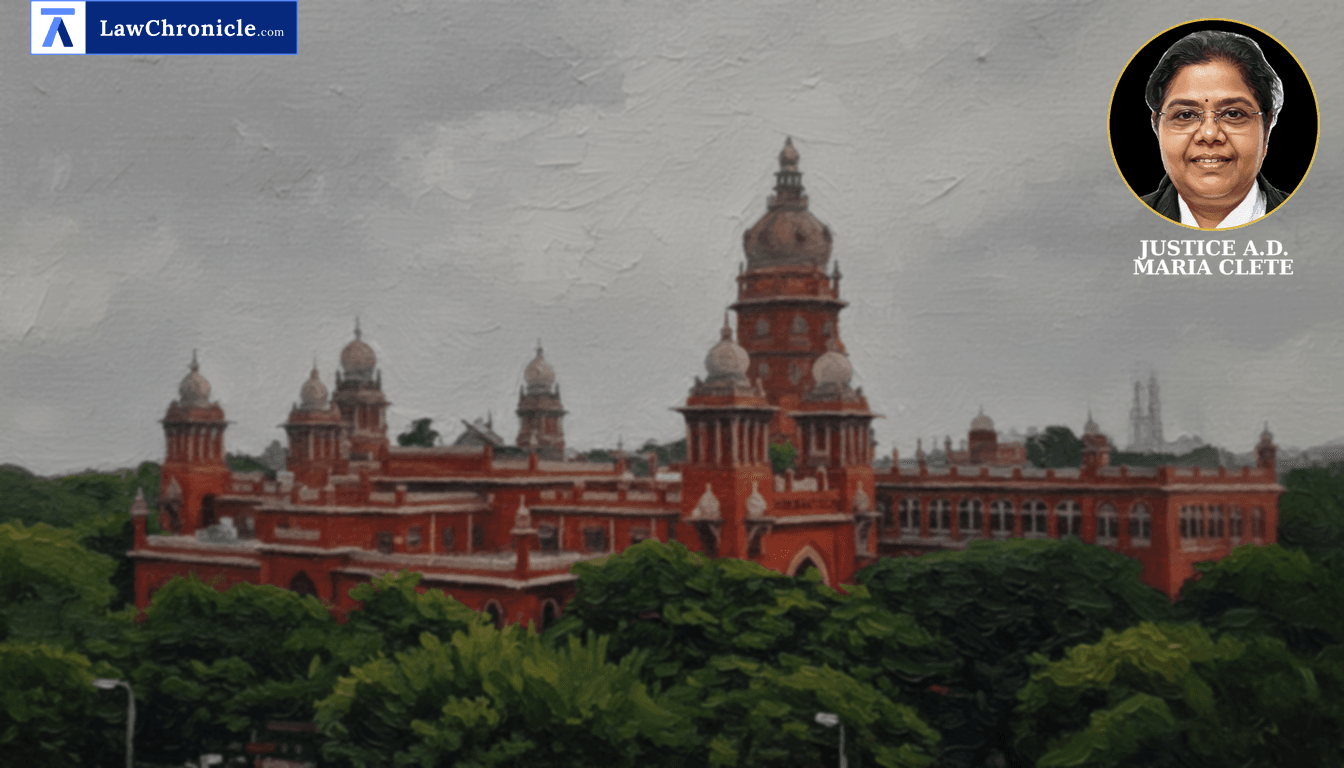
In a decisive affirmation of fundamental property law principles, the High Court of Judicature at Madras ruled that a party claiming ownership cannot secure a decree for property declaration or recovery based merely on the deficiencies of the defendant's title. The Court underscored that vague descriptions and unproven title deeds cannot displace long-standing public infrastructure constructed on disputed land.
A single-judge bench comprising Justice Dr. A.D. Maria Clete dismissed an appeal filed by representatives of the Jamia Mosque & Madrasa against a trial court judgment that denied them ownership over a disputed parcel of land in Cuddalore district. The suit sought a declaration of title, recovery of possession, and alternative damages after local authorities demolished a dilapidated structure to construct a public library.
Civil Suit Maintainability Not Barred by Res Judicata
Addressing the preliminary objection regarding maintainability, the High Court clarified that the prior dismissal of the plaintiffs' suit by a Wakf Tribunal on technical grounds does not attract the bar of res judicata under Section 11 of the Code of Civil Procedure.
The Court, in its reasoning, observed: "For a matter to operate as res judicata under Section 11 of the Code of Civil Procedure, the former suit must have been heard and finally decided on its merits by a competent court. The earlier suit... was dismissed on the technical ground that an unregistered mosque could not maintain such a suit under the Wakf Act; it was not a decision on the merits of the question of title. A dismissal on such a preliminary or technical ground does not bar a subsequent suit..."
Failure to Discharge Burden of Proof on Title
The Court noted that the plaintiffs failed to establish that the property purchased via a 1953 sale deed was specifically acquired for or vested in the mosque. Although the purchaser was described in a certified copy as the manager of a mosque, the document failed to identify the specific institution or demonstrate dedication to the plaintiff mosque. The Court further highlighted that the statutory presumption under Section 90 of the Indian Evidence Act only applies to the due execution and genuineness of an ancient document, not to the truth of its recitals or title vesting.
The Court stated: "A plaintiff seeking a declaration of title and recovery of possession must succeed on the strength of his own title, not on the weakness or absence of the defendant's title. It is not enough to show that the defendant has no title; the plaintiff must affirmatively establish that he, or those whom he represents, holds the title claimed."
On the failure to identify the property and establish title, the Court issued the following order:
"Accordingly, the appeal is dismissed, and the judgment and decree of the Principal District Judge, Cuddalore, dated 25.01.2018, in O.S. No. 142 of 2011, dismissing the suit, are confirmed. No order as to costs. Consequently, the connected miscellaneous petition, if any, is closed."
Key Takeaways
- Strength of Own Title Mandatory: Litigants seeking title declaration must affirmatively prove their ownership rather than relying on flaws in the opponent's records.
- Limited Scope of Section 90 Evidence Act: Ancient document presumptions only validate due execution, not the legal effect or truth of recitals contained within.
- Res Judicata Excludes Technical Dismissals: Rejection of a suit on procedural grounds does not prevent fresh civil litigation on substantive merits.
- Precise Identification Required: Decrees for possession cannot be granted without clear, current survey boundaries and subdivision details.
Ratio
In a suit for declaration of title and recovery of possession, the plaintiff must succeed strictly on the strength of their own title. The statutory presumption for ancient documents under Section 90 of the Indian Evidence Act is restricted to execution and genuineness, and does not establish title or validate unproven recitals.
Background:
The appellants, representing the Jamia Mosque & Madrasa at M.Agaram, claimed that a 3,000 sq. ft. property in Gramanatham Survey No. 111/2 was purchased under a registered sale deed on 10.11.1953. They alleged that the state government wrongfully classified the land as poramboke and that the local Panchayat demolished their dilapidated building in 2009 to construct a library.
After earlier proceedings before the Wakf Tribunal and a writ petition were dismissed on technical grounds, the High Court in W.A. No. 144 of 2010 granted liberty to approach the civil court. The appellants filed a suit under Order 20 Rule 12 of the Code of Civil Procedure seeking title declaration, possession, or Rs. 12,00,000 as damages. The trial court dismissed the suit in 2018.
Evaluating precedents such as Sayyed Ali and others v. A.P. Wakf Board, Hyderabad and others ( "(1998) 2 SCC 642": 1998 CaseBase(SC) 102) on non-extinguishment of wakf character, Gitarani Paul v. Dibyendra Kundu alias Dibyendra Kumar Kundu ( "AIR 1991 SC 395": 1990 CaseBase(SC) 128) on recovery of title, Corporation of the City of Bangalore v. M. Papaiah and another ( "AIR 1989 SC 1809": 1989 CaseBase(SC) 165), Senniyappan v. The Deputy Tahsildar, Palladam and others, M.E.A. Mohamed Ali and others v. The District Revenue Officer, Ramanathapuram and others, and N.S. Kuppuswamy Odayar and another v. Panchayat Narthangudi on revenue records, as well as Varadarasu alias Devarasu v. Malone Veerasamy alias Thanapal and others, Surat Cotton Spinning and Weaving Mills Ltd. v. Secretary of State, and State of Punjab v. M/s. Modern Cultivators regarding adverse inference, the High Court held that the appellants failed to prove identity, title, or continuous possession, affirming the trial court's dismissal.
Case Details:
Case No.: A.S. No. 425 of 2018
Case Title: Mohammed Siddique and another v. The Special Officer, M.Agaram Panchayat and others
Appearances:
For the Petitioner(s): Mr.R.Gururaj
For the Respondent(s): Mr.B.Tamil Nidhi, Government Advocate (for R1); Mr.M.Murali, Government Advocate (for R2 & R3)
Source: 2026 CaseBase(MAD) 5226
Similar Articles
 Breaking News


