


Plaintiff Must Prove Own Title Regardless Of Weakness In Defence: SC
 Copy Link
 Share
 Save
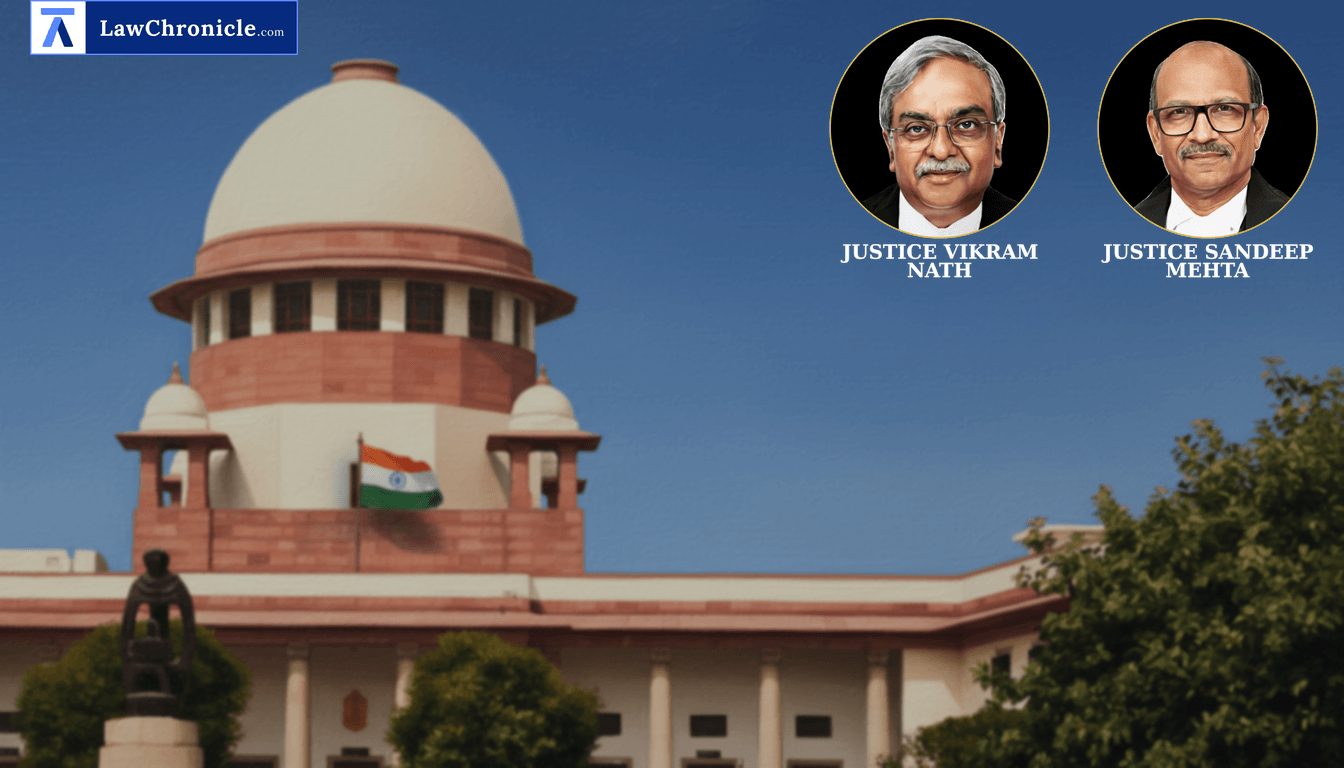
In a significant clarification on the law of title suits, the Supreme Court has set aside a decree for possession, emphasizing that a plaintiff cannot succeed merely because the defendant failed to prove their ownership. This ruling underscores that the burden of proving absolute title remains strictly with the claimant.
A bench of Justice Vikram Nath and Justice Sandeep Mehta presided over an appeal challenging a long-standing dispute over a temple property in Kota, Rajasthan. The Court examined whether the respondent society had successfully established its proprietary rights over the suit property to justify the ejectment of the appellant-defendant.
Establishing Proprietary Rights Over Managerial Functions
The Court observed that the lower courts had conflated the management of a religious institution with the actual ownership of its properties. While the respondent-plaintiffs demonstrated that they exercised supervisory control and appointed 'pujaris', the Bench noted that such managerial activities do not automatically confer legal title.
The Court, in its reasoning, observed: "The mere fact that the society exercised certain supervisory or managerial functions over the temple or participated in the appointment of “pujaris” would not ipso facto confer title upon it... The distinction between management of a religious institution and ownership of its properties is well recognised in law, and the two cannot be conflated."
Failure to Discharge Burden of Proof
Highlighting the requirements under Sections 101 and 102 read with Section 110 of the Indian Evidence Act, 1872, the Supreme Court noted that the respondent-plaintiffs failed to produce any deed of dedication or endowment. Following the precedent set in Union of India v. Vasavi Co-op. Housing Society Ltd. ( "(2014) 2 SCC 269": 2014 CaseBase(SC) 128), the Bench reiterated that the plaintiff must succeed on the strength of their own case.
The Court has following directions:
"The judgment dated 28th September, 2007, passed by the High Court of Judicature for Rajasthan at Jaipur Bench, Jaipur in S.B. Civil First Appeal No. 36 of 1988, is hereby set aside. Consequently, the present appeal stands allowed and the suit is dismissed."
Background:
The dispute originated when a registered society (respondent No. 1) filed a suit in 1977 seeking the removal of the appellant-defendant from the position of 'pujari' and restoration of possession of the "Moorti Swarup Shri Govardhan Nath Ji" temple. The society claimed the temple was its property and that the defendant's predecessors were merely appointed as caretakers since 1926.
Conversely, the appellant-defendant contended that the temple was private property devolved through a line of successive adoptions and inheritances. He asserted that his predecessor, Gordhan Lal, had even executed a Will in his favor.
The Trial Court and the Rajasthan High Court had previously ruled in favor of the society, finding that the defendant was merely a custodian based on minutes of meetings from 1926 and 1951. However, the Supreme Court found this approach legally flawed, stating that even if the defendant's claim of adoption was not proved, it did not relieve the plaintiffs of their primary duty to prove their own title through admissible evidence.
Case Details: Case No.: CIVIL APPEAL NO. 1245 OF 2011 NeutralCitation: 2026 INSC 448 Case Title: KISHAN CHAND (DEAD) THROUGH LRS. VERSUS GAUTAM GAUR HITKARAK SABHA, KOTA & ORS. Appearances: For the Petitioner(s): Shri Sushil Kumar Jain, Senior Counsel For the Respondent(s): Shri Ajay Choudhary, Counsel
Source: 2026 CaseBase(SC) 550
Similar Articles
 Breaking News


