


Magistrate Lacks Jurisdiction Under Section 145 CrPC If Dispossession Occurs Beyond Two Months: Himachal Pradesh HC
 Copy Link
 Share
 Save
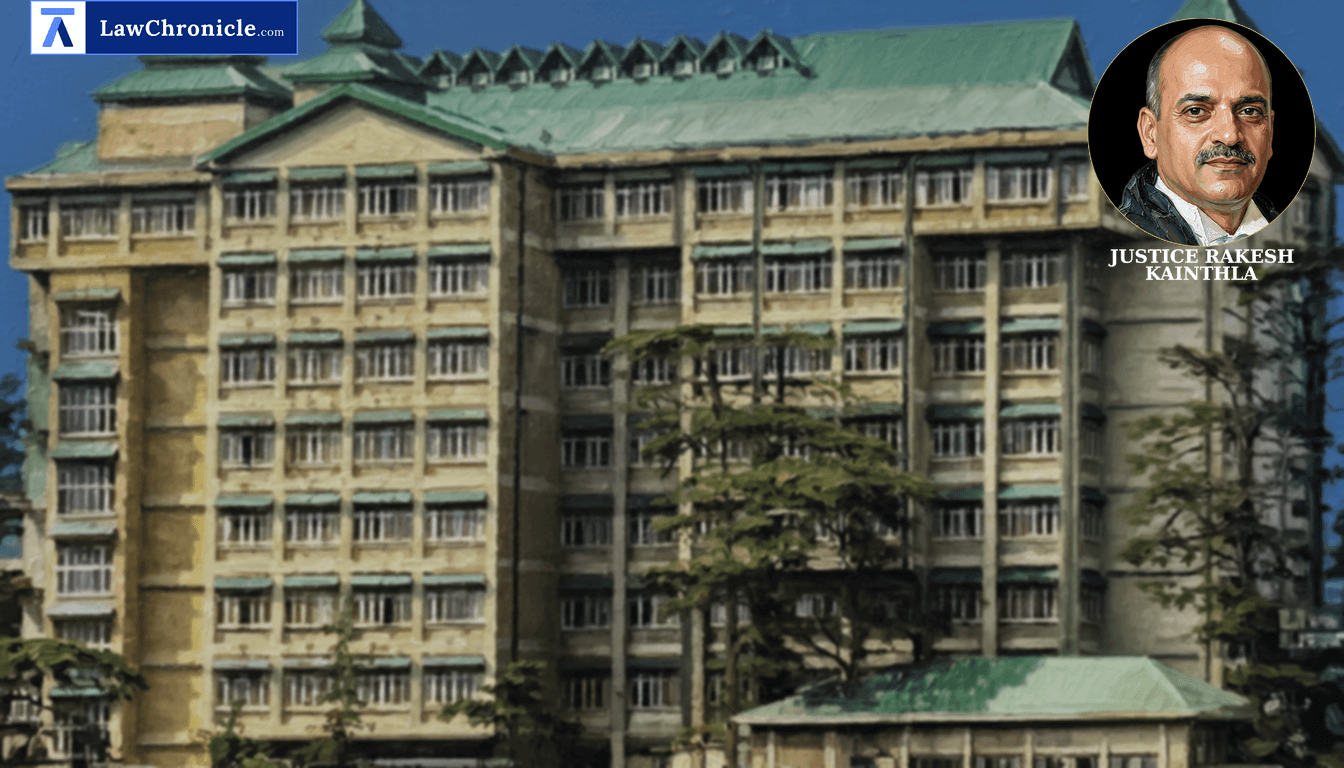
The Himachal Pradesh High Court has reinforced the strict statutory timelines governing property possession disputes, ruling that a Magistrate cannot exercise jurisdiction under Section 145 of the Code of Criminal Procedure, 1973, if the alleged dispossession occurred more than two months prior to the complaint. In a significant clarification of the boundary between criminal prevention of breach of peace and civil property remedies, the Court held that the summary powers of a Magistrate are strictly conditional upon the immediacy of the dispossession.
Justice Rakesh Kainthla, presiding as a single-judge bench, dismissed a petition seeking to invoke the Court's inherent powers under Section 528 of the BNSS (corresponding to Section 482 of the Code of Criminal Procedure, 1973). The Court emphasized that while the High Court possesses supervisory jurisdiction to correct grave miscarriages of justice, it must not be used as a substitute for a second revision when statutory conditions for the primary relief are not met.
Key Takeaways
Strict Adherence to Two-Month Window
If a party is dispossessed more than two months before the police report or information reaches the Magistrate, the summary remedy under Section 145 is legally unavailable.
Inherent Powers vs. Second Revision
High Courts will not exercise inherent powers under Section 482 of Code of Criminal Procedure, 1973 (or Section 528 of BNSS) to circumvent the statutory bar on second revisions unless there is a blatant abuse of process.
Distinction Between Civil and Criminal Remedies
Disputes involving joint possession or long-term dispossession are essentially civil in nature, requiring adjudication by a Civil Court rather than a Magistrate.
Immovable Property Definition
Structures affixed to the land, such as iron staircases, fall within the legal definition of immovable property for the purpose of possessory disputes.
Magistrate’s Jurisdiction Tethered to Immediacy
The Court scrutinized the scope of Section 145(4) of the Code of Criminal Procedure, 1973, noting that the Magistrate's power to treat a dispossessed party as being in possession is a legal fiction limited to specific circumstances. The Court, in its reasoning, observed: "It is apparent from the perusal of the section that the person complaining of dispossession should have been dispossessed within 2 months before making the complaint. It was laid down by the Hon'ble Supreme Court in R.C. Patuck v. Fatima A. Kindasa that where there was no evidence that the informant was in possession two months before filing the complaint, the Magistrate had no jurisdiction under Section 145 of the CrPC."
The Court noted that in the present case, the informant's own pleadings admitted that the alleged obstruction and nuisance began in 2018, whereas the police complaint was only filed in May 2019. Consequently, the two-month statutory window had already closed.
The Scope of High Court’s Inherent Powers
Referring to a series of precedents, including Krishnan Vs. Krishnaveni ( "(1997) 4 SCC 241": 1997 CaseBase(SC) 1215) and Rajinder Prasad v. Bashir ( "(2001) 8 SCC 522": 2001 CaseBase(SC) 64), the Court discussed the limits of its intervention after a revision petition has already been dismissed by a Sessions Court. The Court noted: "Ordinarily, when revision has been barred by Section 397(3) of the Code, a person accused/complainant cannot be allowed to take recourse to the revision to the High Court under Section 397(1) or inherent powers of the High Court under Section 482 of the Code since it may amount to circumvention of the provisions of Section 397(3) or Section 397(2) of the Code."
Applying the principles from Kailash Verma v. Punjab State Civil Supplies Corporation ( "(2005) 2 SCC 571": 2005 CaseBase(SC) 390) and Surender Kumar Jain v. State, the Bench concluded that the High Court's inherent power is "paramount" but must be exercised "sparingly and with great caution," primarily to rectify errors of law or prevent failures of justice. Since the lower courts had correctly applied the two-month limitation rule, no interference was warranted.
Court Directions
The Court has following directions:
"In view of the above, the present petition fails and is dismissed."
Ratio
The jurisdiction of a Magistrate under Section 145 of the Code of Criminal Procedure, 1973 is strictly contingent upon the party being in possession on the date of the preliminary order, or having been forcibly and wrongfully dispossessed within two months prior to the receipt of the police report. If the dispossession occurs outside this two-month window, the Magistrate lacks the legal authority to restore possession, and the aggrieved party must seek redressal through civil litigation.
Background
The dispute originated from a complaint by the petitioner regarding ancestral property jointly owned with his brothers. He alleged that the respondent had blocked access to his house by constructing iron stairs and creating a nuisance by tethering cattle and dumping cow dung near his kitchen since 2018. The police filed a complaint under Section 145 of Code of Criminal Procedure, 1973 in May 2019.
The Trial Court initially dropped the proceedings, describing the matter as a civil dispute. Following a remand by the Revisional Court, the Trial Court again dismissed the complaint, finding no evidence of the informant's possession within the two months preceding the complaint. The Revisional Court upheld this dismissal, leading to the present challenge before the High Court. Relying on Shakuntala Devi v. Chamru Mahto ( "(2009) 3 SCC 310": 2009 CaseBase(SC) 903) and R.C. Patuck v. Fatima A. Kindasa, the High Court affirmed that the mandatory provisions regarding the timeline of dispossession were not satisfied, thus justifying the lower courts' refusal to intervene.
Case Details:
Case No.: Cr. MMO No. 1320 of 2024
Neutral Citation: 2026:HHC:37619
Case Title: Pratap Singh Versus Ranjit Singh & Another
Appearances:
For the Petitioner(s): Mr Janesh Gupta, Advocate.
For the Respondent(s): Mr Ajay Kumar Lahota, Advocate (for R-1); Mr Prashant Sen, Deputy Advocate General (for R-2/State).
Source: 2026 CaseBase(HP) 7987
Similar Articles

 Breaking News


