


Mere Recovery Of Tainted Money Without Proof Of Demand Cannot Sustain Conviction Under PC Act: Himachal Pradesh HC
 Copy Link
 Share
 Save
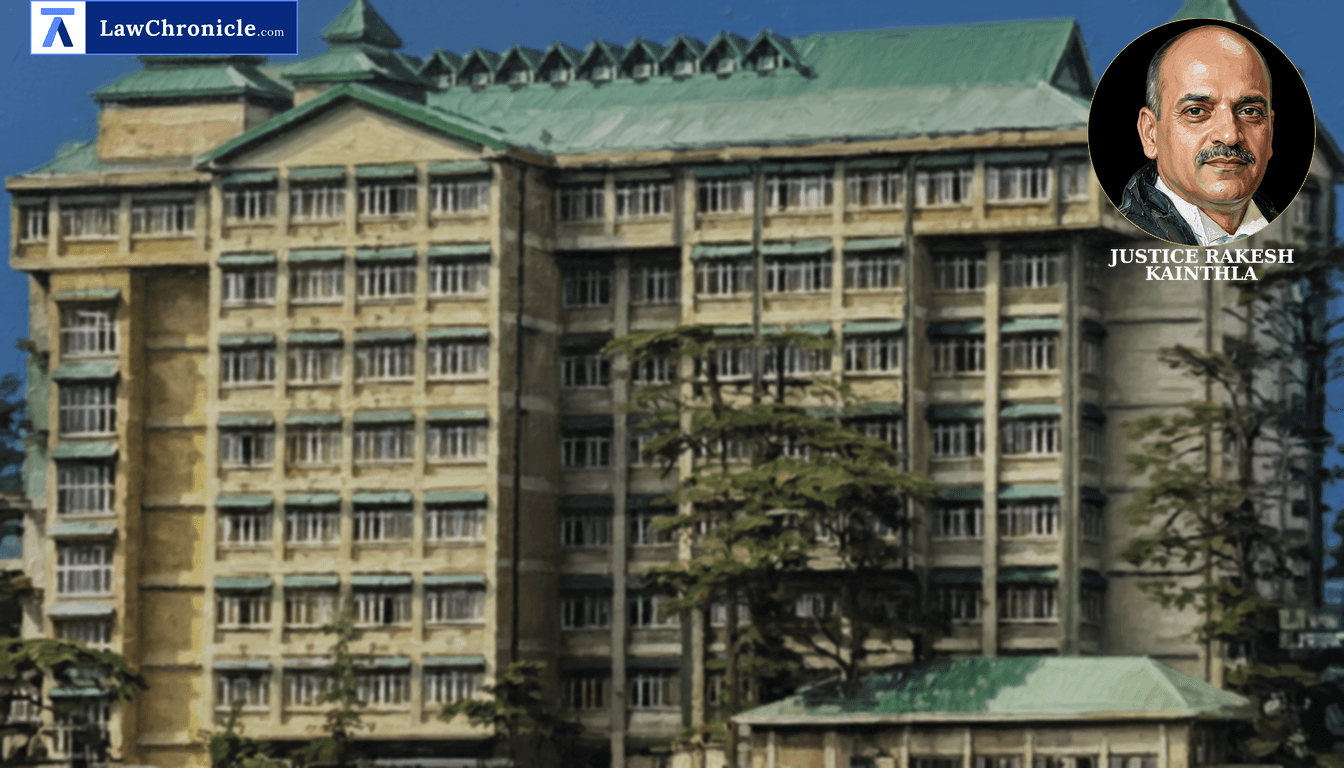
In a decisive reinforcement of the 'sine qua non' for corruption charges, the Himachal Pradesh High Court has overturned the conviction of a Junior Engineer, ruling that the mere recovery of phenolphthalein-treated currency notes cannot trigger a legal presumption of guilt in the absence of cogent evidence showing a specific demand for a bribe.
A single-judge bench of Justice Rakesh Kainthla heard the criminal appeal filed by a Junior Engineer against the 2014 judgment of the Special Judge, Kinnaur. The appellant had been sentenced to two years of simple imprisonment under Sections 7 and 13(2) of the Prevention of Corruption Act following a trap laid by the police after an informant alleged that the official demanded a bribe for preparing bills related to road construction work.
Key Takeaways
Demand as Sine Qua Non
Proof of a specific demand for illegal gratification is an absolute prerequisite; recovery of money alone is legally insufficient to establish an offence under Section 7 of the PC Act.
Restrictions on Section 20 Presumption
The statutory presumption that money was accepted as a motive or reward only triggers after the prosecution proves the fundamental facts of demand and voluntary acceptance.
Hostile Witnesses Impact
When the primary informant turns hostile and denies the demand, the prosecution cannot rely solely on the testimony of raiding party members who were not present during the alleged transaction.
Benefit of Doubt in Corrupt Practices
Any gap in the prosecution's narrative, such as the failure to produce records of pending bills that formed the alleged reason for the bribe, must result in the acquittal of the accused.
The Court analyzed the testimony of the informant, who turned hostile and denied that any demand was made or that he had paid any money to the accused as a bribe. The Court found that the prosecution failed to establish the 'meeting of minds' necessary for an 'offer' or 'obtainment' under the Act.
The Court has following directions:
"The present appeal is allowed, and the judgment and order passed by the learned trial Court in Corruption case No. 0100001 of 2011 are set aside, and the accused is acquitted of the charged offence. Fine amount, if any, be refunded to the appellant/accused after the expiry of the period of appeal... the appellant/accused is directed to furnish personal bond in the sum of ₹25,000/- with one surety in the like amount to the satisfaction of the learned Registrar (Judicial) of this Court/learned Trial Court."
Requirement of Proof for Demand and Acceptance
The Court, in its reasoning, observed: "...mere possession and recovery of tainted currency notes from a public servant, in the absence of proof of demand, is not sufficient to establish an offence under Sections 7 and 13(1)(d) of the PC Act, respectively. Consequently, without evidence of demand for illegal gratification, it cannot be said that the public servant used corrupt or illegal means, or abused his position, to obtain any valuable thing or pecuniary advantage."
The Court further noted that even though the trial court relied on the fact that the informant was literate and likely signed the complaint after reading it, such considerations are irrelevant when the evidence on record fails to prove the essential ingredients of the crime.
Ratio
The presumption of guilt under Section 20 of the Prevention of Corruption Act does not militate against an accused unless the prosecution first proves the factum of demand and voluntary acceptance. Mere recovery of tainted money, dehors the proof of demand, is fatal to the prosecution's case and cannot form the basis for conviction under Sections 7 and 13 of the Act.
Background
The appellant was a Junior Engineer in the HPPWD at Kaza, supervising road works. The informant, a contractor, allegedly filed a complaint stating the appellant demanded ₹1,00,000 to prepare a bill of ₹24,00,000. A trap was laid, and the appellant was caught with the money, which he purportedly threw on a bed upon the arrival of the police. While the trial court convicted him by applying Devinder Kumar Bansal v. State of Punjab ( "(2025) 4 SCC 493: 2025 SCC OnLine SC 488": 2025 CaseBase(SC) 233) and invoking the Section 20 presumption, the High Court found this erroneous. Referring to State through the Central Bureau of Investigation Vs. Dr Anup Kumar Srivastava ( "2017(15) SCC 560": 2017 CaseBase(SC) 757) and Aman Bhatia v. State (NCT of Delhi) ( "2025 SCC OnLine SC 1013": 2025 CaseBase(SC) 594), the High Court emphasized that demand is the gravamen of the offence. The Court also cited Balwinder Singh vs. State of Punjab ( "MANU/PH/4184/2015": 2015 CaseBase(PNH) 150), Dileepbhai Nanubhai Sanghani vs. State of Gujarat & Anr. ( "2025: LiveLaw (SC) 273": 2025 CaseBase(SC) 113), Soundarajan vs. State, State of Lokayuktha Police Davanagere vs. CB Nagaraj, Mil Mustafa Ali Hasmi vs. State of A.P. ( "2024 INSC503": 2024 CaseBase(SC) 654), and Paritala Sudhakar v. State of Telangana ( "2025 SCC OnLine SC 1072": 2025 CaseBase(SC) 558) to underscore that the failure to prove demand is fatal. Consequently, the High Court set aside the conviction and ordered the refund of any fines paid.
Case Details:
Case No.: Cr. Appeal No. 229 of 2014
Neutral Citation: 2026:HHC:43213
Case Title: Krishan Chand v. State of Himachal Pradesh
Appearances:
For the Petitioner(s): Mr N.S. Chandel, Senior Advocate, with Ms Kanika Verma, Advocate.
For the Respondent(s): Mr P.K. Nadda, Additional Advocate General.
Source: 2026 CaseBase(HP) 9433
Similar Articles

 Breaking News


