


Mere Recovery in absence of Proof Of Demand Insufficient Under PC Act: SC
 Copy Link
 Share
 Save
The Supreme Court has reiterated that mere possession or recovery of tainted currency notes from a public servant cannot substitute for concrete proof of demand and voluntary acceptance. Reaffirming established precedent, the Apex Court clarified that the absence of direct or reliable circumstantial evidence establishing a prior demand for an illegal gratification is fatal to the prosecution's bribery case.
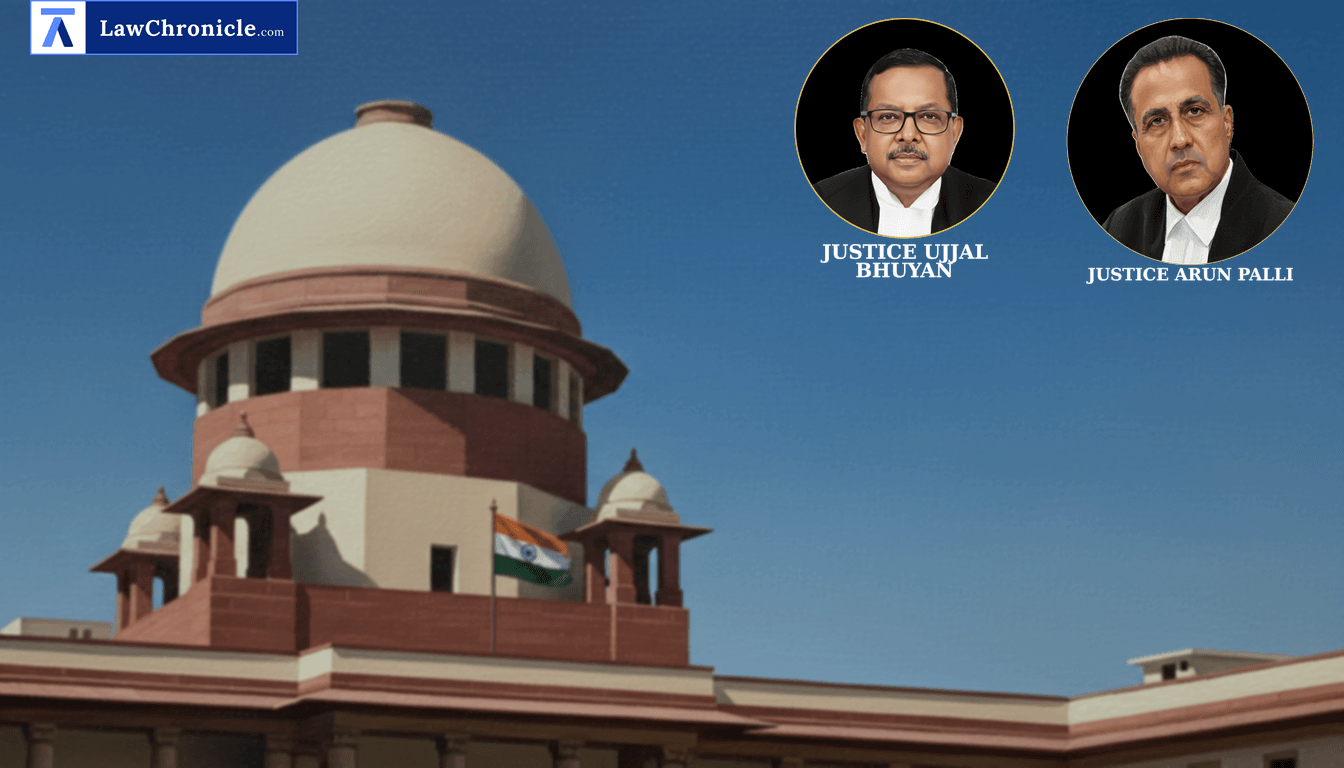
A bench comprising Justice Ujjal Bhuyan and Justice Arun Palli set aside the conviction and sentence of a deceased Patwari, whose legal representatives had stepped in to pursue the appeal, challenging a decision of the High Court of Punjab and Haryana that had affirmed his conviction under the Prevention of Corruption Act, 1988.
Key Takeaways
- Demand as Sine Qua Non: Proving a prior demand for illegal gratification remains an indispensable prerequisite to establish guilt under Sections 7 and 13 of the PC Act.
- Recovery Insufficiency: The physical recovery of tainted currency notes, even when backed by a positive phenolphthalein test, holds no legal weight in the absence of proof establishing demand and acceptance.
- Evidentiary Gaps Fatal: Inconsistencies among prosecution witnesses regarding whether the money was paid, accepted, or recovered in their presence undermine the core charge of corruption.
- Rights of Legal Heirs: Legal representatives can clear the posthumous stigma of conviction on behalf of a deceased public servant.
Analyzing the statutory scope and precedent, the Supreme Court highlighted that the prosecution failed to prove either the demand or the acceptance of the bribe money. Independent and official witnesses brought by the prosecution contradicted the complainant's narrative and admitted that neither the demand nor the acceptance occurred in their presence.
The Apex Court observed that "From the above exposition of law, it may be safely concluded that mere possession and recovery of tainted currency notes from a public servant, in the absence of proof of demand, is not sufficient to establish an offence under Sections 7 and 13(1)(d) of the PC Act respectively. Consequently, without evidence of demand for illegal gratification, it cannot be said that the public servant used corrupt or illegal means, or abused his position, to obtain any valuable thing or pecuniary advantage in terms of Section 13(1)(d) of the PC Act."
While evaluating the legal framework under Sections 7 and 13 of the Prevention of Corruption Act, 1988, the Supreme Court relied on its landmark judgments in P. Satyanarayana Murthy Vs. State of A.P. ( "(2015) 10 SCC 152": 2014 CaseBase(SC) 611), Neeraj Dutta Vs. State (Government of NCT of Delhi), and Aman Bhatia Vs. State to reiterate that proof of demand is the gravamen of the offence.
Ratio
Proof of demand and voluntary acceptance of illegal gratification by a public servant is a sine qua non to establish guilt under Sections 7 and 13(1)(d) of the Prevention of Corruption Act, 1988. Mere possession, recovery of tainted money, or a positive chemical test, independent of proof of demand, is insufficient to sustain a conviction.
Background
The dispute originated from an incident in April 2002, where a Patwari was accused of demanding a bribe of Rs. 10,000 (settled at Rs. 9,500) from the informant to execute a land mutation entry following the death of the informant's brother. The Vigilance Bureau organized a trap raid on April 19, 2002, applying phenolphthalein powder to 19 currency notes of Rs. 500 denomination handed over by the informant.
Following the raid, the Special Judge, Hoshiarpur, convicted the appellant on February 25, 2004, under Section 7 and Section 13(2) of the Prevention of Corruption Act, 1988, sentencing him to two years of rigorous imprisonment along with a fine. The appellant assailed this before the Punjab and Haryana High Court, which dismissed the appeal on November 28, 2013.
During the pendency of the appeal before the Supreme Court, the appellant passed away, following which his legal representatives were substituted to contest the appeal. Examining the trial records, the Supreme Court noted significant contradictions. While the complainant stated that the appellant demanded and placed the bribe money in his trouser pocket, the shadow witness (PW-2) and official witness (PW-4) explicitly admitted during cross-examination that no money was paid or accepted in their presence. Furthermore, PW-2 stated that he was outside the room when the alleged transaction took place and gave conflicting accounts of whether the money was retrieved from the shirt or trouser pocket.
Finding that neither the demand nor the acceptance was proved by the prosecution beyond reasonable doubt, the Supreme Court allowed the appeal and set aside the conviction and sentence passed by the trial court and affirmed by the High Court.
Case Details:
Case No.: Criminal Appeal No. 2137 of 2014
Neutral Citation: 2026 INSC 1031
Case Title: Jaswinder Singh (Dead Through LRs.) v. State of Punjab
Source: 2026 CaseBase(SC) 7020
Similar Articles


 Breaking News


