


Mere Recovery of Tainted Money Without Proof of Demand Insufficient For Conviction under PC Act: SC
 Copy Link
 Share
 Save
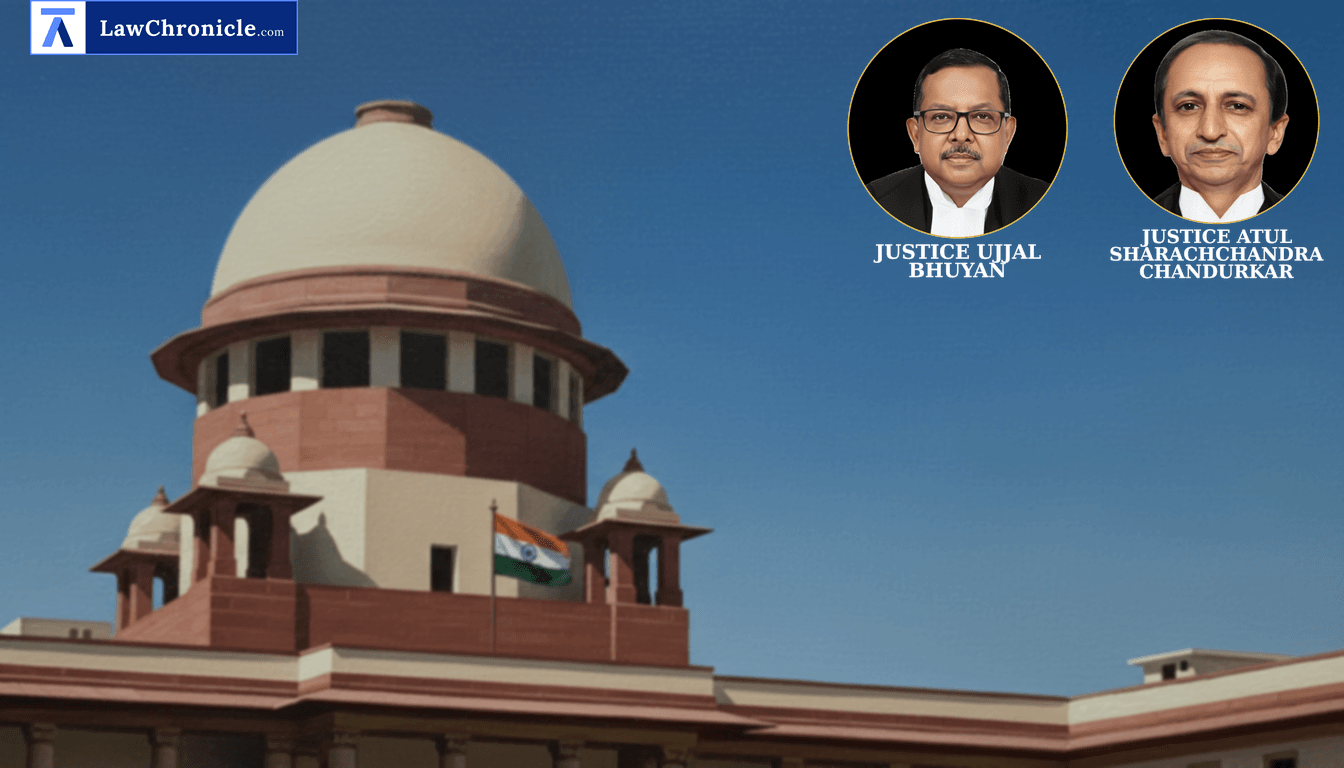
The Supreme has ruled that proof of demand for illegal gratification remains the indispensable foundation for corruption charges, rendering mere recovery of tainted money wholly insufficient to sustain a conviction. A Division Bench comprising Justice Ujjal Bhuyan and Justice Atul S. Chandurkar cleared an Assistant from the District Education Office of corruption charges, emphasizing that uncorroborated recovery of currency notes cannot substitute for concrete evidence of a bribe demand.
Key Takeaways
- Demand Is Sine Qua Non: Prosecution must independently prove the demand of illegal gratification to establish offences under Section 7 and Section 13 of the Prevention of Corruption Act, 1988.
- Recovery Alone Insufficient: The recovery of chemical-stained currency notes from an accused person's residence or possession does not automatically prove guilt in the absence of evidence showing voluntary acceptance upon demand.
- Uncorroborated Testimony Fatal: Relying purely on the uncorroborated testimony of a complainant without shadow or independent witnesses to the actual demand invalidates the trap operation's evidentiary value.
Court's Rationale on Demand and Recovery
Summarizing the core failure of the prosecution's case, the Supreme Court pointed out that despite trap preparations, no member of the trap team or independent witnesses observed the alleged demand or transaction of bribe money.
The Court, in its reasoning, observed: "In so far the present case is concerned, proof of demand and acceptance of illegal gratification by the accused as a fact in issue could not be proved by the prosecution. That being the position, it cannot be said that the charge against the appellant under Sections 7 and 13 of the PC Act was proved, not to speak of beyond all reasonable doubt."
Analyzing the jurisprudence under the Prevention of Corruption Act, 1988, the Bench placed reliance on the Constitution Bench precedent in Neeraj Dutta Vs. State (Government of NCT of Delhi), which established that proof of demand and acceptance is a fact in issue that must be proved either by direct oral or documentary evidence. The Court also reiterated the principles laid down in P. Satyanarayana Murthy Vs. State of A.P. ( "(2015) 10 SCC 152": 2014 CaseBase(SC) 611), Aman Bhatia Vs. State, and Jaswinder Singh Vs. State of Punjab ( "2026 SCC OnLine SC 1952": 2026 CaseBase(SC) 2095), highlighting that failure of the prosecution to establish a demand for illegal gratification is fatal to the prosecution's case, and mere recovery of tainted money cannot entail conviction.
Ratio
Proof of demand of illegal gratification is the sine qua non for establishing an offence under Sections 7 and 13 of the Prevention of Corruption Act, 1988. In the absence of proof of demand, mere recovery of tainted currency notes or a positive phenolphthalein test does not establish corrupt means, abuse of official position, or voluntary acceptance of a bribe beyond reasonable doubt.
Background
The dispute arose from a complaint filed by an orderly appointed at the Government High School at Sirum, who alleged that his salary was withheld and that an Assistant in the District Education Office at Saraikella demanded Rs. 5,000 as a bribe to release it. Following a complaint to the Vigilance Bureau, a trap was organized on May 20, 2010. The complainant and the accused went to the accused's rented residence, where the money was allegedly handed over and kept under a pillow. A subsequent search by the trap team led to the recovery of Rs. 5,000 and a positive phenolphthalein reaction when the accused's hands were tested.
The Special Judge, Anti-Corruption Bureau, West Singhbhum at Chaibasa convicted the accused under Section 7 and Section 13(2) of the Prevention of Corruption Act, 1988, sentencing him to four years of rigorous imprisonment along with a fine. The High Court of Jharkhand affirmed the conviction and sentence in an appeal. Although the appellant had already served his sentence of imprisonment and paid the fine, he pursued the appeal before the Supreme Court to clear his name.
Re-evaluating the evidence, the Supreme Court highlighted serious inconsistencies and noted that no member of the trap team witnessed the actual demand or acceptance of the money. Consequently, the Supreme Court allowed the appeal, set aside the judgment of the Special Judge and the High Court of Jharkhand, and cleared the appellant of all charges.
Case Details:
Case No.: Criminal Appeal No. 4573 of 2026
Neutral Citation: 2026 INSC 1084
Case Title: Ajit Kumar v. State of Jharkhand
Appearances:
For the Petitioner(s): Mr. Shambo Nandy, Advocate
For the Respondent(s): Mr. Mukherjee, Advocate
Source: 2026 CaseBase(SC) 8231
Similar Articles

 Breaking News


