


Mere Suspicion Cannot Override Evidence of Bona Fide Travel: Delhi HC
 Copy Link
 Share
 Save
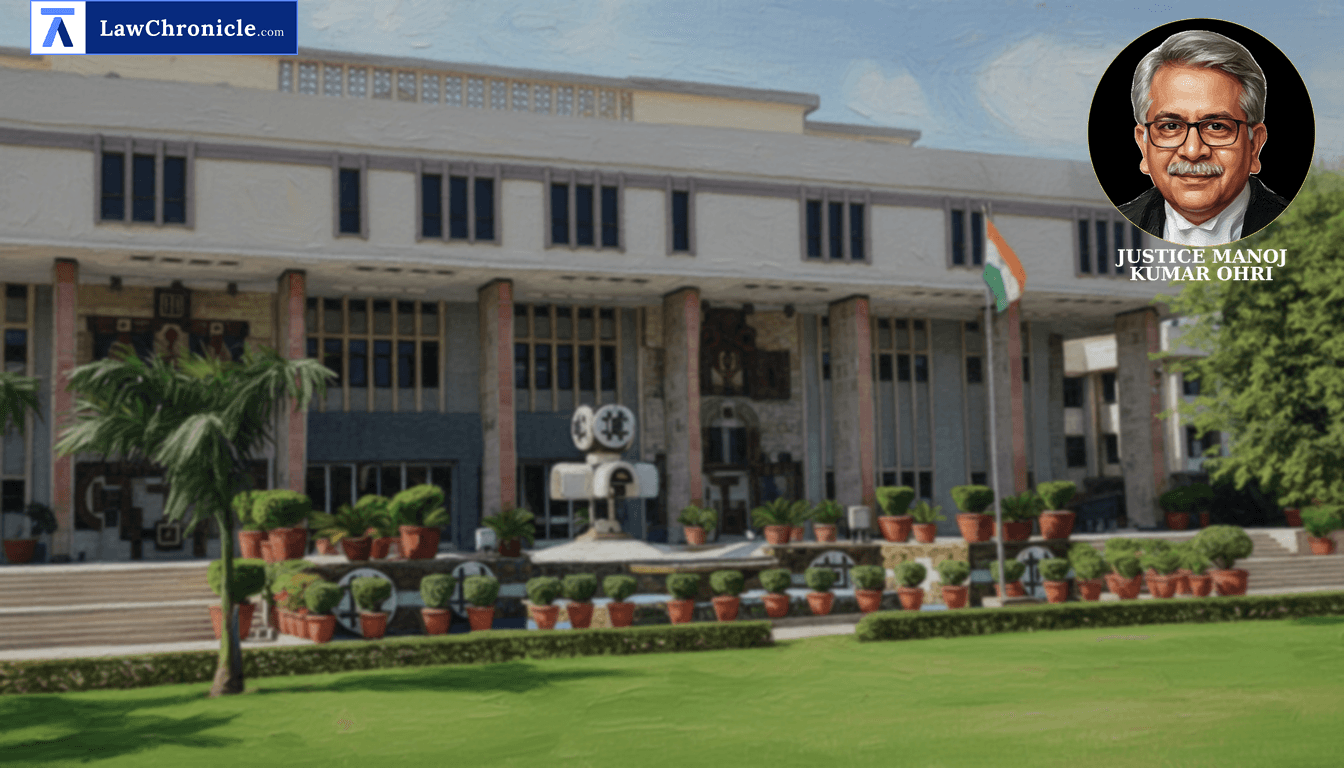
The Delhi High Court recently set aside a Railway Claims Tribunal order, emphasizing that once the recovery of a valid ticket is established, a legal presumption of bona fide travel arises which the Railways must rebut with cogent evidence. A single-judge bench of Justice Manoj Kumar Ohri was hearing an appeal against the dismissal of a claim application involving the death of a passenger near Mathura Railway Station.
Justice Manoj Kumar Ohri observed that technicalities or minor improbabilities in timings cannot be used to defeat claims under beneficial social legislations. The Court noted that the Tribunal had erred by relying on CCTV footage and train timings to rule out an 'untoward incident' despite the recovery of a genuine ticket from the deceased.
Purposive Interpretation of 'Untoward Incident'
The Court, in its reasoning, observed: "the expression 'accidental falling of a passenger from a train carrying passengers' has to receive liberal and purposive interpretation keeping in view the beneficial object of the legislation. ... once presence of a valid railway ticket is established, a presumption arises in favour of bona fide travel unless rebutted by cogent evidence. It was further held that mere absence of eyewitness or mere doubt regarding the manner of occurrence cannot by itself defeat a claim where surrounding circumstances support accidental fall from train."
The Court has following directions:
"The impugned judgment dated 05.11.2020 is set aside and the matter is remanded back to the Tribunal, which is requested to assess the amount of compensation payable to the appellants in accordance with law and direct the authorities concerned to disburse the same within two months from the receipt of a copy of this order. For this purpose, the matter be listed before the Tribunal at the first instance on 28.05.2026."
Background:
The appellants, parents of the deceased Nishank Gupta, filed a claim under Section 23 of the Railway Claims Tribunal Act, 1987 following his death on September 18, 2018. They contended that the deceased fell accidentally from a running train near Naroli, Mathura, while traveling from New Delhi to Nagpur. The Railway Claims Tribunal had dismissed the claim, suggesting the deceased was not a bona fide passenger because CCTV footage showed him at Mathura station after his scheduled train had allegedly departed.
During the proceedings, the appellants relied on Union of India v. Prabhakaran Vijaya Kumar & Ors. ( "(2008) 9 SCC 527": 2008 CaseBase(SC) 1499) to argue for a liberal interpretation of the law. They further cited Union of India v. Rina Devi ( "(2019) 3 SCC 572": 2018 CaseBase(SC) 1157) to establish that the burden of proof shifts to the Railways once a valid ticket is found. The Court also referred to Dwarika Mahto & Ors. v. Union of India, which clarifies that even in cases of break-in-journey or lack of technical endorsements, a person remains a bona fide passenger under Section 2(29) of the Railways Act, 1989 as long as they possess a valid ticket.
Setting aside the Tribunal's findings, the High Court held that the deceased was indeed a bona fide passenger and that the death constituted an 'untoward incident' under Section 123(c) of the Railways Act, 1989. The matter was remanded for compensation assessment.
Case Details:
Case No.: FAO 113/2022
Case Title: P.K. GUPTA AND ANR v. UNION OF INDIA
Appearances:
For the Petitioner(s): Mr. Sirish Gupta, Advocate
For the Respondent(s): Mr. Rajesh Kumar, SPC for UOI with Mr. Siddharth Shekhar and Mr. Yash Narain, Advocates
Source: 2026 CaseBase(DEL) 350
 Breaking News


