Nirmal Hingorani: Lawyer who Championed Rights to Equality and Freedom
 Copy Link
 Share
Share Save
Save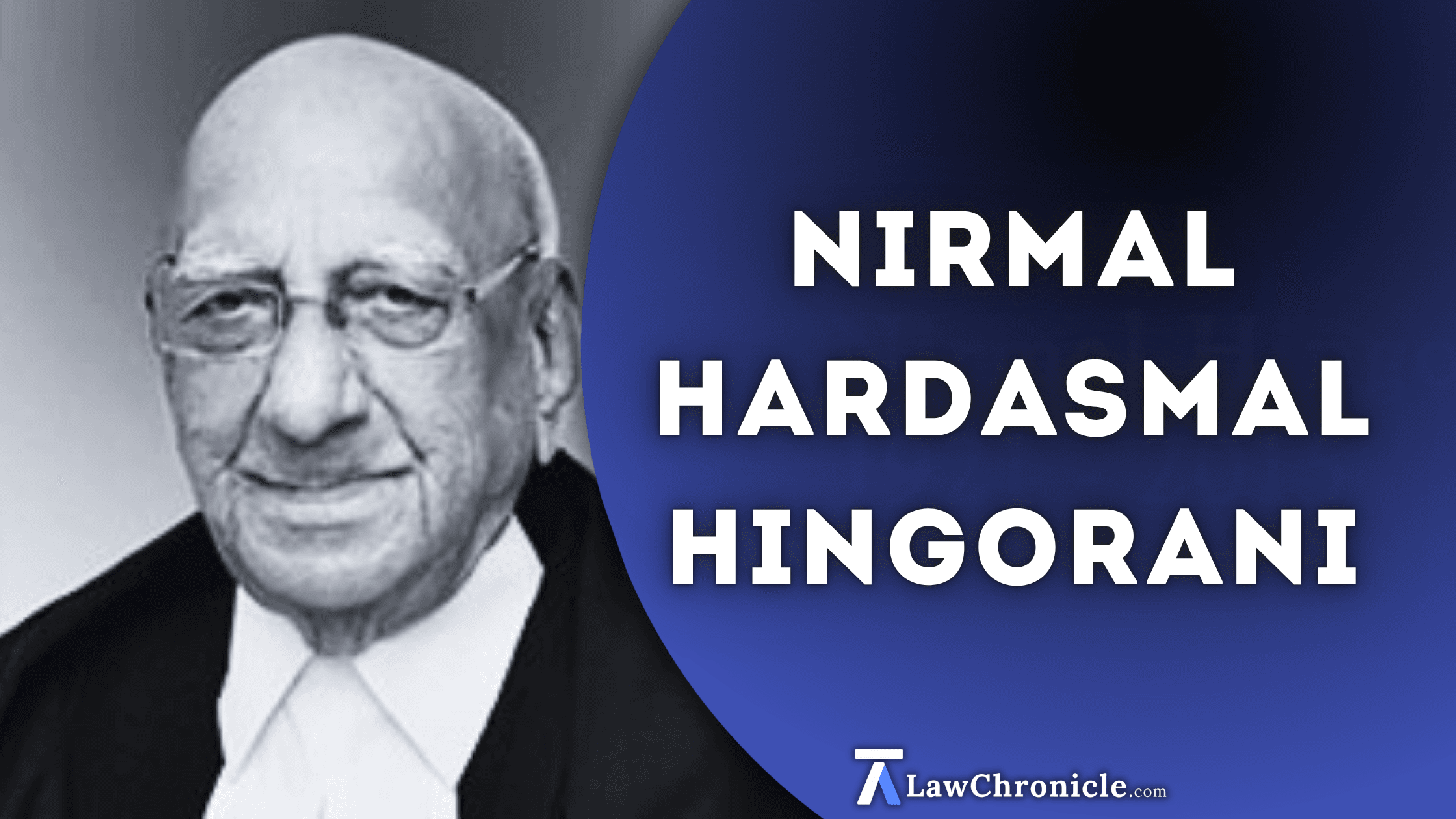
PIL’s are too common these days, and this article is about the one behind PILs in India. Nirmal Hardasmal Hingorani was an Indian lawyer who served as a Senior Advocate of the Supreme Court of India. At the time of his death, Nirmal Hingorani was the Supreme Court’s senior-most practicing advocate, with a standing of nearly 70 years at the Bar. He was born in Larkana, Sind (in undivided India, now in Pakistan), and after Partition migrated to India in 1952, where he was enrolled with the newly formed Supreme Court of India and took up Indian citizenship.
Nirmal Hingorani practiced at the Supreme Court of India from 1952 until his death in 2015, a career of roughly 63 years in India, and nearly 70 years at the Bar overall, counting his earlier practice in Karachi. He is best known, together with his wife Kapila Hingorani, for conceiving and filing India’s first Public Interest Litigation, the Hussainara Khatoon case (1979 CaseBase(SC) 523), which is credited with founding the modern PIL movement in Indian constitutional law.
He is remembered as a pioneering constitutional lawyer of the pre-Partition generation who, together with his wife, used PIL to secure relief for some of India’s most marginalised citizens, and who was formally honoured by the Supreme Court of India through a Full Court Reference upon his death. Raju Ramachandran's “14 Lawyers - Portraits from the Bar” duly recognized his contribution by tracing Nirmal Hingorani's journey through the top court.
Early Life and Education
Nirmal Hingorani was born on 1st July 1921 in Larkana, in the Sind province of undivided India (now in Pakistan), into a prominent Sindhi family with a strong legal background. His paternal grandfather, Diwan Banasing, was a judge in Tharoo Shah, Sind, while his maternal grandfather, Diwan Man Singh, served the princely state of Khairpur. His father, Hardasmal Banasing Hingorani, was also a judge in Karachi and later chaired the Sind and West Pakistan Public Service Commission.
Given this family background, Hingorani took to the study of law. He was conferred the Bachelor of Laws (LL.B.) degree on 11th February 1944 by S.C. Shahani Law College, Karachi, then affiliated to the University of Bombay. On 27 March 1946, he was admitted as an Advocate of the Chief Court of Sind at Karachi under the Indian Bar Councils Act, 1926.
Legal Career
Nirmal Hingorani’s early practice was in Karachi. From 1947 to 1952, he served as Assistant Public Prosecutor for Sind, Karachi, assisting the Government of Sind on issues including the distribution of the waters of the Indus River. In this period, the Governor of Sind also appointed him Special Counsel under the Sind Special Court of Inquiry Ordinance, 1948, to conduct what is described as the first-ever Commonwealth inquiry against a sitting Chief Minister, M.A. Khuhro, the then Chief Minister of Sind, on charges of misconduct and corruption.
While his parents remained in Pakistan until 1966, Nirmal Hingorani himself migrated to India in 1952 and enrolled with the newly established Supreme Court of India. He went on to build a substantial Supreme Court practice, with several of his reported cases from the 1950s contributing to changes in the law. He appeared in a number of major constitutional cases alongside Niren De, the then Attorney General of India, including the Bank Nationalisation Case (1970 CaseBase(SC) 36) and the Privy Purse Case (1970 CaseBase(SC) 268).
His principal area of specialization, particularly from 1979 onward, was constitutional law and public interest litigation, with a strong focus on the protection of fundamental rights: life, liberty and human dignity of marginalized and disadvantaged groups. He was designated a Senior Advocate of the Supreme Court of India in recognition of this standing.
Nirmal Hingorani met his future wife, Pushpa Kapila (who later became known as Kapila Hingorani), at the Supreme Court of India in the early 1960s. Despite differing backgrounds, the couple shared a strong belief in the Indian Constitution and its values, which led them, in 1979, to conceive and file India’s first PIL in the Hussainara Khatoon case (1979 CaseBase(SC) 523). It was reportedly Nirmal Hingorani’s idea to file the petition, as “an officer of the Court and a citizen of the country,” under Article 32 of the Constitution, on behalf of undertrial prisoners personally unknown to either him or Kapila Hingorani, on the basis that the Supreme Court, as the constitutionally appointed protector of fundamental rights, had an obligation to act.
Thereafter, the couple together filed and argued more than 100 PIL actions pro bono in the Supreme Court, addressing issues ranging from undertrial detention, custodial torture, the Bhagalpur Blindings case (1980 CaseBase(SC) 209), conditions in mental hospitals (1988 CaseBase(SC) 546), non-payment of wages to public-sector workers (2003 CaseBase(SC) 434), bonded labour, child labour, dowry, and the practices of devadasi dedication and sati (1990 CaseBase(SC) 585), among others. Their socio-legal work has since been carried forward through the Kapila & Nirmal Hingorani Foundation, which the couple established.
Nirmal Hingorani did not hold any judicial office and was therefore never elevated to the Bench. His career was spent entirely as a practicing advocate, rising to Senior Advocate of the Supreme Court of India.
Notable Cases of Nirmal Hingorani
Hussainara Khatoon & Ors. v. Home Secretary, State of Bihar (1979): India’s First PIL
In 1979, Nirmal Hingorani along with his wife Kapila Hingorani, filed a habeas corpus petition before the Supreme Court of India under Article 32 of the Constitution, on behalf of undertrial prisoners in Bihar who had been detained for periods exceeding the maximum sentences possible for their alleged offences. The petition led to a series of Supreme Court orders holding that the right to a speedy trial is implicit in the right to life and personal liberty guaranteed by Article 21 of the Constitution, and resulted in the release of an estimated 40,000 undertrial prisoners across India. Hussainara Khatoon and Others vs Home Secretary, State of Bihar (1979 CaseBase(SC) 523) is regarded as the origin of the modern PIL movement in India.
Bank Nationalisation Case and Privy Purse Case
Earlier in his career, Hingorani appeared in several major constitutional cases alongside Attorney General Niren De, including the Bank Nationalisation Case in Rustom Cavasjee Cooper v. Union of India (1970 CaseBase(SC) 36) and the Privy Purse Case in H.H. Maharajadhiraja Madhav Rao Jiwaji Raoscindia Bahadur vs Union of India (1970 CaseBase(SC) 268). Both significant constitutional disputes concerning the powers of the Indian state in the years following independence.
Rudul Sah Case
Hingorani, together with Kapila Hingorani, was associated with the PIL in the case of Rudul Sah, an individual who remained incarcerated for about fourteen years after his acquittal. In this matter, the Supreme Court, for the first time in Rudhu Sah vs State of Bihar (1983 CaseBase(SC) 166) granted monetary compensation under its writ jurisdiction (Article 32) for the violation of a fundamental right.
Bhagalpur Blindings and Other PIL Actions
As part of the couple’s broader body of pro bono PIL work, Hingorani was associated with the Bhagalpur Blindings case (concerning police blinding of suspected criminals in Bhagalpur Blindings in Khatri and Others v. State of Bihar (1980 CaseBase(SC) 209)); PILs on the inhuman treatment of mentally ill patients at Ranchi Mental Hospital in 1988 CaseBase(SC) 546, starvation deaths and self-immolation attempts by unpaid public-sector employees in Bihar in 2003 CaseBase(SC) 434, and PILs concerning leprosy patients, bonded labour, child labour in the carpet industry, dowry victims, and victims of police brutality, among other causes.
Public Standing of Nirmal Hingorani
Nirmal Hingorani was described in the Supreme Court’s Full Court Reference on his death as having, with his wife, made an “unparalleled contribution to Constitutional Law and Fundamental Rights” through the first PIL in the Hussainara Khatoon case, and as a lawyer who championed the rights to equality and freedom “not only in his capacity as an advocate, but also in his personal life.” The Reference specifically noted his support for women’s rights, describing him as “a true feminist” who provided “unflagging support to his successful partner.”
More broadly, Nirmal Hingorani is described as having been strongly committed to the rule of law, truth, justice and human dignity, shaped in part by his experience of living through the Second World War and the Partition of British India, during which his immediate family was split between India and Pakistan.
Personal Life
Nirmal Hingorani was married to Pushpa Kapila Hingorani, whom he met at the Supreme Court of India in the early 1960s and who, together with him, is credited as a co-founder of the PIL movement in India and is herself known as the ‘Mother of PIL’. The couple had three children: Aman, Priya, and Shweta, of whom Dr. Aman Hingorani is himself a Senior Advocate practicing in the Supreme Court of India.
Outside law, Nirmal Hingorani was a keen philatelist, maintaining a collection of postage stamps from around the world, some dating back to the 19th century, marking various historical events. He died on 21st July 2015 at the age of 94, having been, at the time of his death, the senior-most practising advocate of the Supreme Court of India.
 Breaking News