


No concept of endless compassion: Karnataka High Court quashes higher post claims for compassionate appointees
 Copy Link
 Share
 Save
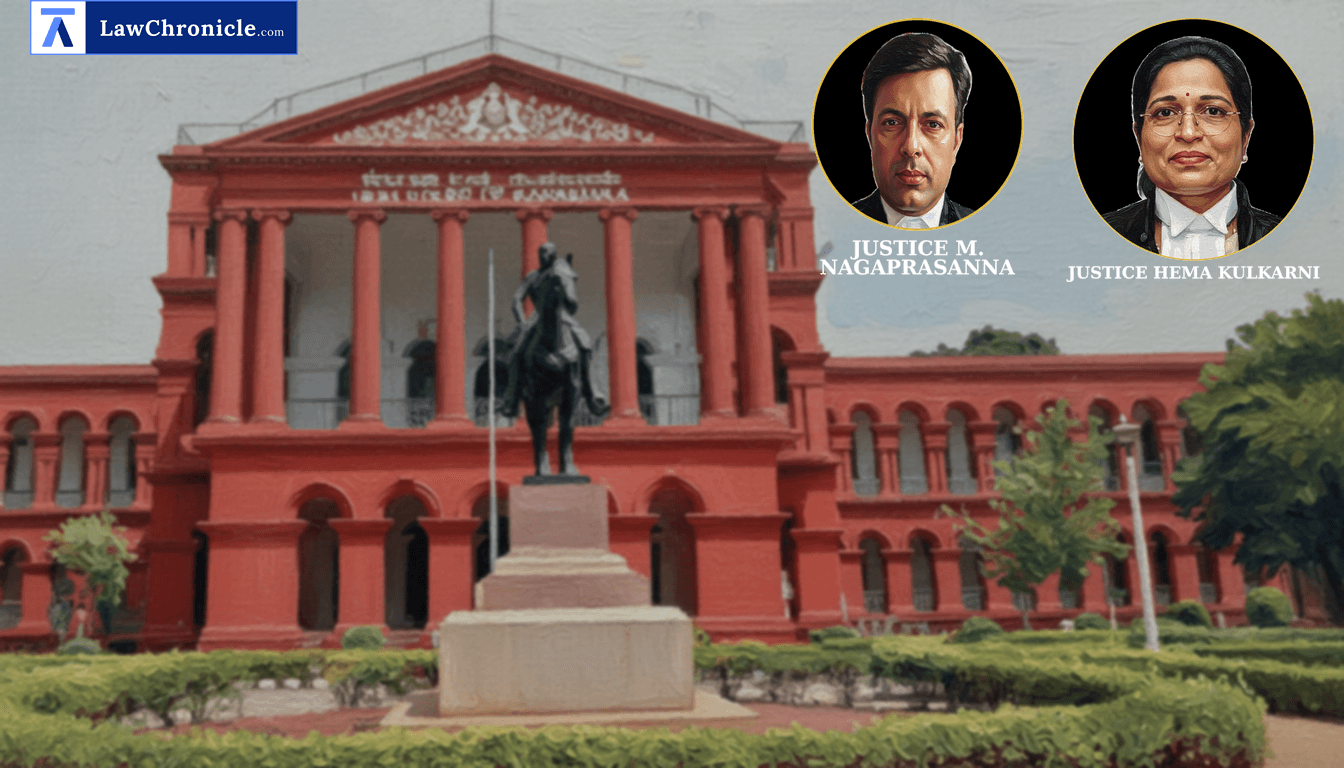
The Karnataka High Court has slammed the brakes on 'endless compassion' in public employment, ruling that appointees under compassionate schemes cannot leverage higher educational qualifications to demand superior posts once they have accepted an initial offer. The Court underscored that such appointments are one-time emergency measures intended to provide immediate financial succour to bereaved families, not a recurring charter for better service benefits or cadre upgrades.
A Division Bench comprising Justice M. Nagaprasanna and Justice Hema Kulkarni delivered this significant verdict while setting aside orders of the Karnataka State Administrative Tribunal (KSAT). The Bench was hearing appeals filed by the State challenging directions to consider two Second Division Assistants (SDAs) for the higher post of First Division Assistant (FDA) solely because they possessed engineering and management degrees.
Key Takeaways
Compassion is not a Reservoir
Compassionate appointment is an exceptional one-time measure that cannot be used as a perpetual ladder for career advancement based on qualification.
Consummation of Right
Once an applicant accepts a post under the scheme, the right to seek compassionate appointment is fully consummated and no second or higher claim survives.
Statutory Limitation Bar
Claims made years after entering service are hit by Section 21 of the Administrative Tribunals Act, 1985, and repeated representations do not extend the limitation period.
Rejection of Negative Equality
Illegal or erroneous benefits granted to others by the State cannot form the basis of a legal claim for parity under Article 14 of the Constitution of India, 1950.
Court Observations on the Limits of Judicial Compassion
The Bench emphasized that public employment cannot be distributed as a matter of descent and exceptions must be strictly construed. The Court, in its reasoning, observed: "Compassionate appointment is not a reservoir from which benefits can be drawn in perpetuity. There is, in law, no concept of endless compassion. Once the object of the Scheme stands fulfilled by appointment to the post contemplated thereunder, compassion cannot be invoked afresh to seek another and higher post."
The Court further cautioned the State against "picking and choosing" individuals for transposition between cadres, noting that administrative aberrations masquerading as precedents lead to chaos and violate Article 14 of the Constitution of India, 1950.
Regarding the specific directions, the Court held: The Court has following directions:
"(i) Both the Writ Petitions are allowed.
(ii) The impugned orders dated 24-03-2026 passed by the Karnataka State Administrative Tribunal, Belagavi in Application Nos.10758 of 2024 and 10759 of 2024 stand quashed."
Ratio
An appointment made under compassionate ground rules attains finality upon acceptance. Possession of a higher educational qualification does not create an indefeasible right to the highest available post within a cadre if the appointment already meets the scheme's criteria. Furthermore, delay in approaching a judicial forum cannot be cured by periodic representations, and Article 14 does not permit the enforcement of 'negative equality' based on prior administrative illegalities.
Background
The case involved two respondents whose fathers died in harness in 2017 while serving as Bandh Peons. Both were appointed as SDAs in 2018 under the Karnataka Civil Services (Appointment on Compassionate Grounds) Rules, 1996. Despite accepting these Group-C posts, they later sought transposition to the FDA cadre citing their higher degrees (B.E. and MBA). When the State rejected their requests, the KSAT directed the State to consider them for the higher posts, relying on the fact that the State had previously transposed other employees in similar situations.
The High Court, however, distinguished several precedents and relied heavily on the Supreme Court's decision in Director Of Town Panchayat V. M. Jayabal. The Bench noted that the respondents had waited six years to approach the Tribunal, violating Section 21 of the Administrative Tribunals Act, 1985, as also seen in Union Of India V. Swapnil. The Court also reiterated the principles from State Of Karnataka V. Madhu Badiger regarding the finality of compassionate appointments. The Court concluded that since the SDA post was a Group-C post, the requirements of the scheme were fully met at the time of initial appointment.
Case Details:
Case No.: WRIT PETITION NO. 106662 OF 2026 (S-KAT) C/W WRIT PETITION NO. 106664 OF 2026 (S-KAT)
Case Title: THE STATE OF KARNATAKA AND OTHERS v. SRI SATHISH V GULLA (and connected matter)
Appearances:
For the Petitioner(s): SRI SHARAD MAGADUM, AGA
For the Respondent(s): SRI G.K.HIREGOUDAR, ADVOCATE FOR C/RESPONDENT
Source: 2026 CaseBase(KAR) 21250
Similar Articles

 Breaking News


