


No Monopoly Over Religious Deities and City Names in Trade Marks: Telangana HC
 Copy Link
 Share
 Save
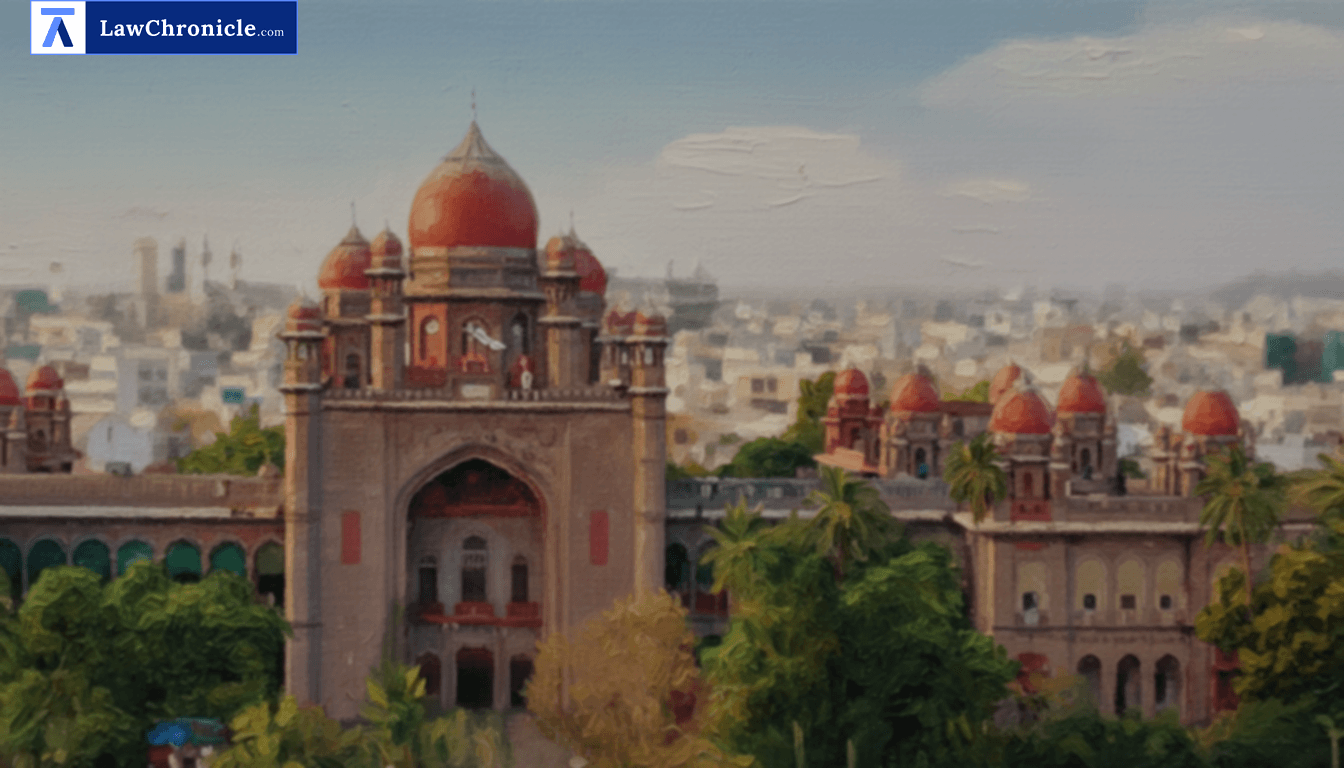
The High Court for the State of Telangana has fundamentally shifted the benchmark for consumer confusion in intellectual property disputes, ruling that trademark protection cannot extend to exclusive proprietary rights over geographical names like 'Kancheepuram' or deity names like 'Mahalakshmi' being trade marked. The Telangana High Court declared that the age-old standard of a consumer with 'imperfect recollection' is now obsolete in the digital era, replaced by the 'perceptive consumer' who makes informed purchasing decisions.
Justice Moushumi Bhattacharya and Justice Renuka Yara delivered this significant verdict while hearing an appeal against a Trial Court order. The dispute involved a prominent silk retailer seeking to restrain a competitor from using a deceptively similar trade name, logo, and trade dress in the retail saree market.
Key Takeaways
Redefining the Consumer Test
In a digital-first world, the traditional test of 'average intelligence and imperfect recollection' has been replaced by the 'perceptive consumer' standard for high-engagement purchases.
Public Domain Restrictions
Proprietors cannot claim exclusive rights over terms denoting geographical origins or names of deities, as these remain part of the common vocabulary and trade.
Composite Mark Limitations
Under Section 17 of the The Trade Marks Act, 1999, registration of a composite mark does not grant an exclusive right to individual non-distinctive components of that mark.
Visual Over Phonetic Similarity
In industries where purchasing involves tactile and visual sensations, such as textile retail, visual dissimilarities in labels outweigh phonetic similarities in names.
Transitioning from 'Imperfect Recollection' to 'Perceptive Consumer'
The Court observed that the traditional legal framework for determining trademark infringement must evolve with changing consumer behavior. Rejecting the appellant's argument that consumers would be unintentionally misled, the Court emphasized that modern buyers are constantly exposed to product information via social media and digital platforms.
The Court, in its reasoning, observed: "In our considered opinion, the traditional test of a person of average intelligence and imperfect recollection should shift to a perceptive consumer with informed associations – who is mindful of the source, brand, quality, comfort and aspirational-index of the proposed purchase. The earlier test no longer serves the present society; consumers are now constantly exposed to product-promotions by means of print and social media feeds on a daily basis."
The Doctrine of Dissimilarity in Composite Marks
Analyzing the competing labels, the Bench noted that the similarities paled in significance when compared to the obvious visual differences. Since the appellant's mark used common words like 'Kancheepuram' (a city famous for silk) and 'Mahalakshmi' (a deity), it was held to be a composite mark subject to the restrictions of Section 17 of the The Trade Marks Act, 1999.
Referring to the classical trinity of trademark law as established in Reckitt & Colman Products V. Borden, the Court noted that a plaintiff must satisfy the requirements of reputation, misrepresentation, and consequential damage. The Bench further relied on the principles of Salmon and Hueston on Law of Torts regarding the tort of passing off to distinguish between unfair competition and legitimate trade use.
The Court has following directions:
"CMA.No.441 of 2025, along with all connected applications, is accordingly dismissed. No costs."
Ratio
A registered proprietor of a composite trade mark cannot claim exclusive rights over individual components that are common to the trade, non-distinctive, or denote geographical origin under Section 17(2)(b) of the The Trade Marks Act, 1999. Furthermore, for planned leisure purchases like sarees, the phonetic similarity of marks is secondary to visual and tactile sensations, and the legal standard for confusion must be based on a 'perceptive consumer' rather than one with 'imperfect recollection.'
Background
The appellant, M/s Sai Silks (Kalamandir) Limited, moved the High Court challenging a Common Order dated July 24, 2025, passed by the II Additional Chief Judge, City Civil Court at Hyderabad. The appellant had filed a suit for permanent injunction and infringement under the The Trade Marks Act, 1999 and Section 55 of the The Copyright Act, 1957 against the respondents for using the name 'Kanchipuram Varahi Lakshmi Silks'.
The appellant contended that they were the registered proprietors of 'Kancheepuram Vara Mahalakshmi Silks' and that the respondents—one of whom had a prior business MoU with the appellant—were riding on their goodwill. The respondents argued that the suit was an attempt to evade revenue-sharing obligations and that the marks were visually distinct.
The High Court upheld the Trial Court's findings, noting that 'Kanchipuram' is a recognized Geographical Indication (GI) and 'Mahalakshmi' is a common religious reference. Consequently, the appellant could not monopolize these terms. The appeal was dismissed, confirming that no interim injunction was warranted as the dissimilarities outweighed the phonetic similarities.
Case Details:
Case No.: CIVIL MISCELLANEOUS APPEAL NO.441 OF 2025
Case Title: M/s Sai Silks (Kalamandir) Limited vs. SKP B Gopinath Private Limited and 2 Others
Appearances:
For the Petitioner(s): Mr. Basa Chanakya, Advocate
For the Respondent(s): Mr. Herur Rajesh Kumar, Advocate
Source: 2026 CaseBase(TEL) 21864
Similar Articles
 Breaking News


