


No Notice Needed To Borrower Under Section 14 Of SARFAESI Act: Allahabad HC
 Copy Link
 Share
 Save
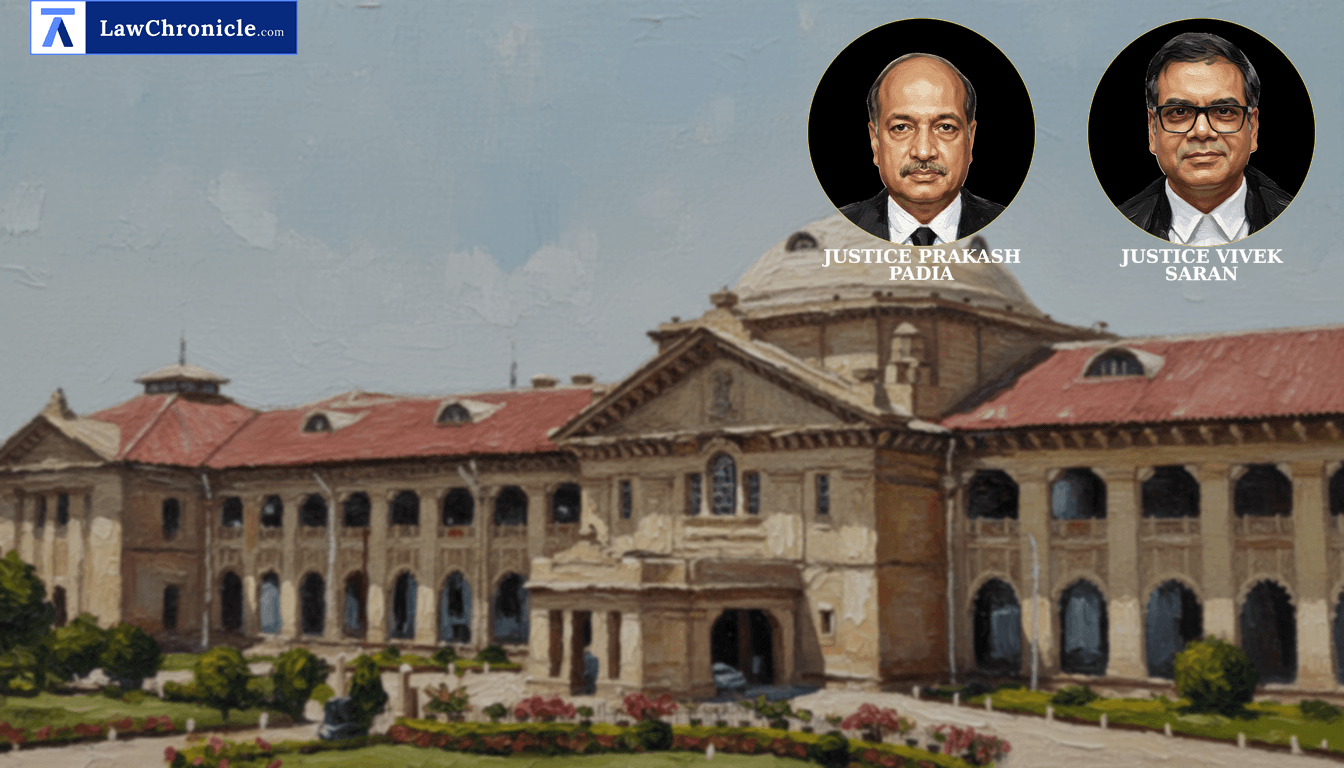
In a decisive affirmation of debt recovery procedures, the Allahabad High Court has ruled that District Magistrates are not required to issue prior notice or grant a hearing to defaulting borrowers when taking physical possession of secured assets. The decision reinforces that proceedings under Section 14 of the Securitisation and Reconstruction of Financial Assets and Enforcement of Security Interest Act, 2002 are purely administrative and ministerial, leaving no room for quasi-judicial adjudication of disputes raised by borrowers.
Delivering the judgment, a Division Bench comprising Justice Prakash Padia and Justice Vivek Saran dismissed a writ petition challenging an eviction and possession order passed by the Additional District Magistrate. The Bench underscored that the statutory scheme under Section 14 mandates only the verification of affidavits provided by secured creditors rather than an inquiry into the underlying rights of the default borrower.
Key Takeaways
No Hearing Rights for Borrowers: District Magistrates acting under Section 14 are not bound by principles of natural justice to afford a hearing to defaulting borrowers.
Ministerial Function Clarified: Passing possession orders is a non-adjudicatory, ministerial act limited strictly to verifying the compliance details in the lender's affidavit.
Protection for Tenants Distinguished: The High Court clarified that while tenant-lessees in possession may claim procedural notice, actual borrowers cannot extend those precedent protections to themselves.
Magistrate Performs Ministerial Act Under Section 14
The High Court carefully evaluated the scope of power exercised by the District Magistrate or Chief Metropolitan Magistrate under Section 14 of the Securitisation and Reconstruction of Financial Assets and Enforcement of Security Interest Act, 2002. The Court held that the statutory provision does not contemplate any notice or opportunity of hearing to the borrower before assisting the secured creditor in obtaining possession of mortgaged property.
The Court, in its reasoning, observed: "...the step to be taken by the CMM/DM under Section 14 of the SARFAESI Act, is a ministerial step. While disposing of the application under Section 14 of the SARFAESI Act, no element of quasi-judicial function or application of mind would require. The Magistrate has to adjudicate and decide the correctness of the information given in the application and nothing more. Therefore, Section 14 does not involve an adjudicatory process qua points raised by the borrower against the secured creditor taking possession of secured assets."
Addressing the precedent relied upon by the petitioners in Harshad Goverdhan Sondagar Vs. International Assets Reconstruction Co. Ltd., the Bench noted that the cited judgment governed the rights of third-party lessees or tenants in possession, not defaulting borrowers themselves. Relying on the principles in Balkrishna Rama Tarle Dead Vs. Phoenix ARC Private Limited and R.D. Jain & Co. Vs. Capital First Ltd., the High Court reiterates that the administrative nature of Section 14 proceedings remains settled, and the judgment in Bank of Baroda Earlier Vijaya Bank Vs. State of U.P. and others offers no assistance to borrowers.
Ratio
Proceedings under Section 14 of the Securitisation and Reconstruction of Financial Assets and Enforcement of Security Interest Act, 2002 are purely ministerial in nature, requiring no quasi-judicial adjudication or compliance with natural justice principles of hearing qua the borrower before the Magistrate takes measures to hand over possession of secured assets to a secured creditor.
Background
The petitioners, Sachchidanand Yadav and another, had approached the High Court seeking a writ of certiorari to quash an order dated February 28, 2026, passed by the Additional District Magistrate in Case No. 336 of 2026 under Section 14 of the Securitisation and Reconstruction of Financial Assets and Enforcement of Security Interest Act, 2002 upon an application filed by Adhar Housing Finance Limited. The petitioners contended that the order suffered from a manifest error as it was passed without providing them an opportunity of hearing, relying heavily on the judgment in Harshad Goverdhan Sondagar Vs. International Assets Reconstruction Co. Ltd..
Conversely, the respondent financial institution placed reliance on Bank of Baroda Earlier Vijaya Bank Vs. State of U.P. and others, arguing that Section 14 actions require no prior notice or adjudication. Concurring with the respondents and binding precedent from the Apex Court, the High Court held that the petitioners, being borrowers, possessed no legal right to an adjudicatory hearing at the stage of Section 14 possession assistance. Consequently, the High Court found the writ petition to be sans merit and dismissed the same without any order as to costs.
Case Details:
Case No.: WRIT - C No. - 27589 of 2026
Case Title: Sachchidanand Yadav and another v. State of U.P. and 3 others
Appearances:
For the Petitioner(s): Umesh Chandra Prajapati
For the Respondent(s): C.S.C., Ramesh Kumar Shukla
Source: 2026 CaseBase(ALL) 873
Similar Articles


 Breaking News


