


No Recovery Of Excess Pay From Employee In Absence Of Misrepresentation: Madras HC
 Copy Link
 Share
 Save
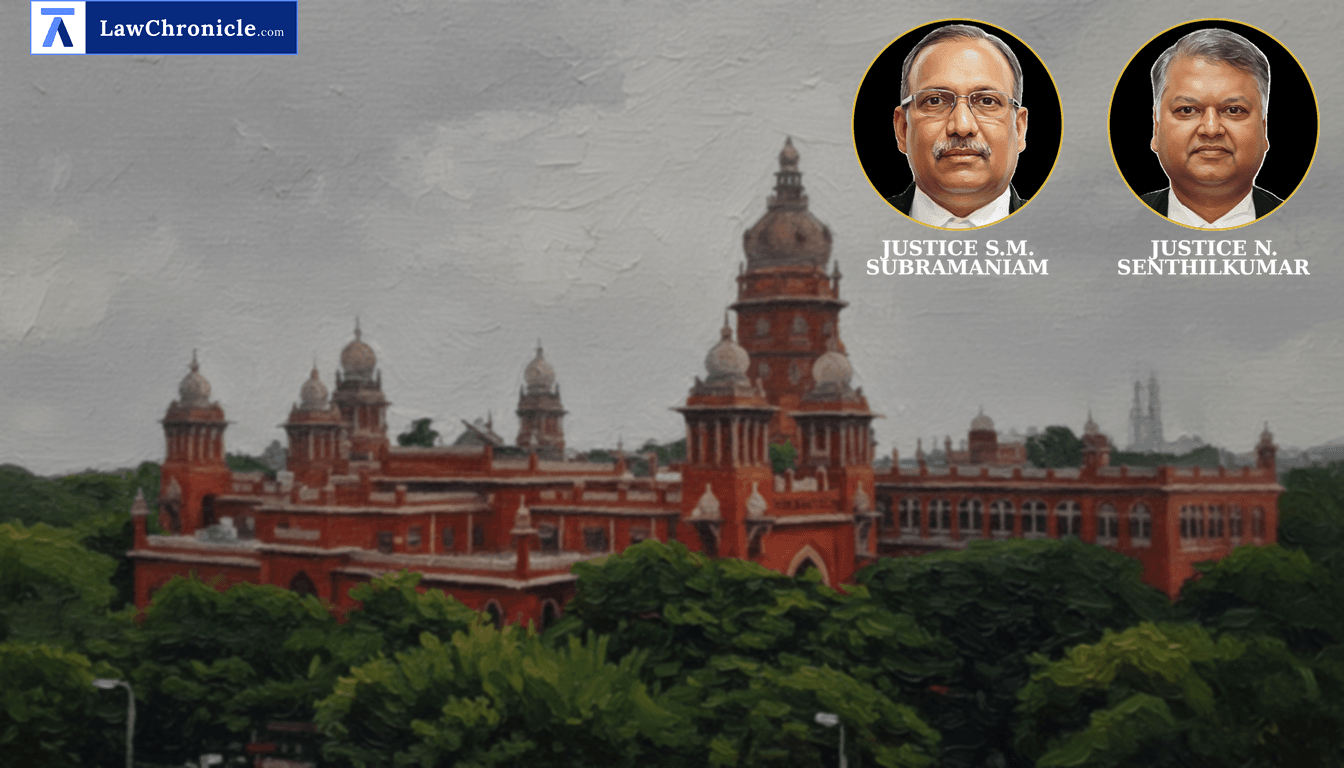
The Madras High Court has quashed recovery orders for excess salary paid due to departmental errors, ruling that penalizing an employee for an establishment's mistake after several years constitutes extreme hardship. The court reaffirmed that while the State may rectify pay-fixation errors, it cannot recover excess payments from employees who did not contribute to the error through any misrepresentation.
A division bench comprising Justice S.M. Subramaniam and Justice N. Senthilkumar heard the writ petition filed under Article 226 of the Constitution of India. The Court was tasked with determining the legality of a recovery order issued against a judicial department employee after an internal audit flagged an inadmissible advance increment granted over a decade ago.
The Court observed that while the authorities are empowered to rectify pay scales to prevent the unjust gain of public money, the recovery of already disbursed amounts is subject to equitable principles. The Court has the following directions:
"The excess amount, if any, recovered on account of the impugned order is directed to be re-paid to the petitioner within a period of twelve (12) weeks from the date of receipt of a copy of this order."
The Court, in its reasoning, observed: "Unjust gain of public money is impermissible under law. In such circumstances, the Authorities Competent are empowered to rectify the errors in fixation of pay and grant the correct pay as applicable. However, the respondents are unable to establish that there was a misrepresentation on the part of the employee during fixation of pay. It is an error committed by the Establishment for which the petitioner cannot be penalised after a lapse of many years. Recovery of excess salary at this length of time would result in extreme hardship to the employee."
Referencing the landmark decision in State of Punjab v. Rafiq Masih, the bench noted that recovery is impermissible from Group C and D employees or when the payment was made more than five years prior to the recovery order.
Background:
The petitioner was appointed as a Steno-Typist Grade-III on a temporary basis in 1997 and later re-allotted to the Judicial Department by the TNPSC in 2001. Over the years, she received promotions to Grade-II and Grade-I. However, in September 2025, the Principal District Judge, Nagapattinam, issued an order for the recovery of Rs.69,450/- in 35 instalments. This action was prompted by an internal audit report which claimed an advance increment granted on June 1, 2009, was inadmissible.
The petitioner challenged this recovery, seeking a writ of certiorari and mandamus to quash the order and ensure the continuation of her existing pay scale. The respondents argued that they were merely correcting an audit objection regarding inadmissible pay. The High Court, while allowing the revision of the pay scale to ensure future correctness, held that the retrospective recovery was legally unsustainable as there was no fault or misrepresentation on the part of the employee.
Key Takeaways:
Mistake of Establishment Exception
Employees cannot be made to suffer for clerical or administrative errors in pay fixation that have persisted for years without any fraud on their part.
Timely Recovery Limitations
Administrative bodies must act promptly; attempting to recover excess payments made over five years ago is deemed iniquitous and arbitrary.
Protection for Lower Cadres
Reiterating settled law, the court emphasized that Group C (Class III) and Group D employees are specially protected from recovery actions that would cause them financial distress.
Ratio Decidendi:
While the State retains the inherent right to correct erroneous pay fixations to safeguard public funds, the recovery of excess amounts already paid is prohibited if the error was committed by the employer without any misrepresentation by the employee and if such recovery would cause extreme hardship or be iniquitous due to the passage of time.
Case Details:
Case No.: W.P.NO.42022 OF 2025
Case Title: K.Amutha v. The Registrar General, High Court of Madras and Others
Appearances:
For the Petitioner(s): Mr.A.Sakthivel
For the Respondent(s): Mr.Anand Subramanian (R1 & R3), Dr.R.Gouri (R2 & R5), Mr.S.Mahesh for Mr.V.Vijay Shankar (R4)
Source: 2026 CaseBase(MAD) 315
Similar Articles

 Breaking News


