


Overstaying Visa Does Not Amount to Illegal Entry to deny bail under UAPA: SC
 Copy Link
 Share
 Save
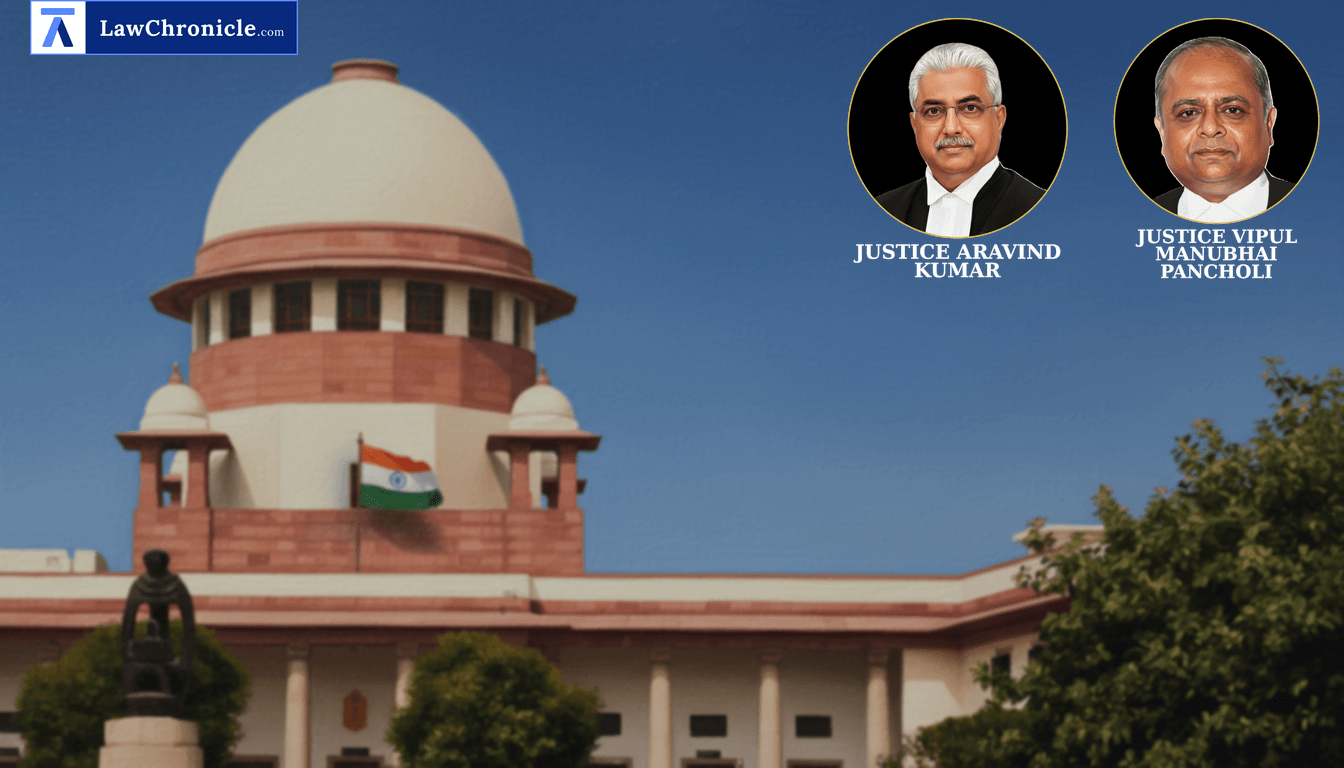
In a decisive clarification of anti-terror jurisprudence, the Supreme Court ruled that a foreign national's entry into India under a valid visa does not retroactively become an 'unauthorized or illegal entry' upon the visa's expiry to trigger the stringent statutory bail bar under the Unlawful Activities (Prevention) Act, 1967. The Apex Court affirmed that the statutory bar against granting bail to non-citizens under anti-terror provisions cannot override an accused's right to default bail when the prosecution fails to file a timely charge-sheet.
A Bench comprising Justice Aravind Kumar and Justice Vipul M. Pancholi dismissed the Union of India's appeal against a Madras High Court judgment, which had set aside an order cancelling the default bail of a Sri Lankan national accused in an anti-terror case.
Key Takeaways
-
Temporal Scope of Illegal Entry Clarified
Overstaying a visa after lawful entry does not retroactively convert the initial entrance into an illegal entry for invoking strict anti-terror bail restrictions.
-
Default Bail Protection Preserved
The statutory bar under Section 43D(7) of the Unlawful Activities (Prevention) Act, 1967 overrides only specific bail restrictions and does not whittle down the right to default bail under Section 167(2) of the Code Of Criminal Procedure, 1973.
-
Evidentiary Value of VAO Confessions
Confessions made to a Village Administrative Officer are not barred under Section 25 of the Evidence Act as a VAO is not a police officer.
-
High Evidentiary Bar for Bail Cancellation
Seeking cancellation of default bail long after a charge-sheet is filed requires strong, special grounds and cannot be granted on unproven factual assertions.
Interpretation and Application of Section 43D(7) of UAPA
Analyzing the statutory scheme governing bail under the Unlawful Activities (Prevention) Act, 1967, the Supreme Court evaluated the precise interaction between Section 43D(2) and Section 43D(7). The Court noted that Section 167 of the Code Of Criminal Procedure, 1973 applies to offenses punishable under the Unlawful Activities (Prevention) Act, 1967 with modified timeframes for investigation up to a maximum of 180 days. Dissecting Section 43D(7) of the Unlawful Activities (Prevention) Act, 1967, the Court enumerated three conjunctive conditions required to trigger the absolute bar against granting bail: the person must be accused of an offense under the UAPA, must not be an Indian citizen, and must have entered India unauthorizedly or illegally.
The Apex Court discussed that "merely because a person is not an Indian Citizen will not suffice to trigger the rigors of sub-section (7) of Section 43D rather the condition mandating 'at the time he entered India', such entry must be either unauthorized or illegal must also co-exist, therefore, a probable inference that can be drawn herein is that where a foreign national enters India under an authorization or through a legal process such as a valid visa, mere fact that subsequently, such authorization is revoked or the stay becomes illegal will not retroactively convert a lawful entry into an 'unauthorized or illegal entry' warranting invocation of sub-section (7) of Section 43D..."
Addressing the exception provided within Section 43D(7), the Supreme Court noted that judicial discretion to grant bail to a foreign national exists under a high threshold requiring "very exceptional circumstances" and "reasons to be recorded in writing." The Court observed: "The legislative intent warranting such high threshold is primarily backed by considerations of national security, larger public interest and sovereignty of India."
On the issue of the respondent's extra-judicial confession to a Village Administrative Officer (VAO) recorded in a separate FIR under the Foreigners Act, 1946, the Passport (Entry into India) Rules, 1950, the Passports Act, 1967, and the Citizenship Act, 1955, the Supreme Court clarified that such confessions are not automatically inadmissible. Citing Sivakumar v. State by Inspector of Police ( "(2006) 1 SCC 714": 2005 CaseBase(SC) 400), R. Kuppusamy v. State represented by Inspector of Police, Ambeiligai ( "(2013) 3 SCC 322": 2013 CaseBase(SC) 963), Baskaran and Another v. State of Tamil Nadu ( "(2014) 5 SCC 765": 2014 CaseBase(SC) 267), and Kadamanian Alias Manikandan v. State represented by Inspector of Police, the Apex Court recognized that a VAO is not a police officer under Section 25 of the Indian Evidence Act, 1872, making the extra-judicial confession admissible subject to voluntariness and credibility.
Ratio
Subsequent revocation of visa authorization or overstaying in India does not retroactively convert an initially lawful entry into an 'unauthorized or illegal entry' under Section 43D(7) of the Unlawful Activities (Prevention) Act, 1967. Furthermore, Section 43D(7) overrides sub-sections (5) and (6) of Section 43D but does not exclude or whittle down the statutory mandate of default bail under Section 43D(2) read with Section 167(2) of the Code of Criminal Procedure, 1973.
Background
The case arose from an FIR registered in April 2018 at PS Keelakarai, Tamil Nadu, under Sections 153A and 120B of the Indian Penal Code, 1860, Sections 15, 17, 18, 19, and 20 of the Unlawful Activities (Prevention) Act, 1967, and Section 25(1)(a) of the Arms Act, 1959. The respondent was arrested for an alleged conspiracy to cause religious disharmony. Since the prosecution failed to file a charge-sheet within the statutory period, the Sessions Court granted default bail under Section 167(2) of the Code Of Criminal Procedure, 1973 on July 5, 2018.
In January 2019, the National Investigation Agency (NIA) took over the investigation. Subsequently, in November 2019, another FIR was registered under Sections 468 and 471 of the Indian Penal Code, 1860, Section 14 of the Foreigners Act, 1946, Sections 3(a) and 6(a) of the Passport (Entry into India) Rules, 1950, Section 6(c) of the Passports Act, 1967, and Section 2(1)(b)(I) of the Citizenship Act, 1955, alleging that the respondent was a Sri Lankan national who overstayed his visa and forged Indian identification documents.
After the NIA filed its charge-sheet in January 2021, the Union of India moved for cancellation of default bail in April 2022 under Section 439(2) of the Code Of Criminal Procedure, 1973, arguing that the respondent suppressed his Sri Lankan nationality to bypass Section 43D(7) of the Unlawful Activities (Prevention) Act, 1967. The Special Court cancelled the bail in July 2022. However, on appeal, the Madras High Court set aside the cancellation order in December 2023, prompting the Union of India to appeal to the Supreme Court.
Examining settled precedents on bail cancellation, the Supreme Court referenced Gurcharan Singh and Others v. State (Delhi Administration), Dolat Ram and Others v. State of Haryana ( "(1995) 1 SCC 349": 1994 CaseBase(SC) 907), Prakash Kadam and Others v. Ram Prasad Vishwanath Gupta and Another, Neeru Yadav v. State of Uttar Pradesh and Another, Deepak Yadav v. State of Uttar Pradesh and Another, State of Karnataka v. Sri Darshan and Others, Yogendra Pal Singh v. Raghvendra Singh alias Prince and Another ( "(2025) SCC OnLine SC 2580": 2025 CaseBase(SC) 1371), and Zeba Khan v. State of U.P. & Others ( "(2026) SCC OnLine SC 188": 2026 CaseBase(SC) 127) to emphasize the fundamental distinction between setting aside an illegal bail order and cancelling bail based on post-bail supervening conduct. The Supreme Court also discussed Abdul Basit Alias Raju and Others v. Mohd. Abdul Kadir Chaudhary and Another on trial court review powers and State through Central Bureau of Investigation v. T Gangi Reddy Alias Yerra Gangi Reddy regarding statutory bail cancellation.
Finding no proof that the respondent's initial entry into India was unauthorized or illegal, and noting the unexplainable delay in seeking bail cancellation, the Supreme Court dismissed the appeal and affirmed the judgment of the Madras High Court.
Case Details:
Case No.: Criminal Appeal No(s). of 2026 (Arising out of SLP (Criminal) No(s). 7177 of 2024)
Neutral Citation: 2026 INSC 1160
Case Title: Union of India v. Mohamed Rifas @ Mohamed Rigbas
Appearances:
For the Petitioner(s): Ms. Aishwarya Bhati, Learned Additional Solicitor General of India
For the Respondent(s): Shri A Velan, Learned Counsel
Source: 2026 CaseBase(SC) 9504
Similar Articles
 Breaking News


