


Delhi High Court Grants Bail to Human Rights Activist Under UAPA
 Copy Link
 Share
 Save
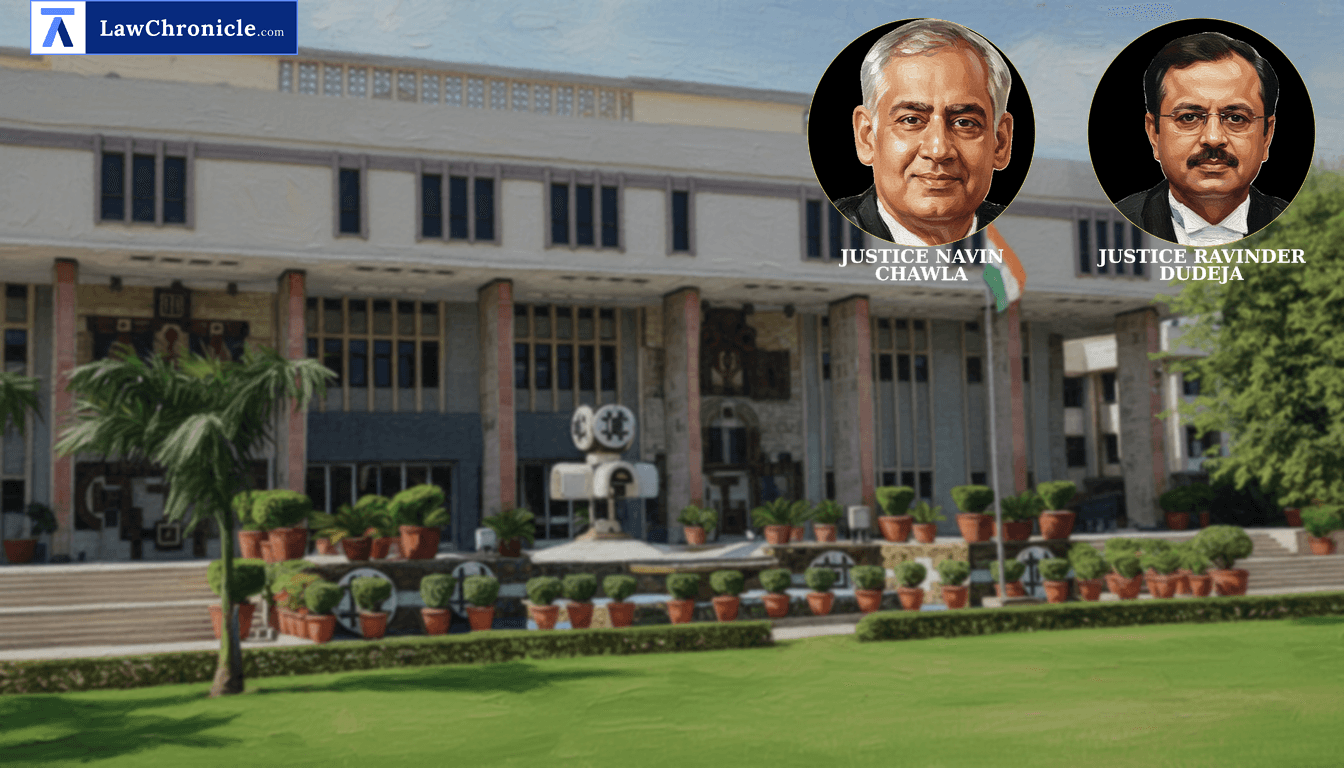
The Delhi High Court granted regular bail to a Kashmiri human rights activist after nearly four and a half years of incarceration under the stringent Unlawful Activities (Prevention) Act, 1967. The Court held that, despite the seriousness of the allegations of terror links, the prolonged pre-trial detention and the slow pace of the trial required balancing national security concerns with the fundamental right to a speedy trial under the Constitution of India, 1950.
A bench comprising Justice Navin Chawla and Justice Ravinder Dudeja heard the appeal challenging a Trial Court's order that had rejected the bail plea of the appellant. The appellant, who serves as a Program Coordinator for a civil society group, was accused by the National Investigation Agency Act, 2008 of acting as an over-ground worker (OGW) for the Lashkar-e-Taiba (LeT) and facilitating the recruitment of others into the proscribed organization.
Balancing Statutory Bars with Constitutional Guarantees
The Court extensively analyzed the interplay between the restrictive bail conditions under Section 43D(5) of the Unlawful Activities (Prevention) Act, 1967 and the right to life and liberty. Relying on Union of India v. K.A. Najeeb ( "(2021) 3 SCC 713": 2021 CaseBase(SC) 830), the Court noted that statutory rigors 'melt down' when there is no likelihood of the trial being completed within a reasonable time. The bench emphasized that the Constitution of India, 1950 remains the ultimate protector of individual freedom, even in cases involving national security.
The Court, in its reasoning, observed: "Article 21 rights, though not absolute, require the State and the Court to justify continued custody with reference to the specific individual before it. Treating all accused identically irrespective of their roles would risk transforming pre-trial detention into a punitive mechanism divorced from individual circumstances. The constitutional mandate demands a differentiated inquiry: where prolonged custody disproportionately burdens those whose roles are limited, the balance between individual liberty and collective security may call for conditional release."
Court Observations on 'Infirmity' and Evidence
The bench also took note of the appellant's physical condition, as he uses a prosthetic leg following a 2004 landmine blast. Invoking the proviso to Section 437(1) of the Code Of Criminal Procedure, 1973, the Court recognized that 'infirm' persons deserve special consideration. Regarding the merits, the Court found that several documents cited by the NIA as 'intelligence gathering' such as reports on army structures, were actually publicly available human rights documentations published years ago.
Directions Issued by the Court
The Court has the following directions:
"a. The appellant shall execute a personal bond in the sum of Rs. 2,00,000/- with two sureties in the like amount to the satisfaction of the learned Trial Court;
b. The appellant shall surrender his passport, if any, before the learned Trial Court. If he does not hold a passport, an affidavit to that effect shall be filed before the learned Trial Court;
c. The appellant shall not leave the National Capital Territory of Delhi without prior permission of the learned Trial Court. Any application seeking permission to travel shall disclose the destination, duration, purpose of travel and complete contact details during such travel;
d. The appellant shall only use one mobile phone and/or landline number during the course of the trial, which shall always be kept in the switch-on mode. He shall furnish his current residential address, the mobile/landline number and his e-mail address to the Investigating Officer and to the learned Trial Court. He shall not change his residence or contact particulars without giving at least seven days’ prior intimation to the Investigating Officer and the learned Trial Court;
e. The appellant shall appear before the learned Trial Court on each date of hearing, unless exempted by the learned Trial Court from such appearance;
f. He shall not exhibit any conduct that has the effect of delaying the proceedings;
g. The appellant shall not directly or indirectly contact, influence, threaten or communicate with any prosecution witness, protected witness, complainant or person acquainted with the facts of the case;
h. The appellant shall not tamper with evidence, electronic material, records, devices or documents relating to the case;
i. The appellant shall not make any public statement, including through print, electronic media or social media, touching upon the merits of the case, the evidence, the witnesses or the pending trial;
j. The appellant shall not participate in any activity which may prejudice public order or the integrity of the trial;
k. The appellant shall not upload/share/disseminate or circulate any anti-national material on any social media platform or otherwise;
l. The appellant shall report to the Investigating Officer once every fortnight, or at such interval as may be directed by the learned Trial Court.
m. In the event of breach of any condition, it shall be open to the prosecution to seek cancellation of bail before the appropriate court."
Background:
The dispute began with an FIR registered in 2021 alleging a conspiracy by LeT handlers in Pakistan to run a network of operatives in India. The NIA alleged that the appellant used human rights activism as a facade to collect intelligence on security forces and channel terror funds. The prosecution relied heavily on the statement of an accomplice-turned-approver and chats suggesting attempts to bribe a former NIA official, NIA v. Zahoor Ahmad Shah Watali ( "(2019) 5 SCC 1": 2019 CaseBase(SC) 2976).
The appellant’s counsel argued that the trial was stalled at the stage of framing charges with over 190 witnesses yet to be examined. He cited several precedents including Alemla Jamir v. National Investigation Agency ( "SLP (CRL.) No.11095/2025": 2025 CaseBase(DEL) 7280), Gulfisha Fatima v. State (Govt. of NCT of Delhi) ( "2026 SCC OnLine SC 10": 2026 CaseBase(SC) 1), and Union Territory of Ladakh and Ors. v. Jammu and Kashmir National Conference and Anr. ( "(2024) 18 SCC 643": 2023 CaseBase(SC) 784) to argue that prolonged incarceration violates the right to a speedy trial. The High Court, while acknowledging the dismissal of bail for a co-accused in NIA v. Zahoor Ahmad Shah Watali ( "(2019) 5 SCC 1": 2019 CaseBase(SC) 2976) and Kareem @ Sadam v. State by National Investigation Agency ( "SLP (Crl.) No. 11626/2025": 2025 CaseBase(KAR) 15164), distinguished the appellant's role and granted him relief.
Case Details:
Case No.: CRL.A. 1234/2024
Case Title: KHURAM PARVEZ v. NATIONAL INVESTIGATION AGENCY
Appearances:
For the Petitioner(s): Mr. Tanveer Ahmed Mir, Sr. Adv. with Ms. Swati Khanna, Ms. Raminder Kaur, Mr. Md. Imran Ahmad and Mr. Shahzad Khan, Advs.
For the Respondent(s): Mr. Rahul Tyagi, SPP, Ms. Priya Rai, Mr. Shubham Goyal, Mr. Jatin, Mr. Amit Rohila, Advs. with DSP Sonu Verma, CIO
Source: 2026 CaseBase(DEL) 434
Similar Articles
 Breaking News


