


Parental Transfers Outside State Cannot Be Excluded From Residence For Domicile: Gujarat HC
 Copy Link
 Share
 Save
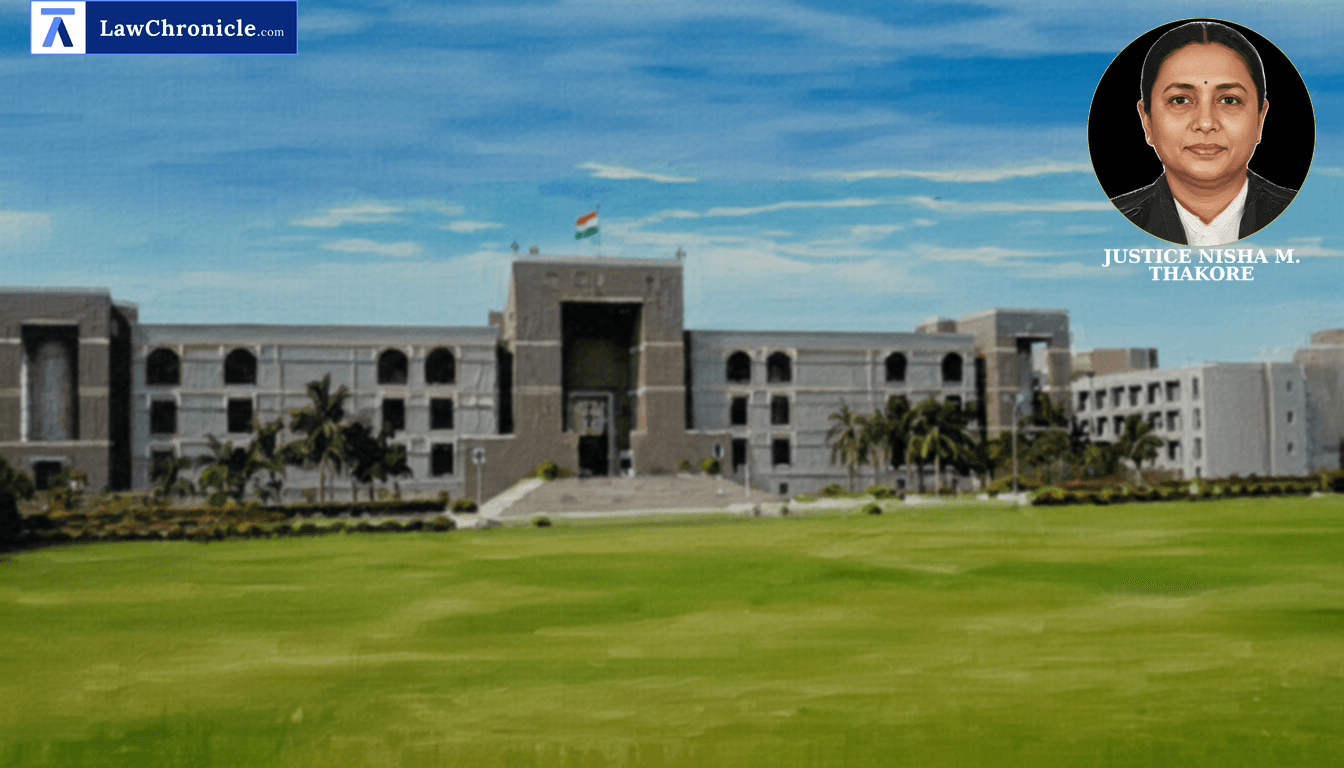
The Gujarat High Court has ruled that temporary relocation outside the state due to a parent's central government transfer cannot be treated as a break in continuous residency, safeguarding the educational prospects of students seeking medical admissions. In a significant intervention, the court established that 'domicile' signifies an indefinite intent to reside and not merely a mechanical count of days, thereby preventing administrative circulars from overriding substantial residential proof.
A Single Judge bench of Justice Nisha M. Thakore heard the petition challenging the rejection of a domicile certificate. The Court examined whether a student who spent the majority of her life in Gujarat, but lived elsewhere for a few years due to her father's central government postings, could be denied domicile status based on technical requirements of continuous stay.
Key Takeaways
Intent Over Continuity
The Court clarified that domicile relates to the permanent nature of residence rather than a purely mechanical, unbroken physical presence, especially when relocations are involuntary.
Circulars Cannot Override Rules
Administrative instructions or circulars cannot impose additional eligibility criteria, such as a strict '10-year continuous stay', if such requirements are not explicitly part of the governing statutory rules.
Protection for Central Employees' Children
Time spent outside the state due to a parent’s transfer in central government service must be included in residency computations, ensuring that children of transferable officers are not penalized.
The Court emphasized that the concept of domicile involves a legal relationship between an individual and a territory. It observed that the petitioner had completed 11 years of schooling in Gujarat, which clearly indicated an intention to settle in the state.
Regarding the rejection by authorities based on administrative circulars, the Court noted that such instructions cannot be used to exclude periods of study spent outside the state if the student returns to their permanent residence. The Court has the following directions:
"The respondent - concerned authority is directed to issue a Domicile Certificate in favour of the petitioner immediately, preferably within a period of Three Weeks from the date of receipt of the copy of this order."
The Court, in its reasoning, observed: "The only interpretation that can be given to the term 'domicile' as contained in the rules is residence of a particular kind. This residence, however, need not be continuous but it must be indefinite not purely fleeting... when any other requirement is not prescribed by the rules, then such requirement cannot be introduced by the State by way of a letter or even a circular."
Ratio
The period for which a student remains outside the State of Gujarat to pursue studies due to parental job transfers cannot be excluded while computing the minimum continuous stay of ten years for a domicile certificate. Administrative circulars cannot introduce additional restrictive conditions for domicile that are not found in the primary rules.
Background
The petitioner, Manushree Agarwal, sought a domicile certificate for medical admission (NEET). Her father, a Central Government employee, was transferred to Mumbai between 2018 and 2021, during which time the petitioner completed standards 4th to 6th outside Gujarat. Although she had completed over 10 years of education within Gujarat and her family owned registered property in Ahmedabad, the authorities rejected her application.
The State argued that according to the General Administration Department circulars, a continuous stay of ten years is mandatory. However, the petitioner's counsel relied on Muskan Sunilkanth Tiwari versus State of Gujarat, Tilakkumar Vijaykumar Mishra versus State of Gujarat and Others, and Aman Ramesh Panjiyar versus Mamlatdar Office, Surat and Another ( "Special Civil Application No.13338 of 2025, decided on 16.10.2025": 2025 CaseBase(GUJ) 36187) to argue that temporary relocation for parental employment does not constitute a break in domicile.
The Court noted that the petitioner’s family demonstrated a clear intent to reside in Gujarat through property ownership and long-term schooling. Relying on the principles in Muskan Sunilkanth Tiwari versus State of Gujarat, the Court held that the denial violated the petitioner's rights under Article 14 and Article 21 of the Constitution of India, 1950. Consequently, the High Court quashed the rejection orders and directed the issuance of the certificate.
Case Details:
Case No.: R/SPECIAL CIVIL APPLICATION NO. 13039 of 2026
Neutral Citation: 2026:GUJHC:65728
Case Title: Manushree Manish Agarwal Since Minor Through Mother And Natural Guardian Anju Manish Singhal Versus State Of Gujarat & Ors.
Appearances:
For the Petitioner(s): Kashyap R Jani
For the Respondent(s): Mr. Henil Shah, AGP
Source: 2026 CaseBase(GUJ) 29387
Similar Articles

 Breaking News


