


Personal Presentation Of Election Petition Mandatory Under RP Act: Supreme Court
 Copy Link
 Share
 Save
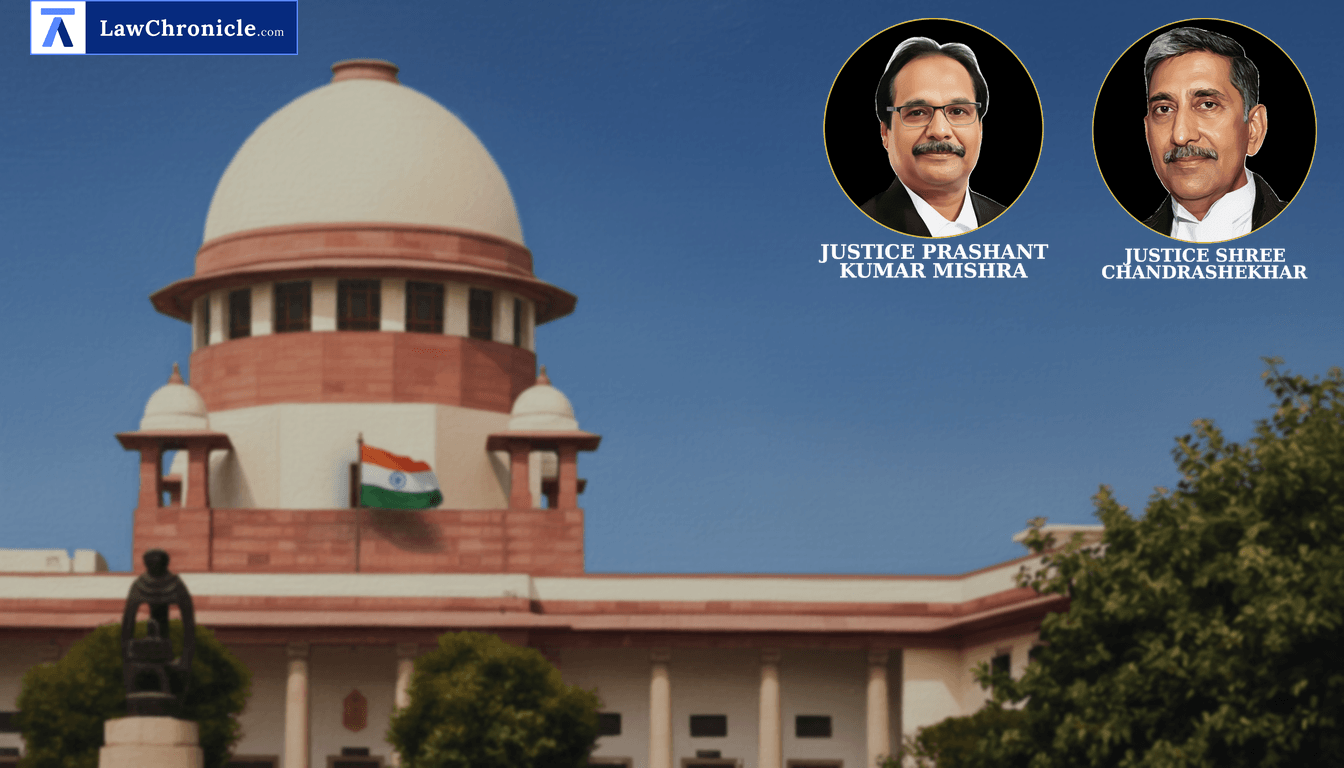
The Supreme Court has affirmed that non-compliance with the personal presentation requirement under Section 81 of the Representation of the People Act, 1951 mandates threshold dismissal of the election petition. The Apex Court clarified that failure to personally present an election petition strictly in accordance with statutory mandates deals a fatal blow to the challenge, leaving no room for curable procedural leniency.
A Division Bench comprising Justice Prashant Kumar Mishra and Justice Shree Chandrashekhar adjudicated the challenge against the dismissal of an election petition for non-compliance with personal presentation norms.
Key Takeaways
Strict Adherence Mandatory: Election petitions must be presented by the petitioner in person to prevent frivolous litigation from disturbing democratic outcomes.
Threshold Dismissal: Defects in presentation under Section 81 are non-curable and lead to summary rejection under Section 86(1).
Rule-Making Power Upheld: High Courts possess inherent and incidental authority to regulate procedural receiving of election petitions via court rules.
Proof of Presence Insufficient: Merely proving entry into court premises or advocate filings does not fulfill the requirement of personal presentation.
Section 81 of RP Act and High Court Rules
The Supreme Court affirmed the order of the High Court dismissing the election petition as not maintainable, observing that the requirement of presentation under Section 81 of the Representation of the People Act, 1951 cannot be treated as a mere procedural formality. Writing for the Bench, Justice Prashant Kumar Mishra highlighted the five essential components of Section 81(1) as delineated in G.V. Sreerama Reddy and Another v. Returning Officer and Others. The Apex Court emphasized that an election petition is a serious proceeding capable of vitiating an electoral process, making strict adherence to prescribed procedure imperative.
The Supreme Court observed that _“The requirement that the petition be presented “by” the petitioner enables the High Court, at the stage of presentation itself, to undertake a preliminary verification so as to ensure that the proceeding is not frivolous or vexatious.”_Addressing the interaction between the High Court rules and statutory mandates, the Bench relied on Jamal Uddin Ahmad v. Abu Saleh Najmuddin and Another ( "(2003) 4 SCC 257": 2003 CaseBase(SC) 656) to hold that Rule 7 of the Madras High Court Election Petitions Rules, 1967 operated as an incident of jurisdiction rather than contrary to the statutory scheme. The Court noted that conferment of statutory jurisdiction carries implied powers to regulate ministerial incidents, such as reception of petitions by designated court officers.
Distinguishing the precedent in Dr. Vijay Laxmi Sadho v. Jagdish ( "(2001) 2 SCC 247": 2001 CaseBase(SC) 1796), the Bench clarified that threshold dismissal under Section 86(1) strictly applies to non-compliance with Section 81, Section 82, or Section 117, unlike defects under Section 83. Furthermore, unlike the circumstances in Sheo Sadan Singh v. Mohan Lal Gautam ( "(1969) 1 SCC 408": 1969 CaseBase(SC) 335), where an advocate's clerk presented a petition in the immediate presence of the petitioner, the petitioner here failed to establish contemporaneous proof of personal presentation.
Ratio
The requirement under Section 81(1) of the Representation of the People Act, 1951 that an election petition be presented "by" the petitioner in person is mandatory and non-curable. Any failure to strictly comply with this presentation requirement directly attracts mandatory dismissal at the threshold under Section 86(1) of the Representation of the People Act, 1951. High Court rules regulating the ministerial receipt of such petitions fall within the court's ancillary procedural power and do not violate the statutory framework.
Background
The dispute arose out of an election petition filed by V. Pon. Paneerselvam challenging the election of S. Regupathy from the 181-Thirumayam Assembly Constituency in the 2026 Tamil Nadu Legislative Assembly Elections. The petitioner invoked Sections 80, 80A, 81, 83, 100(1)(b), 100(1)(d)(i) & (iv) read with Section 123(2) of the Representation of the People Act, 1951, along with Rule 2 of the Rules of the Madras High Court Election Petitions, 1967 and Order II Rule 3 of the Rules of the High Court, Madras Original Side, 1994.
The petitioner sought to declare the election null and void, alleging corrupt practice and deliberate suppression of spouse assets in Form 26 Affidavit. However, the Madras High Court dismissed the petition as maintainability was barred because the petition was presented by the petitioner's counsel instead of the petitioner in person, violating Rule 7 of the Madras High Court Election Petitions Rules, 1967.
Tracing the legislative history, the Supreme Court noted that the Representation of the People (Amendment) Act, 1966 deleted sub-section (2) of Section 81, which previously allowed presentation through an authorized agent or registered post. Following this amendment, the self-contained code of the Representation of the People Act, 1951 strictly enforced personal presentation without granting scope for liberal extensions under the general principles of limitation, aligned with rulings in K. Venkateswara Rao and Anr. v. Bekkam Narasimha Reddi & Ors. ( "(1969) 1 SCR 679": 1968 CaseBase(SC) 56) and Hukumdev Narain Yadav v. Lalit Narain Mishra ( "(1974) 2 SCC 133": 1973 CaseBase(SC) 226).
Finding that the petitioner's CISF entry pass and CCTV footage only proved presence in the building complex, and noting that the security deposit receipt under Section 117 was issued in the counsel's name, the Supreme Court dismissed the Special Leave Petition.
Case Details:
Case No.: SPECIAL LEAVE PETITION (CIVIL) NO.30538 OF 2026
Neutral Citation: 2026 INSC 1092
Case Title: V. PON. PANEERSELVAM v. S. REGUPATHY AND OTHERS
Source: 2026 CaseBase(SC) 8244
Similar Articles

 Breaking News


