


Plaintiff Must Stand On Own Legs To Prove Title In Property Suit: Karnataka HC
 Copy Link
 Share
 Save
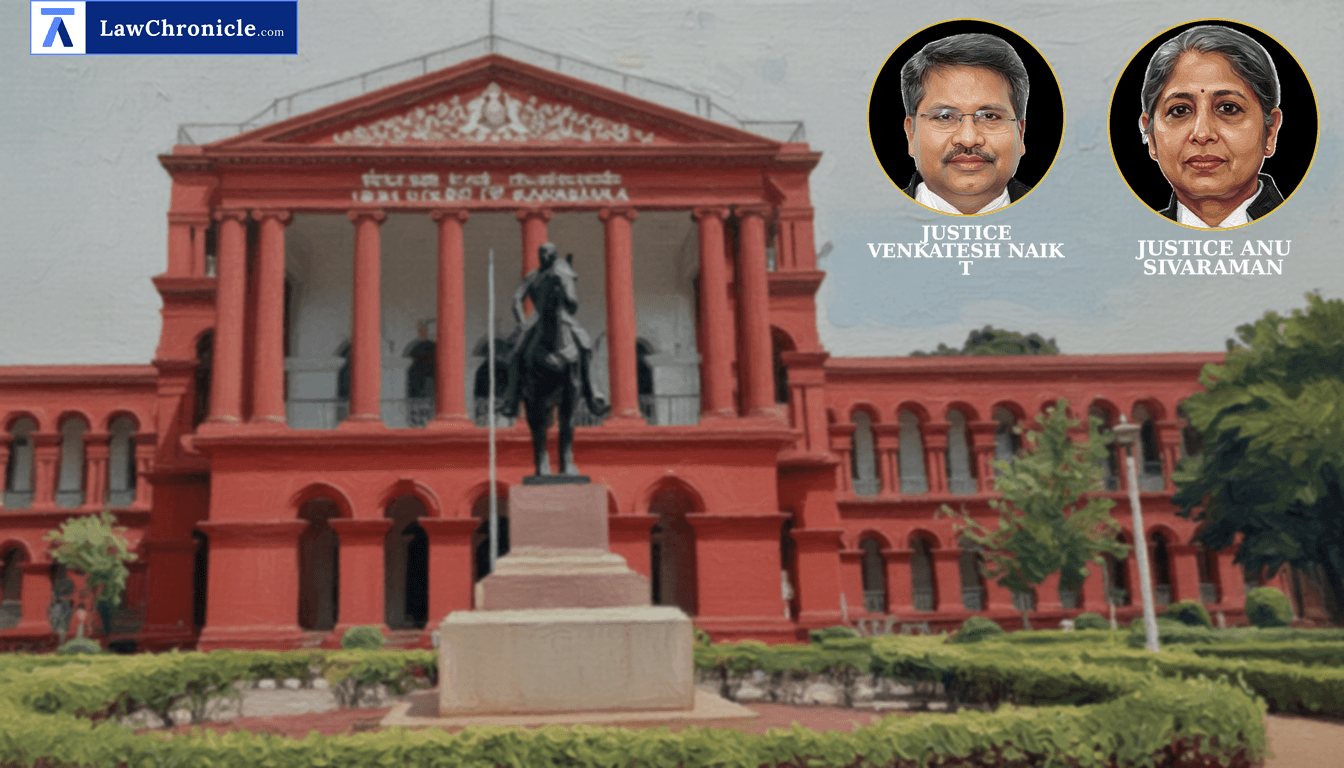
In a decisive affirmation of fundamental property jurisprudence, the High Court of Karnataka has ruled that a plaintiff seeking declaration of ownership cannot capitalize on weaknesses in the defendant's defense to claim title over immovable property. Reaffirming that the burden of proving ownership rests squarely on the claimant, the Court held that failure to independently establish a lawful chain of acquisition renders a suit for declaration unsustainably deficient.
A division bench of Justice Anu Sivaraman and Justice Venkatesh Naik T delivered the judgment while hearing a regular first appeal challenging the dismissal of a civil suit for declaration of title, possession, and mesne profits over a valuable municipal plot.
Key Takeaways
Burden of Proof Remains Fixed: Litigants claiming title must independently establish their ownership through valid, recognized legal instruments rather than pointing out flaws in the opponent's documentation.
Weakness of Defendant Is No Shield: The absence of title proof or documentary evidence from a municipal body or defendant cannot automatically translate into a decree in favor of the plaintiff.
Discretionary Nature of Declaratory Relief: Even upon fulfilling statutory prerequisites under Specific Relief Act, 1963, civil courts retain judicial discretion to grant or deny declaratory remedies based on unique factual matrices.
Judicial Rationale and Court Observations
Examining the evidentiary framework required to grant declaratory relief, the High Court emphasized that the entitlement to a legal character or property right must be proven by cogent documentary evidence. The Court analyzed Section 34 of the Specific Relief Act, 1963 and reiterated the statutory preconditions necessary to maintain a declaratory suit.
Highlighting the established precedent laid down in Moran Mar Basselios Catholicos and Another v. The Most Rev. Mar Poulose Athanasius and Others ( "(1954) 2 SCC 42": 1954 CaseBase(SC) 141) and Union of India and Others v. Vasavi Co-operative Housing Society Limited and Others, the High Court noted that plaintiffs must succeed on the strength of their own title rather than the gaps in the defendant's claims.
The Court, in its reasoning, observed: "It is a settled law that in a suit for declaration of title, the burden heavily lies on the plaintiff and the plaintiff is not supposed to depend upon the weakness in the case set up by defendant... To prove the title, what becomes essential is to identify the erstwhile owner of the property and then to explain the manner in which it has accrued to the plaintiff."
The Court issued the following directions:
"In view of the dismissal of the appeal, pending interlocutory applications, if any, shall stand dismissed."
Ratio
In a suit for declaration of title and possession of immovable property, the burden of proof rests entirely on the plaintiff to establish ownership through known sources of title acquisition such as purchase, gift, succession, or adverse possession. The plaintiff cannot establish title or succeed in securing a decree for declaration merely by relying on the evidentiary lacunae, weaknesses, or absence of title documents of the defendant.
Background
The dispute pertained to a suit property measuring 120 x 80 square feet located in Bengaluru. The plaintiff trust, Ashwathakate Bhaktha Mandali, filed an original suit under Order VII, Rule 1 read with Section 151 of the Code of Civil Procedure, 1908 seeking a declaration of ownership, possession, removal of construction materials, and mesne profits against the Bruhath Bangalore Mahanagara Palike (BBMP).
The plaintiff contended that the property was originally gifted by a private donor in 1966 to establish a trust and build a public Kalyana Mantapa. It alleged that a trustee later transferred management responsibilities of an existing temple to the plaintiff's General Secretary, who subsequently formed a separate trust in 1992. The plaintiff asserted that BBMP unlawfully encroached upon the land, constructed a Ward Office, and initiated further construction for 'Bengaluru One' without authority, despite statutory legal notices issued under Section 482 of the Karnataka Municipal Corporations Act, 1976.
Conversely, BBMP denied the plaintiff's title, contending that the property was gifted to the municipal corporation by the original Gayatri Kalyana Mantapa Trust, placing BBMP in lawful possession. BBMP also raised procedural objections regarding non-compliance with statutory notice requirements under Section 482 of the Karnataka Municipal Corporations Act, 1976.
The trial court dismissed the suit after finding that the plaintiff failed to establish its title over the property. Upon evaluating cross-examinations, the High Court observed that the plaintiff's witness admitted the members and trustees of Gayatri Kalyana Mantapa Trust and Ashwathakate Bhaktha Mandali were entirely distinct entities, and no document reflected ownership in favor of the plaintiff. Consequently, the High Court upheld the trial court's dismissal and dismissed the regular first appeal.
Case Details:
Case No.: RFA No. 18 of 2023
Case Title: Ashwathakate Bhaktha Mandali v. The Commissioner, Bruhath Bangalore Mahanagara Palike
Appearances:
For the Petitioner(s): Smt. P. Varalakshmi, Advocate
For the Respondent(s): Sri B.S. Satyanand, Advocate
Source: 2026 CaseBase(KAR) 11810
Similar Articles




 Breaking News


