


Proof of Ownership Essential for Interim Injunction in Copyright Suits: Delhi HC
 Copy Link
 Share
 Save
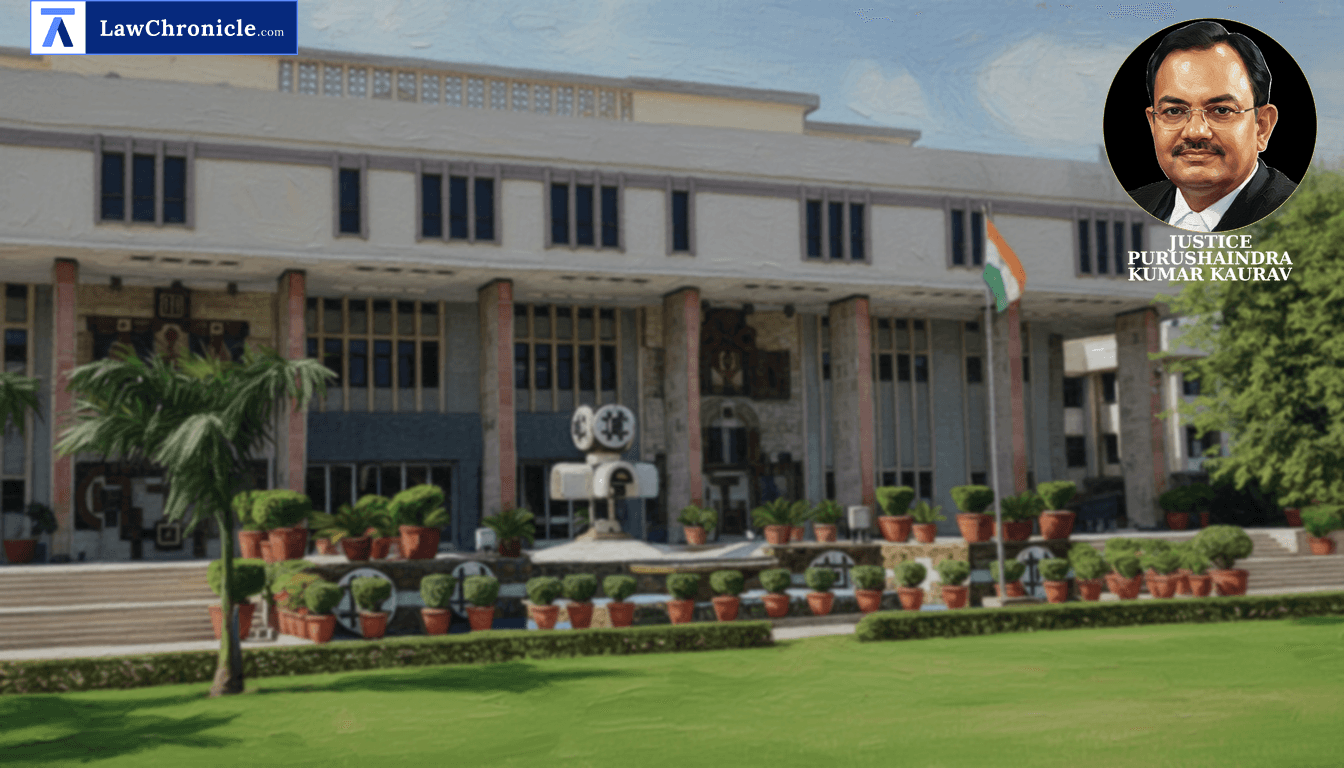
The High Court of Delhi has clarified that a plaintiff who is not the author of a literary work must demonstrate an unbroken chain of title from the original author to claim copyright ownership at the interim stage. In a dispute involving decades-old legal commentaries, the Court emphasized that a claim resting solely on disputed testamentary instruments and incomplete assignment records cannot satisfy the 'prima facie case' requirement for a temporary injunction.
In a hearing presided over by Justice Purushaindra Kumar Kaurav, the Court dealt with an application filed by a widow seeking to restrain several family members and a partnership firm from publishing 47 legal titles. The primary issue concerned whether the plaintiff had established an indefeasible right over works originally authored by third parties and published through various family-held partnership firms over forty years.
Key Takeaways
Authorship Presumption Prevails
Under Section 55(2) of the Copyright Act, 1957, the person whose name appears on the work is presumed to be the author unless the contrary is proved.
Mandatory Written Assignment
Any person other than the author can only derive title through a written assignment signed by the assignor as mandated by Section 19 of the Copyright Act, 1957.
Interim Relief Not Absolute
An injunction in copyright infringement is not an automatic right; it requires the concurrent satisfaction of the 'trinity test' comprising a prima facie case, balance of convenience, and irreparable injury.
Monetary Compensation Suffices
Where the alleged injury is a loss of revenue capable of computation, it does not constitute 'irreparable injury' for the purposes of granting an interim injunction.
Requirement of Disclosing Title Root
The Court observed that while the plaintiff claimed title through the Wills of her father-in-law and husband, she failed to show how the original publishers from whom her father-in-law allegedly received the rights acquired those rights from the actual authors. Referencing the principles in Tech Plus Media (P) Ltd. v. Jyoti Janda, the Court noted that a juristic person or a non-author successor must disclose the instrument under which they became the owner.
The Court, in its reasoning, observed: "The root of the plaintiff’s title is, therefore, not disclosed at this stage. The two Wills cannot fill this gap. A legatee takes only what the testator held... Whether these documents are genuine is a matter for trial on evidence, and this Court refrains from returning any finding thereon. For the present purpose, it is sufficient to note that a claim to copyright which rests on disputed testamentary instruments, and whose root in an assignment by the authors is not disclosed, does not demonstrate the existence of a prima facie right."
Trinity Test for Injunctions
Reaffirming the standards for interlocutory orders, the Court relied on Shruti Manav Sharma v. Sunanina Singh ( "2026 SCC OnLine SC 1549": 2026 CaseBase(SC) 780) to state that courts must not conduct "mini-trials" at the interim stage but must strictly apply the three-fold test of prima facie case, balance of convenience, and irreparable injury. The Court found that since the plaintiff's title was not prima facie established, the question of infringement, as discussed in Midas Hygiene Industries (P) Ltd. v. Sudhir Bhatia, did not even arise.
Regarding the balance of convenience, the Court noted that the books had been published for decades by the defendants' firm. Following the rationale in Najma Heptulla v. Orient Longman Ltd., the Court held that as long as the financial interests (royalties) of a non-author copyright holder are secured, it is improper to restrain the publication of the work.
Ratio
A plaintiff who is not the author of a work cannot maintain a claim for copyright infringement at the interim stage without establishing a clear, documented chain of assignment from the original author. Disputed testamentary successions and historical 'free use' permissions do not constitute a prima facie right sufficient to overrule the statutory presumption of authorship or to warrant an injunction that would halt a long-standing publication business.
Background
The plaintiff, Mrs. Shakti Sagar, filed a suit under the Commercial Courts Act, 2015 alleging that her copyrights in 47 legal titles were being infringed by 'The Delhi Law House' (Defendant No. 1) and other relatives. She claimed that these copyrights were inherited via the Will of her father-in-law, Sh. R.G. Sagar, and her husband, Sh. Subhash Sagar. She alleged that while she permitted 'Delhi Law House' (Defendant No. 5) to publish the titles, the defendants had diverted the business to a deceptively similar entity, 'The Delhi Law House'.
The defendants countered that the authors were the first owners under Section 17 of the Copyright Act, 1957 and no assignment deeds were produced. They further challenged the validity of the Wills and argued that the works had fallen into the public domain or were exempted under Section 52(1)(q) of the Copyright Act, 1957.
The Court dismissed the application for interim injunction filed under Order XXXIX Rules 1 and 2 of the Code of Civil Procedure, 1908, finding no irreparable injury as the loss was purely financial and compensable by damages.
Case Details:
Case No.: CS(COMM) 492/2024
Case Title: MRS. SHAKTI SAGAR V. THE DELHI LAW HOUSE & ORS.
Appearances:
For the Petitioner(s): Mr. Gaurav Bahl, Advocate.
For the Respondent(s): Mr. Sanjay Vashishtha, Mr. Lavkesh Bhambhani, Mr. Siddhartha and Mr. Aditya, Advocates for D-1 to 4.
Source: 2026 CaseBase(DEL) 6665
Similar Articles
 Breaking News


