


Punishment Must Match Misconduct: Himachal Pradesh HC
 Copy Link
 Share
 Save
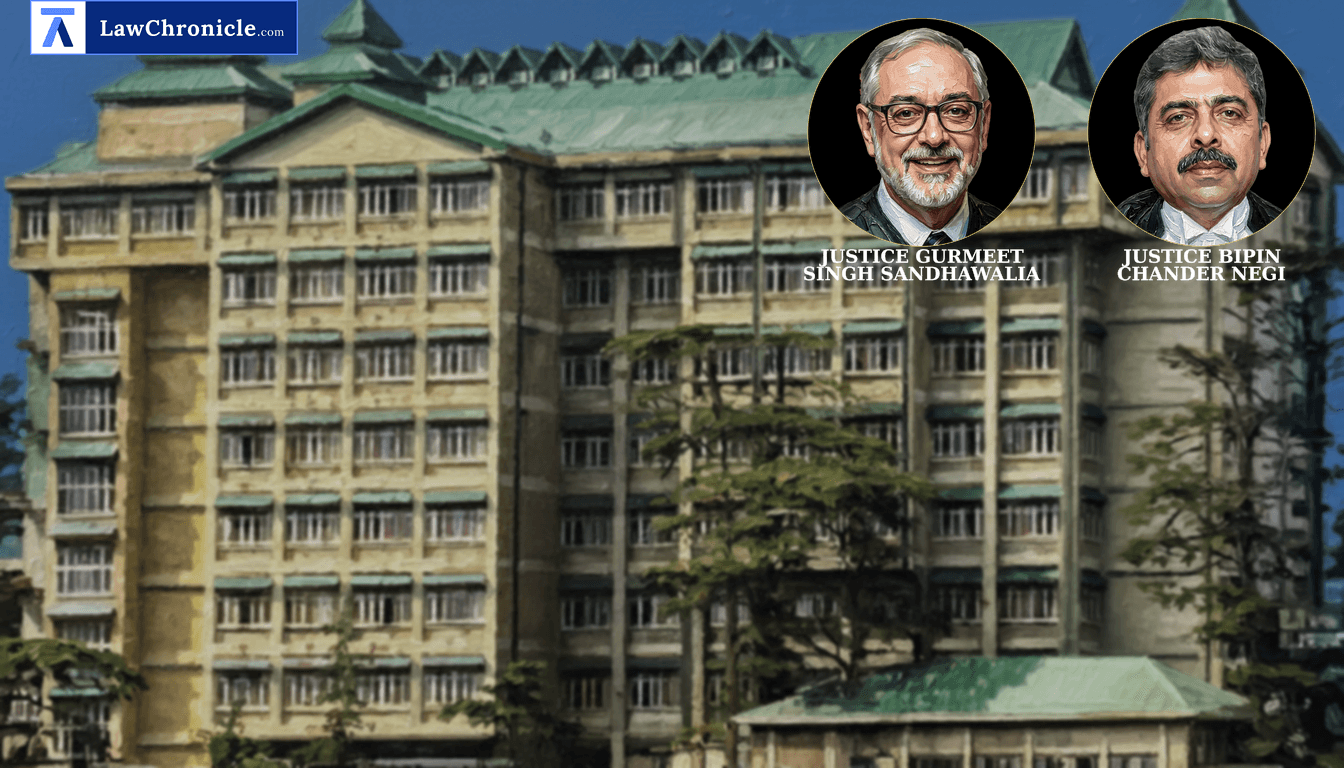
In a decisive check against disproportionate departmental actions, the High Court has held that removing an employee with 19 years of service for delay in joining a transferred posting due to severe family distress shocks judicial conscience. Emphasizing the doctrine of proportionality under Constitution of India, 1950, the court set aside a removal order and substituted it with compulsory retirement to protect long-standing service benefits.
A Division Bench comprising Chief Justice G.S. Sandhawalia and Justice Bipin C. Negi set aside a Single Judge's decision that had previously upheld the removal of a government employee from service following disciplinary proceedings.
Key Takeaways
- Proportionality in Service Law: Penalties imposed during departmental inquiries must reasonably match the severity of misconduct and not shock the judicial conscience.
- Consideration of Mitigating Factors: Length of service and severe personal or domestic hardships must be weighed by disciplinary and appellate authorities before passing extreme orders like removal.
- Mitigation Over Severance: Administrative authorities should consider alternative major penalties provided under service rules rather than automatically resorting to termination.
Court Observations and Directions
The High Court observed that while non-compliance with transfer orders constitutes indiscipline, extreme penalties like removal must not be imposed arbitrarily without evaluating long-term service and extreme domestic circumstances.
The Court, in its reasoning, observed: "...keeping in view the 19 years of long service of the appellant and the fact that there were family circumstances which constrained the employee from joining at Kaza, which is admittedly a Tribal Area and having a working wife and two elders in the house, including the child, who was suffering from the throat cancer, the punishment of removal of service is very extreme. Therefore, to shorten the litigation, this Court is of the considered opinion that the said judgment can be substituted by way penalty of compulsory retirement, with all consequential benefits, as it shocks the conscience of the Court."
The Court issued the following directions:
"Resultantly, the appeal is allowed and the order dated 01.11.2019 of removal of service, which was upheld in an appeal vide order dated 08.01.2020 and further upheld by the learned Single Judge in a Civil Writ Petition No. 422 of 2020, vide order dated 14.06.2024, are set aside and the said order is modified to the extent that the employee would be compulsorily retired from the date of removal from service and would get all consequential benefits. The needful be done within 8 weeks."
Ratio
An administrative order inflicting the extreme penalty of removal from service for unauthorized absence or failure to report to a transferred posting must satisfy the doctrine of proportionality. Disciplinary authorities must consider the length of past service and compelling personal or domestic hardships, ensuring the penalty is not shockingly disproportionate under Constitution of India, 1950.
Background
The appellant had served for over 19 years as a Subject Matter Specialist when he was transferred from Dehra, District Kangra to Kaza in Lahaul & Spiti. Due to severe family crises including a child suffering from throat cancer, bedridden elderly parents, and his wife being employed at another station he repeatedly sought legal redress before tribunals and courts. However, after his challenges failed, departmental proceedings were initiated under Rule 14 of the Central Civil Services (Classification, Control & Amp; Appeal) Rules, 1965.
Upon completion of the inquiry, the disciplinary authority passed an order removing him from service, which was subsequently affirmed by the appellate authority and a Single Judge of the High Court. The Single Judge had relied on rulings like Deputy General Manager (Appellate Authority) and others Vs. Ajai Kumar Srivastava ( "(2021) 2 Supreme Court Cases 612": 2021 CaseBase(SC) 1228) and Union of India and others Vs. Constable Sunil Kumar to hold that administrative transfer disobedience warrants strict discipline.
In appeal, the Division Bench distinguished cases involving corruption or uniformed services and examined key precedents on proportionality, including Raghubir Singh Vs. Haryana Roadways, Ranjit Thakur Vs. Union of India and others ( "(1987) 4 Supreme Court Cases 611": 1987 CaseBase(SC) 59), Union of India and another Vs. G. Ganayutham ( "(1997) 7 Supreme Court Cases 463": 1997 CaseBase(SC) 484), Deputy Commissioner Kendriya Vidyalaya Sangathan and others Vs. Hussain, Union of India Vs. P. Gunasekaran ( "(2015) 2 Supreme Court Cases 610": 2014 CaseBase(SC) 744), UT of Dadra & Nagar Haveli Vs. Gulabhia M. Lad, S.R. Tewari Vs. Union of India ( "(2013) 6 Supreme Court Cases 602": 2013 CaseBase(SC) 46), Jagdish Singh Vs. Punjab Engineering College & Ors. ( "decided on 14.05.2009": 2009 CaseBase(SC) 557), and Sahab Singh (D) through Lrs. Vs. Director General, RPF, Rail Bhawan and others. Recognizing that the appellant had 19 years of unblemished service and genuine family constraints, the court modified the punishment to compulsory retirement with all consequential benefits.
Case Details:
Case No.: LPA No. 293 of 2024
Neutral Citation: 2026:HHC:35448
Case Title: Sh. Rax Pal Vs. State of Himachal Pradesh and others
Appearances:
For the Petitioner(s): M/s Anshul Jairath and Piyush Mehta, Advocates.
For the Respondent(s): Mr. Rakesh Dhaulta, Additional Advocate General.
Source: 2026 CaseBase(HP) 4605
Similar Articles
 Breaking News


