


Removal For 20 Months Unauthorized Absence Not Disproportionate: Madras HC
 Copy Link
 Share
 Save
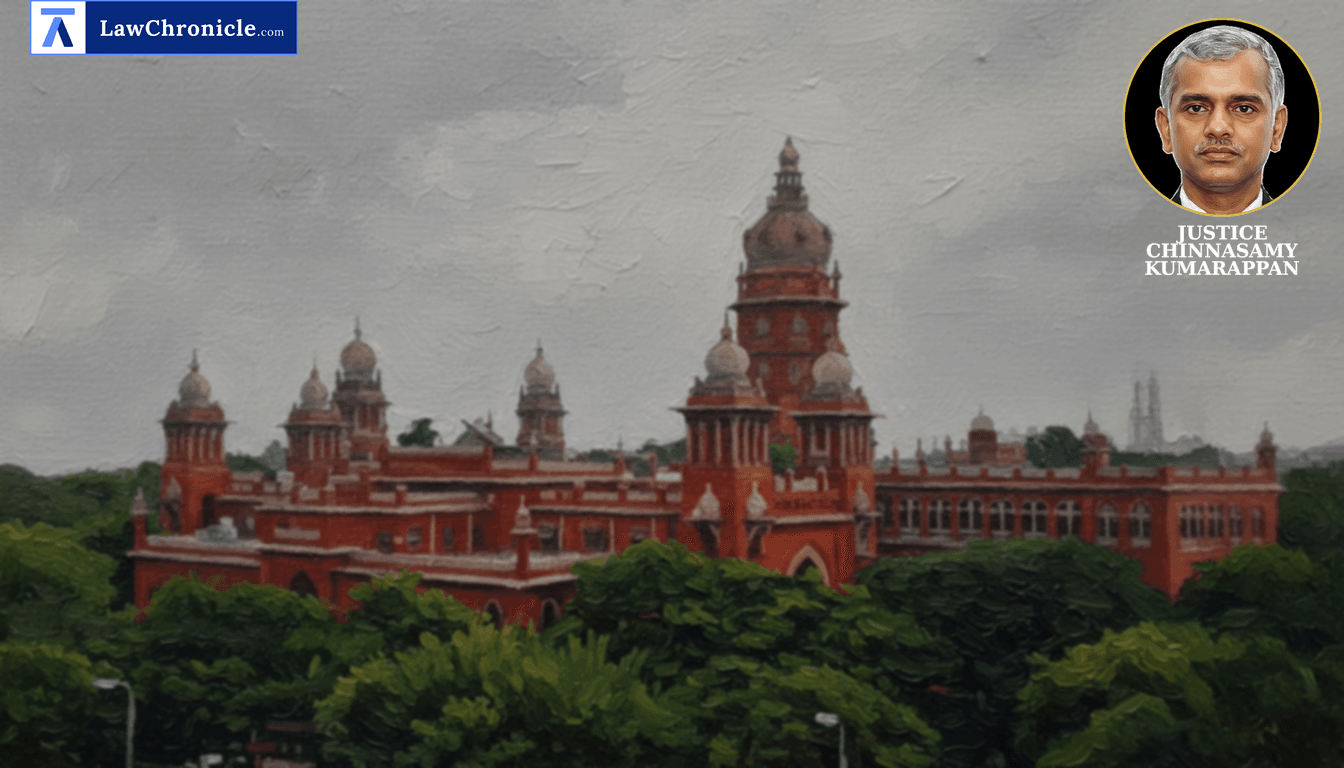
In a decisive affirmation of disciplinary standards within public institutions, the High Court held that an unauthorized absence spanning over 20 months fully justifies the penalty of removal from service and does not warrant judicial interference.
Presiding over the matter, Justice C. Kumarappan rejected a writ petition seeking reinstatement, clarifying that judicial review cannot function as an appellate remedy to re-appreciate evidence or disturb proportionate disciplinary actions.
Key Takeaways
No Interference in Proportionate Penalties: The court confirmed that a 20-month unauthorized absence causes significant operational dislocation, making removal from service fully proportionate.
Preservation of Judicial Review Limits: Judicial review under Article 226 of the Constitution of India is strictly confined to ensuring procedural fairness and natural justice rather than evaluating the merits of administrative conclusions.
Communication by Human Agency Validated: An order signed and communicated by the President of a society pursuant to a Board or Sub-Committee resolution does not render the decision invalid or unauthorized.
Court Observations and Directions
The High Court reaffirmed that courts exercising judicial review must operate with restraint, relying on established precedents including B.C.Chaturvedi Vs. Union of India ( "(1995) 6 SCC 749": 1995 CaseBase(SC) 611), Deputy General Manager (Appellate Authority) Vs. Ajai Kumar Srivastava ( "(2021) 2 SCC 61": 2021 CaseBase(SC) 1228), and The Indian Oil Corporation & Ors., Vs. Ajit Kumar Singh & Anr.. The Court underscored that unless an administrative order suffers from perversity, lack of evidence, or shocks the judicial conscience, no intervention is permissible.
The Court, in its reasoning, observed: "In the impugned order, the Board took cognizance in respect of all the aspects including the mitigating circumstances and ultimately found that there are no reason to interfere with the punishment imposed against the petitioner. As rightly observed in the impugned order, when there is an unauthorized absence of 20 months, the punishment of removal from service cannot be stated as disproportionate. Certainly such 20 months unauthorized absence would have definitely caused dislocation in the work. It is well settled principles of law that, unless the punishment is shocking to the conscience of the Court, the question of interfering with the punishment does not arise."
Ratio
The power of judicial review is meant to ensure fairness in treatment and compliance with natural justice, not to reassess the fairness of administrative conclusions; courts cannot review or substitute a disciplinary penalty unless the finding is perverse or the punishment is shockingly disproportionate to the misconduct.
Background
The dispute arose after a Peon employed with the Tamil Nadu Circle Postal Co-operative Bank Ltd. was removed from service on November 11, 2005, for remaining unauthorizedly absent from duty starting February 2, 2004, following the expiry of his medical leave. Despite show-cause notices sent via registered post being returned with postal endorsements such as "not present" and "party out of station," the Disciplinary Action Sub-Committee resolved to remove him from service.
The petitioner filed a writ petition under Article 226 of the Constitution of India challenging the impugned proceedings dated June 4, 2022, which affirmed his removal. He contended that the original removal order was issued by an incompetent authority (the President instead of the Board of Directors or Sub-Committee under By-Law No. 65(13)) and that his prolonged absence was due to medical reasons.
The respondents submitted that the President merely communicated the decision taken by the Disciplinary Action Sub-Committee in terms of Board Resolution No. 272. Finding no flaw in procedure, incompetence, or disproportionate punishment, the High Court dismissed the writ petition without costs.
Case Details:
Case No.: W.P.No.34611 of 2022
Neutral Citation: 2026:MHC:3520
Case Title: P.Sivakumar v. Union of India and Others
Appearances:
For the Petitioner(s): Mr.S.Udayakumar
For the Respondent(s): Mr.V.T.Balaji, Central Government Senior Panel Counsel (for R1), Mr.P.Rajendiran (for R2 & R3)
Source: 2026 CaseBase(MAD) 18210
 Breaking News


